
Reika Manaki, Japanese Actor, Recounts Steps to Success on TV and Stage, Will Repeat Mata Hari in Autumn

Reika Manaki
11:00 JST, August 8, 2025
Reika Manaki played the role of Asagao, a kindhearted but sickly prostitute, in the first episode of NHK’s Taiga epic historical TV drama for this year, “Berabo: Tsuta-Ju Eiga no Yumebanashi” (“Unbound”). The protagonist, Tsutaya Juzaburo, is abandoned by his parents when he is very young.
He is then adopted by the owner of a business to introduce customers to courtesans in Yoshiwara, a red-light district in Edo, the old name for Tokyo. Insensitive gossip about Juzaburo’s parents regarding the reason for their absence torments him, and Asagao consoles the young boy.
“I presume Asagao was the first driving force behind Juzaburo’s running around and making every effort for Yoshiwara,” Manaki said. “I thought very hard about how much of an impression I could leave with this role because she appears only in the first episode. In the end, I played the role wholeheartedly.”
With an delicate yet cheerful smile, Manaki vividly highlighted the gap between her smile and Asagao’s cruel fate in the episode.
Dialogue in period dramas uses peculiar words and phrases.
“Since I like traditional Japanese plays, I felt familiar [with those lines]” she said.
She was also helped by her experience of playing Tokugawa Iesada, the 13th shogun of the Tokugawa shogunate, in the season 2 of gender-swap period drama series “Ooku: The Inner Chambers” on NHK in 2023, which was based on a manga by Fumi Yoshinaga.
“Unlike typical drama series depicting people’s daily lives, period dramas, in a way, are about a world that’s been elaborately crafted and created. I found it easy to get into the production [of ‘Unbound’] probably because I’ve been working mainly in theater,” she said.
What is it to act?
When Manaki was in elementary school, she watched a regional performance of a production by the Takarazuka Revue Company, which got her excited about the glittering world of the stage. After graduating from junior high school, she enrolled at the Takarazuka Music School, which trains teenage girls to become members of the all-female company. At first, she specialized in female roles, but she soon changed to specialize in male roles. For a while after joining the company, she switched to being a female-role performer again.
“I was very indecisive and bad at making decisions. Actually, I probably still haven’t changed in those respects now,” she said, a little embarrassed.
Today Manaki has a reputation for her precise and refined acting. During her Takarazuka Music School days, however, she was not what she is now.
“I was like, ‘What is it to act?’” she recalled.

Manaki as an elementary school student who was enthusiastic about ballet
One time she placed 45th out of 45 students in an acting exam.
“By nature, I’m not good at talking. Since I started taking ballet lessons when I was very young, I felt more at ease when dancing,” she said.
When there was a lesson about playing famous scenes from “Versailles no Bara” (“The Rose of Versailles”), one of Takarazuka’s most popular musicals, Manaki was at a loss as to how to move and hid herself in a far corner of the classroom.
“I watched my classmates playing the scenes without any problem and was amazed at their acting, thinking, ‘Wow, they’re great.’ There was a line, ‘I love you’, and all I could think was, ‘What is love?’” she said.
Then, in her second year after joining the company, a big chance came Manaki’s way. She was selected to play the role of the dauphin in his childhood, a key character in the musical “The Scarlet Pimpernel” by the company’s Moon Troupe. At that time, Manaki specialized in playing male roles. Since she was rather slightly built for a male-role performer, she was a perfect fit for the director’s image of the young prince. Yet she was worried.
“I had a big sense of crisis,” she revealed. “There was a scene in which I sang with the ‘top star’ [No. 1 performer in the troupe]. So, I did my own research about the character by reading books and tried to live as the character in the story as much as I could.”
She gave her all to play the role of the dauphin, which was favorably received and opened the way for her to become a star in the company.
Manaki joined the company in the 95th year after its foundation. Her fellow “class of the 95th year” members include many talented performers. So far, they have produced eight “top stars” of Takarazuka troupes, among both male-role and female-role players. All Takarazuka members must take exams several times during their careers with the company, the last of which takes place during their fifth year as members. Manaki won first place in the last exam for the class of the 95th year.
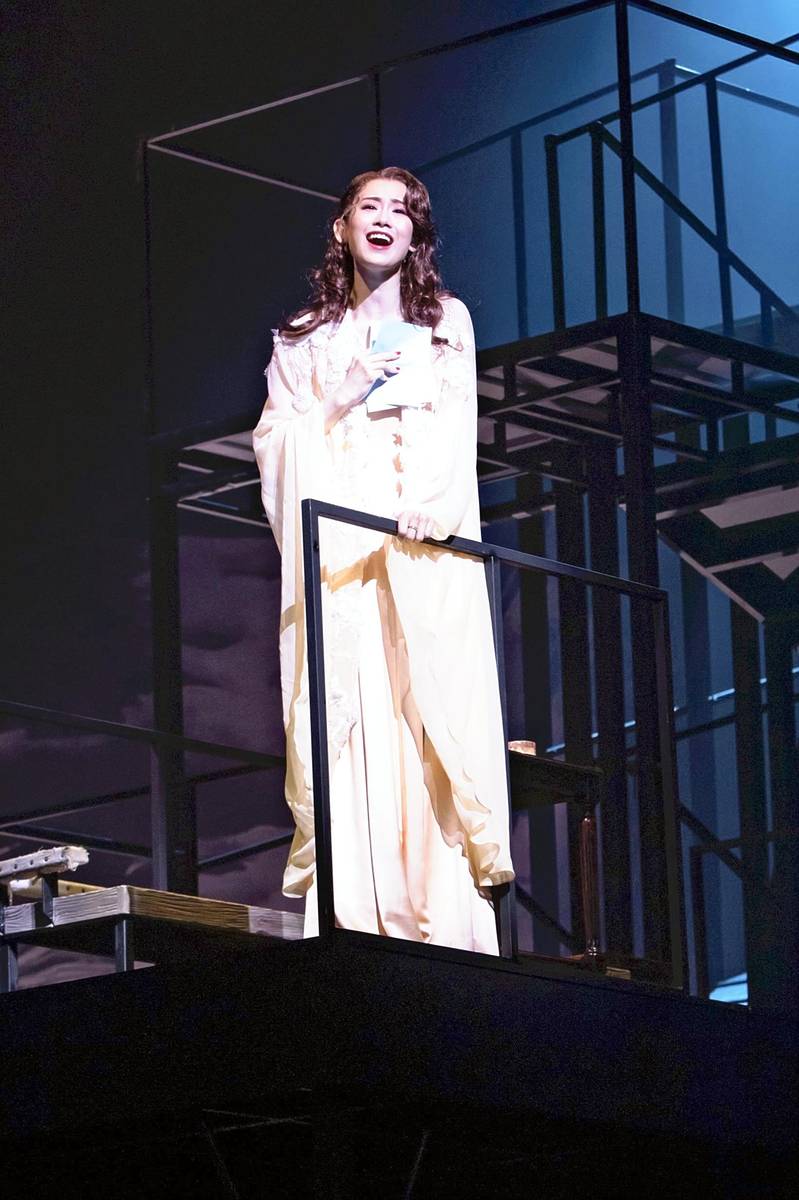
Manaki sings during a performance of “Mata Hari” in 2021.
She also became one of Takarazuka Revue’s few female-role specialists to play a protagonist and ended her years with the company as a female-role player who has gone down in the history of Takarazuka.
Playing Mata Hari
From October to November, Manaki will star in the musical “Mata Hari,” playing the title role on alternate dates with Reon Yuzuki. The musical tells the story of Mata Hari, a historical figure who was an extraordinary dancer and a spy during World War I.
The musical was first performed in Japan in 2018 in a production directed by Sachiko Ishimaru. Manaki joined the production when it was revived in 2021. Since the first revival performances took place during the COVID-19 pandemic, the cast and staff had to deal with various restrictions. At one point, they were unable to rehearse for three weeks.
“It wasn’t that we couldn’t bring it up to a level good enough for the public to appreciate, but I was left with the thought I would’ve liked to spend more time [rehearsing],” Manaki said.
The forthcoming performances will be the production’s second revival.
“I don’t know how much more [acting skill and experience] I have accumulated in my tank in four years, but I think it would be no good if I were the same as last time,” she stressed.
Her eyes now show a willpower that looks quite different from the time when she was frightened and asked herself, “What is it to act?” With those powerful eyes, she will take on another chance to play the turbulent life of Mata Hari.



_0001-250x189.jpg)

Most Read
Popular articles in the past 24 hours
-

Japanese High School Student Aims to Share Kaiten History Through...
-

PM Takaichi Spells out Plans to Advance Bold Policy Shifts in Spe...
-

Chronic Issues Erode Thailand’s Economy as Political Confusion Pe...
-

Japanese Version of Shohei Ohtani's Picture Book Published
-

Tottori: 95-Year-Old Japanese Descendent from Philippines Visits ...
-

Japan to Monitor Trump Administration's Response to U.S. Supreme ...
-

Milano Cortina 2026: Speed Skater Takagi Finishes 6th in the 1,50...
-

Osaka: 40 Ninjas Display Shuriken Throwing Skills at Japan Champi...
Popular articles in the past week
-

Japan PM Takaichi’s Cabinet Resigns en Masse
-

Man Infected with Measles Reportedly Dined at Restaurant in Tokyo...
-

Sanae Takaichi Elected Prime Minister of Japan; Keeps All Cabinet...
-

Japan's Govt to Submit Road Map for Growth Strategy in March, PM ...
-

Bus Carrying 40 Passengers Catches Fire on Chuo Expressway; All E...
-

Milano Cortina 2026: Figure Skaters Riku Miura, Ryuichi Kihara Pa...
-

Japan, U.S. Name 3 Inaugural Investment Projects; Reached Agreeme...
-

U.S. Firm to Build Training Hub in Fukushima N-plant for Debris R...
Popular articles in the past month
-
Japan PM Takaichi’s Cabinet Resigns en Masse
-

Japan Institute to Use Domestic Commercial Optical Lattice Clock ...
-

Israeli Ambassador to Japan Speaks about Japan’s Role in the Reco...
-
Man Infected with Measles Reportedly Dined at Restaurant in Tokyo...
-

Videos Plagiarized, Reposted with False Subtitles Claiming ‘Ryuky...
-

Man Infected with Measles May Have Come in Contact with Many Peop...
-

Prudential Life Insurance Plans to Fully Compensate for Damages C...
-

Woman with Measles Visited Hospital in Tokyo Multiple Times Befor...
Top Articles in Culture
-

BTS to Hold Comeback Concert in Seoul on March 21; Popular Boy Band Releases New Album to Signal Return
-

Lifestyle at Kyoto Traditional Machiya Townhouse to Be Showcased in Documentary
-

Director Naomi Kawase’s New Film Explores Heart Transplants in Japan, Production Involved Real Patients, Families
-

‘Jujutsu Kaisen’ Voice Actor Junya Enoki Discusses Rapid Action Scenes in Season 3, Airing Now
-

Tokyo Exhibition Offers Inside Look at Impressionism; 70 of 100 Works on ‘Interiors’ by Monet, Others on Loan from Paris
JN ACCESS RANKING
-
Japan PM Takaichi’s Cabinet Resigns en Masse
-
Japan Institute to Use Domestic Commercial Optical Lattice Clock to Set Japan Standard Time
-
Israeli Ambassador to Japan Speaks about Japan’s Role in the Reconstruction of Gaza
-
Man Infected with Measles Reportedly Dined at Restaurant in Tokyo Station
-
Videos Plagiarized, Reposted with False Subtitles Claiming ‘Ryukyu Belongs to China’; Anti-China False Information Also Posted in Japan