
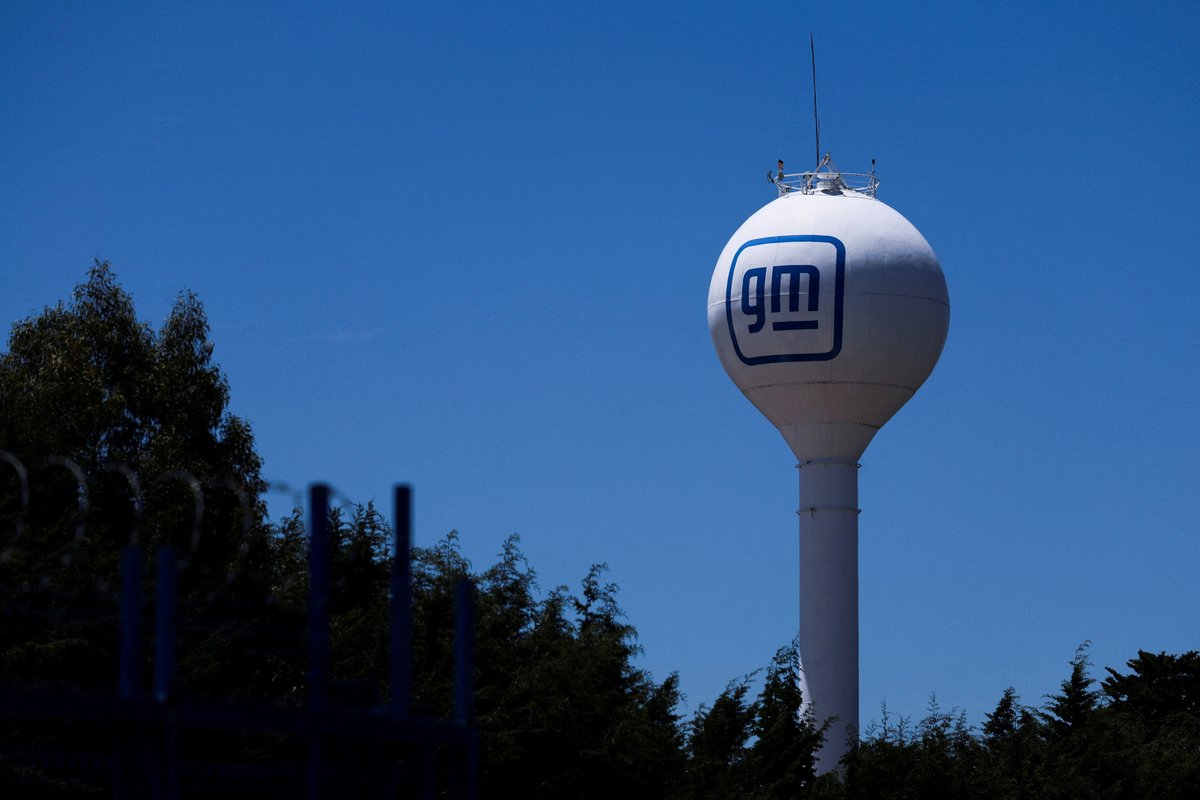
The logo of General Motors is pictured in Santa Ana Tlapaltitlan, Mexico, July 29, 2025.
11:39 JST, August 7, 2025
Aug 6 (Reuters) – General Motors GM.N and Hyundai Motor 005380.KSon Wednesday outlined plans to develop five vehicles as they seek to lower costs amid growing competition from nimble Chinese rivals.
Four of the vehicles — a compact SUV/car/ pickup, and a mid-size pickup — are targeted at Central and South American markets and will support both internal combustion and hybrid powertrains.
At full production scale, the companies expect to roll out at least 800,000 vehicles annually.
The partnership will help GM compete against rising Chinese players in the Latin American market, where the Detroit automaker has had a strong presence for decades.
The two global automakers will also co-develop an electric commercial van for the North American market. Reuters in March reported that the two companies were nearing a deal to share two commercial electric vans.
Global automakers face stiff competition from Chinese EV makers and a trade war impacting imports of crucial parts, including rare earth materials, which has pushed production costs higher.
This is the first major partnership for vehicle development for Hyundai Motor.
The deal would give GM access to hybrid technology it lacks, while enabling Hyundai to enter into new segments such as vans in North America and mid-sized pickups, Kim Sung-rae, an analyst at Hanwha Investment & Securities, said.
The two companies did not say where the models will be produced. Hyundai, which has a factory in Alabama, said it will expand the production capacity of its new factory in Georgia. The company also has a factory in Brazil.
GM’s budding partnership with Hyundai follows an unwinding of several projects the Detroit automaker had pursued with Honda over the past decade.Notably, GM and Honda in 2023 scrapped a $5 billion plan to jointly develop affordable electric vehicles.
Chinese automakers have released several high-tech, low-cost models, putting pressure on legacy automakers such as GM to slash expenses and streamline manufacturing processes. To compete with these rivals, many automakers have explored partnerships as a way to share development costs, especially for battery-powered models.
Cutting costs is even more pressing as tariffs have added billions of dollars in expenses for automakers around the globe. The Hyundai-GM announcement comes after the United States and South Korea last week reached a trade agreement to charge a 15% tariff on imports from South Korea, including autos.
This is among several deals between a South Korean company and a U.S. firm announced in recent weeks, following Samsung Electronics’ 005930.KS chip deal with Tesla TSLA.O and Apple AAPL.O, and LG Energy Solution’s 373220.KS battery deal with Tesla.





Most Read
Popular articles in the past 24 hours
-

Foreign and Security Policy: Political Parties Must Discuss How T...
-

Monkey Strikes Junior High School Girl from Behind in Japan's Yam...
-

Japan's Snow-Clad Beauty: Camellia Flowers Seen in Winter Bloom a...
-
Senior Japanese Citizens Return to University to Gain Knowledge, ...
-

Heavy Snow Linked to 30 Deaths across Japan since Late Jan.; JMA ...
-
Eels Peak Out of Sushi Installations at Sendai Aquarium as Japan ...
-

Tokyo Police Arrest Head of Resignation Assistance Firm
-

Japan’s Nikkei Stock Average Jumps near 4%, Closes at Record High...
Popular articles in the past week
-

Australian Woman Dies After Mishap on Ski Lift in Nagano Prefectu...
-

Foreign Snowboarder in Serious Condition After Hanging in Midair ...
-
Chinese Embassy in Japan Reiterates Call for Chinese People to Re...
-
Narita Airport, Startup in Japan Demonstrate Machine to Compress ...
-

Toyota Motor Group Firm to Sell Clean Energy Greenhouses for Stra...
-

Sakie Yokota, Last Surviving Parent of a North Korea Abductee, Ur...
-

Beer Yeast Helps Save Labor, Water Use in Growing Rice; Govt Hope...
-

Japan Tourism Agency Calls for Strengthening Measures Against Ove...
Popular articles in the past month
-
Univ. in Japan, Tokyo-Based Startup to Develop Satellite for Disa...
-

JAL, ANA Cancel Flights During 3-day Holiday Weekend due to Blizz...
-
China Confirmed to Be Operating Drilling Vessel Near Japan-China ...
-
China Eyes Rare Earth Foothold in Malaysia to Maintain Dominance,...
-

Japan Institute to Use Domestic Commercial Optical Lattice Clock ...
-
M6.2 Earthquake Hits Japan's Tottori, Shimane Prefectures; No Tsu...
-
Japan, Qatar Ministers Agree on Need for Stable Energy Supplies; ...
-

Japan, Italy to Boost LNG Cooperation; Aimed at Diversifying Japa...
Top Articles in News Services
-

Prudential Life Expected to Face Inspection over Fraud
-

Arctic Sees Unprecedented Heat as Climate Impacts Cascade
-

South Korea Prosecutor Seeks Death Penalty for Ex-President Yoon over Martial Law (Update)
-

Trump Names Former Federal Reserve Governor Warsh as the Next Fed Chair, Replacing Powell
-

Japan’s Nagasaki, Okinawa Make N.Y. Times’ 52 Places to Go in 2026
JN ACCESS RANKING
-
Univ. in Japan, Tokyo-Based Startup to Develop Satellite for Disaster Prevention Measures, Bears
-
JAL, ANA Cancel Flights During 3-day Holiday Weekend due to Blizzard
-
China Confirmed to Be Operating Drilling Vessel Near Japan-China Median Line
-
China Eyes Rare Earth Foothold in Malaysia to Maintain Dominance, Counter Japan, U.S.
-
Japan Institute to Use Domestic Commercial Optical Lattice Clock to Set Japan Standard Time