
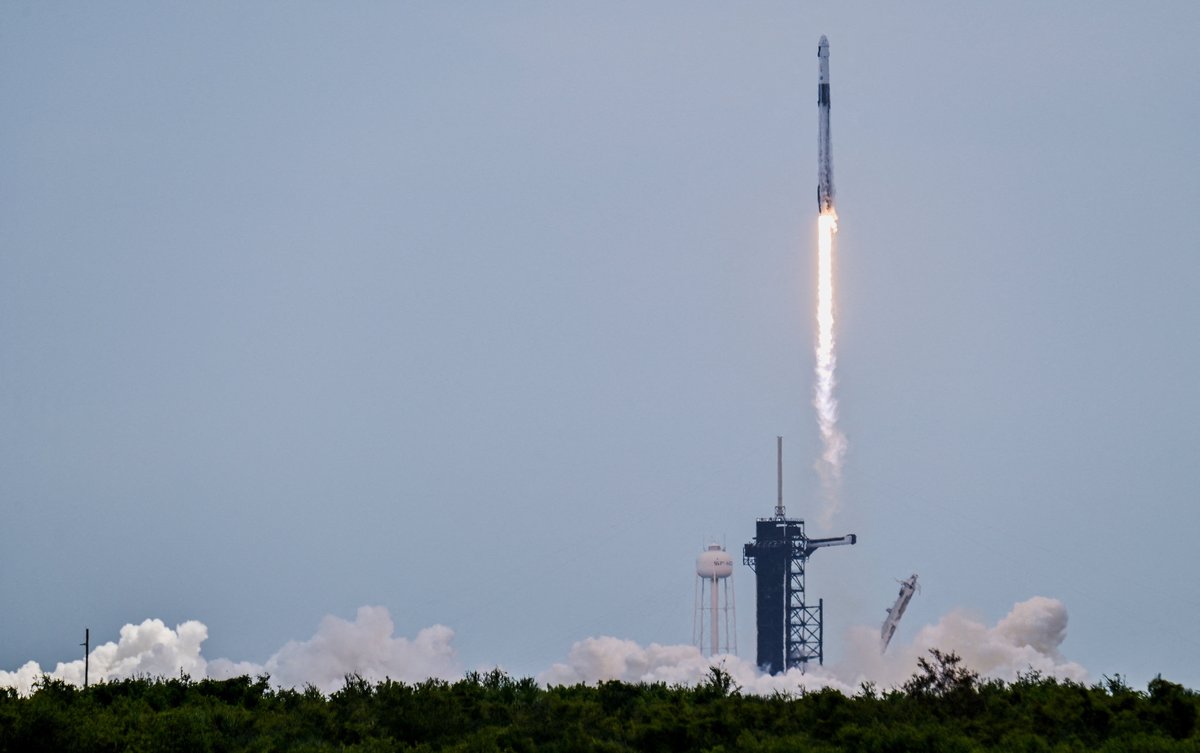
A SpaceX Falcon Nine rocket lifts off from Launch Complex 39A carrying NASA’s Crew-11 mission to the International Space Station in Cape Canaveral, Florida, U.S., August 1, 2025.
10:52 JST, August 2, 2025
WASHINGTON, Aug 1 (Reuters) – An international crew of four astronauts launched toward the International Space Station from Florida on Friday aboard a SpaceX rocket, embarking on a routine NASA mission that could be the first of many to last a couple months longer than usual.
The four-person crew – two NASA astronauts, a Russian cosmonaut and Japanese astronaut – boarded SpaceX’s Dragon capsule sitting atop its Falcon 9 rocket at NASA’s Kennedy Space Center and beat gloomy weather to blast off at 11:43 a.m. ET (1543 GMT). After a roughly 16 hour flight, they will arrive at the ISS at around 3 a.m. (0700 GMT) on Saturday.
While normal crew rotation missions last roughly six months, the Crew-11 crew may be the first to settle into a new routine time of eight months, intended to better align U.S. mission schedules with Russia’s missions, NASA said.
Over the next few months, NASA officials will monitor the health of SpaceX’s Dragon capsule, which remains docked to the ISS, before committing the mission to a full eight months.
Thursday’s mission, called Crew-11, includes NASA astronauts Zena Cardman and Michael Fincke, Russian cosmonaut Oleg Platonov, and Japanese astronaut Kimiya Yui.
A previous attempt to launch on Thursday was scratched at the last minute because of bad weather.
A delegation of senior Russian space officials, including the head of Russia’s space agency, Dmitry Bakanov, was in Florida for the launch attempt on Thursday, but it was unclear whether they stayed in town for Friday’s launch.
Their visit on Thursday included the first face-to-face meeting between the heads of NASA and Roscosmos, Russia’s space agency, since 2018. Roscosmos said Bakanov and acting NASA administrator Sean Duffy discussed continued ISS operations and cooperation on the moon.
The space cooperation is a bright spot in otherwise largely frosty U.S.-Russia relations since Moscow’s full-scale invasion of Ukraine in 2022.
However, apart from ISS cooperation, Russia’s invasion isolated Moscow’s space program from the West and foiled plans to cooperate on NASA’s Artemis moon program. Russia opted to partner on China’s moon program, which rivals Artemis.
No new commitments on any space programs were made during the brief meeting between Bakanov and Duffy, a person familiar with the discussion said.







Most Read
Popular articles in the past 24 hours
-

Foreign and Security Policy: Political Parties Must Discuss How T...
-

Monkey Strikes Junior High School Girl from Behind in Japan's Yam...
-

Japan's Snow-Clad Beauty: Camellia Flowers Seen in Winter Bloom a...
-

Senior Japanese Citizens Return to University to Gain Knowledge, ...
-

Heavy Snow Linked to 30 Deaths across Japan since Late Jan.; JMA ...
-

Eels Peak Out of Sushi Installations at Sendai Aquarium as Japan ...
-

Tokyo Police Arrest Head of Resignation Assistance Firm
-

Japan’s Nikkei Stock Average Jumps near 4%, Closes at Record High...
Popular articles in the past week
-

Australian Woman Dies After Mishap on Ski Lift in Nagano Prefectu...
-

Foreign Snowboarder in Serious Condition After Hanging in Midair ...
-

Chinese Embassy in Japan Reiterates Call for Chinese People to Re...
-

Narita Airport, Startup in Japan Demonstrate Machine to Compress ...
-

Toyota Motor Group Firm to Sell Clean Energy Greenhouses for Stra...
-

Sakie Yokota, Last Surviving Parent of a North Korea Abductee, Ur...
-

Beer Yeast Helps Save Labor, Water Use in Growing Rice; Govt Hope...
-

Japan Tourism Agency Calls for Strengthening Measures Against Ove...
Popular articles in the past month
-
Univ. in Japan, Tokyo-Based Startup to Develop Satellite for Disa...
-

JAL, ANA Cancel Flights During 3-day Holiday Weekend due to Blizz...
-

China Confirmed to Be Operating Drilling Vessel Near Japan-China ...
-

China Eyes Rare Earth Foothold in Malaysia to Maintain Dominance,...
-

Japan Institute to Use Domestic Commercial Optical Lattice Clock ...
-

M6.2 Earthquake Hits Japan's Tottori, Shimane Prefectures; No Tsu...
-

Japan, Qatar Ministers Agree on Need for Stable Energy Supplies; ...
-

Japan, Italy to Boost LNG Cooperation; Aimed at Diversifying Japa...
Top Articles in News Services
-

Prudential Life Expected to Face Inspection over Fraud
-

Arctic Sees Unprecedented Heat as Climate Impacts Cascade
-

South Korea Prosecutor Seeks Death Penalty for Ex-President Yoon over Martial Law (Update)
-

Trump Names Former Federal Reserve Governor Warsh as the Next Fed Chair, Replacing Powell
-

Japan’s Nagasaki, Okinawa Make N.Y. Times’ 52 Places to Go in 2026
JN ACCESS RANKING
-
Univ. in Japan, Tokyo-Based Startup to Develop Satellite for Disaster Prevention Measures, Bears
-
JAL, ANA Cancel Flights During 3-day Holiday Weekend due to Blizzard
-
China Confirmed to Be Operating Drilling Vessel Near Japan-China Median Line
-
China Eyes Rare Earth Foothold in Malaysia to Maintain Dominance, Counter Japan, U.S.
-
Japan Institute to Use Domestic Commercial Optical Lattice Clock to Set Japan Standard Time