
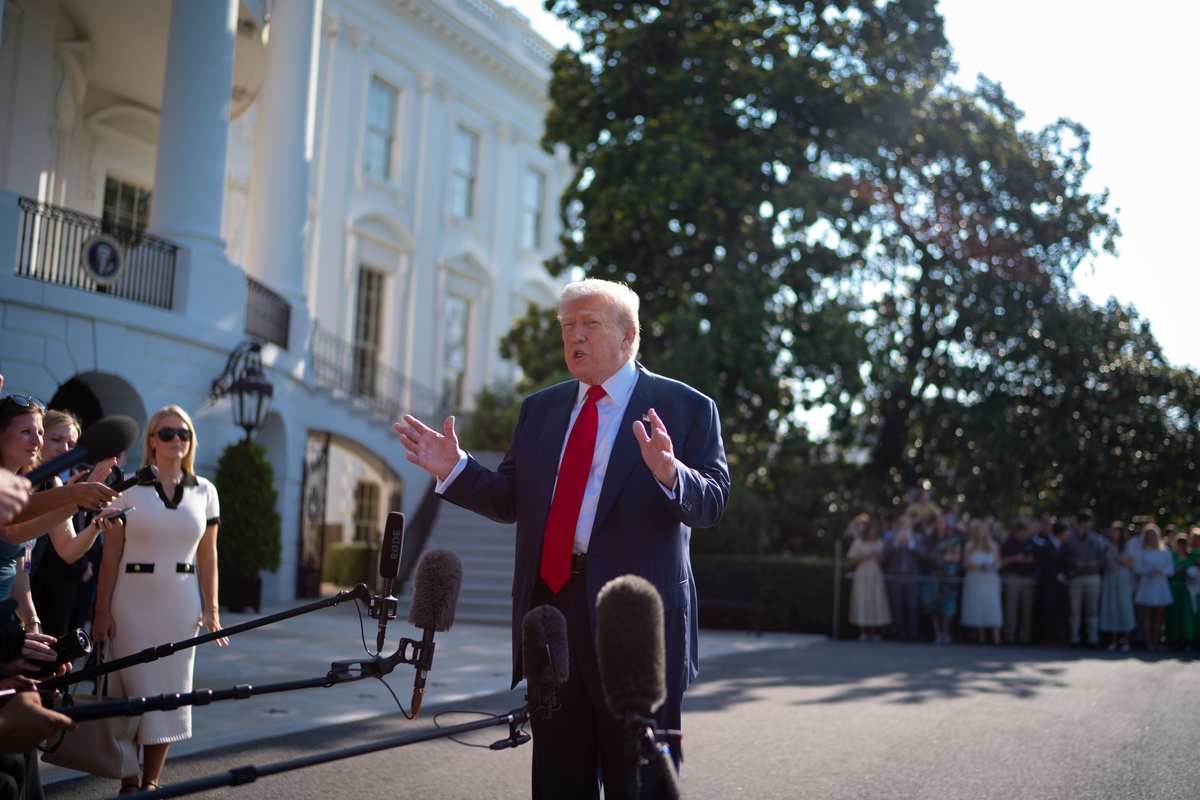
President Donald Trump speaks to the press before departing the White House on Friday
12:11 JST, July 26, 2025
Amid growing alarm about mass starvation in Gaza and images of Palestinians suffering from severe malnutrition, the Trump administration is hardening its tone toward Hamas, blaming it for the humanitarian crisis.
Hamas “didn’t want to make” a deal in this week’s round of ceasefire negotiations and now it would probably be “hunted down,” President Donald Trump said Friday. Special presidential envoy Steve Witkoff said the day before that the United States was at least temporarily pulling out of talks in Doha, Qatar, and would seek “alternative options” to end the conflict because Hamas was not “acting in good faith.”
Basem Naim, a Hamas official, said on Facebook that Witkoff had mischaracterized a Hamas response that was “very close” to what Witkoff himself proposed. The U.S. envoy, in his Thursday remarks, was “serving the Zionist position,” Naim said. Israeli Prime Minister Benjamin Netanyahu welcomed the U.S. announcement and pledged to work with Washington on alternatives.
Much of the rest of the world has escalated its criticism of Israel, whose military operations and evacuation orders have pushed most of Gaza’s 2.2 million people into an ever-shrinking fraction of the enclave, even as food supplies and access to them have diminished. But while Trump has sometimes grown exasperated with Netanyahu, he has maintained strong backing for Israel, often chiding the Biden administration for its “weak” support and attempts to use military and diplomatic leverage to increase humanitarian assistance.
Roughly a third of the Gaza population is going multiple days without eating, according to the United Nations. Already overwhelmed hospitals have been reporting rising deaths from starvation and a lack of medical supplies and fuel, with increasingly shocking images of human suffering emerging daily.
Aid groups say that the drastic decline in food reaching Gaza is the result of Israel blockading the enclave and, since mid-May, impeding the distribution of assistance by the U.N. and other international organizations throughout Gaza through approval delays and military no-go zones.
Instead, Israel and the United States have authorized and supported a mechanism, through the recently created Gaza Humanitarian Foundation, to hand out food at four limited sites located in military zones and guarded by U.S. security contractors.
Despite U.S. and Israeli claims that the talks broke down because Hamas doesn’t want a deal, many analysts say the impasse is due to fundamental differences over its terms.
“Hamas wants a deal,” said Aaron David Miller, a Middle East expert who has advised both Republican and Democratic administrations. Its demands are a guaranteed path to a permanent end to the war and withdrawal of Israeli forces; the resumption of large-scale U.N.-coordinated aid delivery; and release of Palestinian prisoners in exchange for Israeli hostages.
Israel has vowed to eliminate Hamas – physically or by removal of its remaining senior officials and militants to another country – and has continued to seek an agreement that does not commit it to negotiating an end to the war if its conditions are not met.
“The fundamental incompatibility is Hamas’s determination to survive and Netanyahu’s notion of total victory,” Miller said. The decision by Netanyahu and Trump to pull negotiating teams out of the talks, which one Middle East diplomat described as a negotiating tactic rather than a final word, reinforces that the Americans and Israelis will not let the horrifying reality of starvation and malnourishment in Gaza affect their negotiating resolve with Hamas, Miller said.
In a statement Friday, Qatar and Egypt, mediators along with the U.S., indicated that as far as they were concerned, “some progress was achieved during the most recent intensive round of negotiations,” and the talks were only suspended. “Consultations before resuming dialogue once again is a normal procedure within the context of these complex negotiations,” the joint statement said.
Trump, who softened his policy on Ukraine in part because he said he was disturbed at civilian suffering caused by Russian attacks earlier this year, has not dwelled on the images of starvation in Gaza and has not spoken at length about them publicly in recent days. But officials say that he is aware of the humanitarian situation and it is influencing his decisions.
Trump “has seen the images and he does not like them,” one senior White House official wrote in a message, speaking on the condition of anonymity to discuss the president’s private assessment of the humanitarian situation in Gaza.
“That’s why he directed Witkoff to come up with a creative aid/food program solution. He believes it’s a terrible situation and needs to end,” the senior official wrote.
The creative solution referred to the GHF, the Israeli- and U.S.-backed effort to replace the U.N.-coordinated system for aid that had operated in Gaza for decades, the senior official said. Israel charges that the U.N. is corrupted by Hamas.
Hamas, which has run the Gazan government for nearly two decades, attacked Israel on Oct. 7, 2023, killing about 1,200 and taking 250 hostages. The group continues to hold about 50 hostages who were abducted that day. About 20 are still believed to be alive. Israel’s retaliatory military campaign to eliminate Hamas and free the hostages has left most of Gaza in ruins and more than 60,000 dead, according to the Gaza Health Ministry, which does not distinguish between combatants and civilians, but says the majority of the dead are women and children.
U.S. officials have repeatedly spoken of the success of the GHF, pointing to figures that show it has delivered more than 80 million meals in boxes calibrated to feed 5.5 people for 3.5 days since late May. But its operations have also led to chaos and violence, with crowds of civilians desperately and dangerously rushing toward distribution points. Hundreds have been killed, shot at by Israeli troops who allege they pose a threat, or trampled in the surge toward food.
The U.N., as well as many other aid groups, have refused to join the GHF on grounds that it violates their principles of neutrality, while endangering civilians.
In virtual remarks to reporters Friday, GHF spokesman Chapin Fay repeated the foundation’s invitation to collaborate, offering “free” trucks, drivers and security escorts for U.N. convoys that are often attacked by hungry civilians and armed actors as they try to deliver food and medicine.
Israel has said the U.N. and others are free to distribute food, but their own incompetence and Hamas sympathies are preventing it. Israel, and the GHF, say that hundreds of food-laden trucks have been inspected by the Israel Defense Forces and are waiting just inside the enclave for U.N. pickup. “It’s a moment for the United Nations and the entire humanitarian community to step up, not step back,” Fay said. “Let’s stop pretending there’s only one way to deliver aid. … Let’s stop letting organizational ego dictate operational decisions. The old model is broken, and ours is working.”
In a letter Thursday to GHF Executive Chairman Johnnie Moore, U.N. Undersecretary General for Humanitarian Affairs Tom Fletcher “reiterated that the U.N. stands ready to engage with any partner to ensure desperately needed humanitarian aid reaches the people in Gaza,” a U.N. spokeswoman, Stephanie Tremblay, told reporters Friday.
But, she said Fletcher wrote, “any such partnership must adhere to the globally accepted principles of humanity, impartiality, neutrality, and independence. This means that aid must go where needs are greatest and without discrimination, and that we answer to civilians in need, not the warring parties.” He expressed a willingness to meet with Moore.
In a letter of reply Friday, released by the foundation, Moore said that the “GHF exists to be part of the solution, not to replace or rival any institution, but to help fill the gaps with transparency and effectiveness. We are willing to put our differences aside and to adapt to help people now.” Moore said he looked forward to a face-to-face meeting, although none is known to be scheduled.
On Thursday, Canadian Prime Minister Mark Carney became the latest world leader to call for the GHF program to end. “Israel’s control of aid distribution must be replaced by comprehensive provision of humanitarian assistance led by international organizations,” who said blocking such aid “is a violation of international law.”
U.S. officials have strongly rejected the idea that Israel was responsible for the lack of food, charging Hamas with “weaponizing” and stealing aid provided by the U.N. and others, and calling for additional international support for the foundation’s efforts.
“Of course we want to see as much aid getting into Gaza as possible in a way that is not being looted by Hamas, and this mechanism, the Gaza Humanitarian Foundation, has been a way to do that,” Tommy Pigott, a State Department spokesperson, said at a briefing Thursday.
Josh Paul, a former State Department official who resigned in protest of the Biden administration’s support for Israel during the start of the Gaza war, said that for the U.S. government there was now a “sunk costs” problem with Israel.
“Contemplating the fact that our partner is now engaged in the forcible starvation of a people it has spent the last two years bombing means a lot of politicians have to either do what politicians are worst at and admit they have been wrong, or ignore the evidence of their eyes and find some way to avoid facing the truth,” Paul said.
Some former officials said that Trump’s viewpoint on the conflict on Gaza has been clear and consistent, even as the suffering becomes more apparent.
“As tragic as the suffering is of the Palestinians in Gaza, President Trump is not fooled by Hamas’ vicious strategy of weaponizing civilian suffering to manipulate the world,” said Jason Greenblatt, who served as White House envoy to the Middle East during Trump’s first term and had also been a longtime attorney to the president.









Most Read
Popular articles in the past 24 hours
-

Green Tea Exports Hit Record High in 2025 Amid Growing Demand, Li...
-

Tokyo Had 65,000 More People Move In Than Out In 2025; Osaka Area...
-

Hunting for Small Details in PokéPark KANTO, Keep a Sharp Eye Out...
-

Japan's Nikkei Stock Average Slips after Sharp Gain as Software F...
-

Sapporo Snow Festival Opens with 210 Snow and Ice Sculptures at 3...
-

TEPCO’s Restructuring Plan: Develop Business Partnership Plans fo...
-

Astronomers Unveil Map of Dark Matter’s Distribution
-

Japan, Nepal Agree to Strengthen Friendship; Nations’ Leaders Mee...
Popular articles in the past week
-

Australian Woman Dies After Mishap on Ski Lift in Nagano Prefectu...
-

Foreign Snowboarder in Serious Condition After Hanging in Midair ...
-

Chinese Embassy in Japan Reiterates Call for Chinese People to Re...
-

Narita Airport, Startup in Japan Demonstrate Machine to Compress ...
-

Toyota Motor Group Firm to Sell Clean Energy Greenhouses for Stra...
-

Beer Yeast Helps Save Labor, Water Use in Growing Rice; Govt Hope...
-

Japan Tourism Agency Calls for Strengthening Measures Against Ove...
-

‘Jujutsu Kaisen’ Voice Actor Junya Enoki Discusses Rapid Action S...
Popular articles in the past month
-

Univ. in Japan, Tokyo-Based Startup to Develop Satellite for Disa...
-

JAL, ANA Cancel Flights During 3-day Holiday Weekend due to Blizz...
-
China Confirmed to Be Operating Drilling Vessel Near Japan-China ...
-

China Eyes Rare Earth Foothold in Malaysia to Maintain Dominance,...
-

Japan Institute to Use Domestic Commercial Optical Lattice Clock ...
-
M6.2 Earthquake Hits Japan's Tottori, Shimane Prefectures; No Tsu...
-

Japan, Qatar Ministers Agree on Need for Stable Energy Supplies; ...
-

Japan, Italy to Boost LNG Cooperation; Aimed at Diversifying Japa...
Top Articles in News Services
-

Prudential Life Expected to Face Inspection over Fraud
-

Arctic Sees Unprecedented Heat as Climate Impacts Cascade
-

South Korea Prosecutor Seeks Death Penalty for Ex-President Yoon over Martial Law (Update)
-

Trump Names Former Federal Reserve Governor Warsh as the Next Fed Chair, Replacing Powell
-

Suzuki Overtakes Nissan as Japan’s Third‑Largest Automaker in 2025
JN ACCESS RANKING
-
Univ. in Japan, Tokyo-Based Startup to Develop Satellite for Disaster Prevention Measures, Bears
-
JAL, ANA Cancel Flights During 3-day Holiday Weekend due to Blizzard
-
China Confirmed to Be Operating Drilling Vessel Near Japan-China Median Line
-
China Eyes Rare Earth Foothold in Malaysia to Maintain Dominance, Counter Japan, U.S.
-
Japan Institute to Use Domestic Commercial Optical Lattice Clock to Set Japan Standard Time