
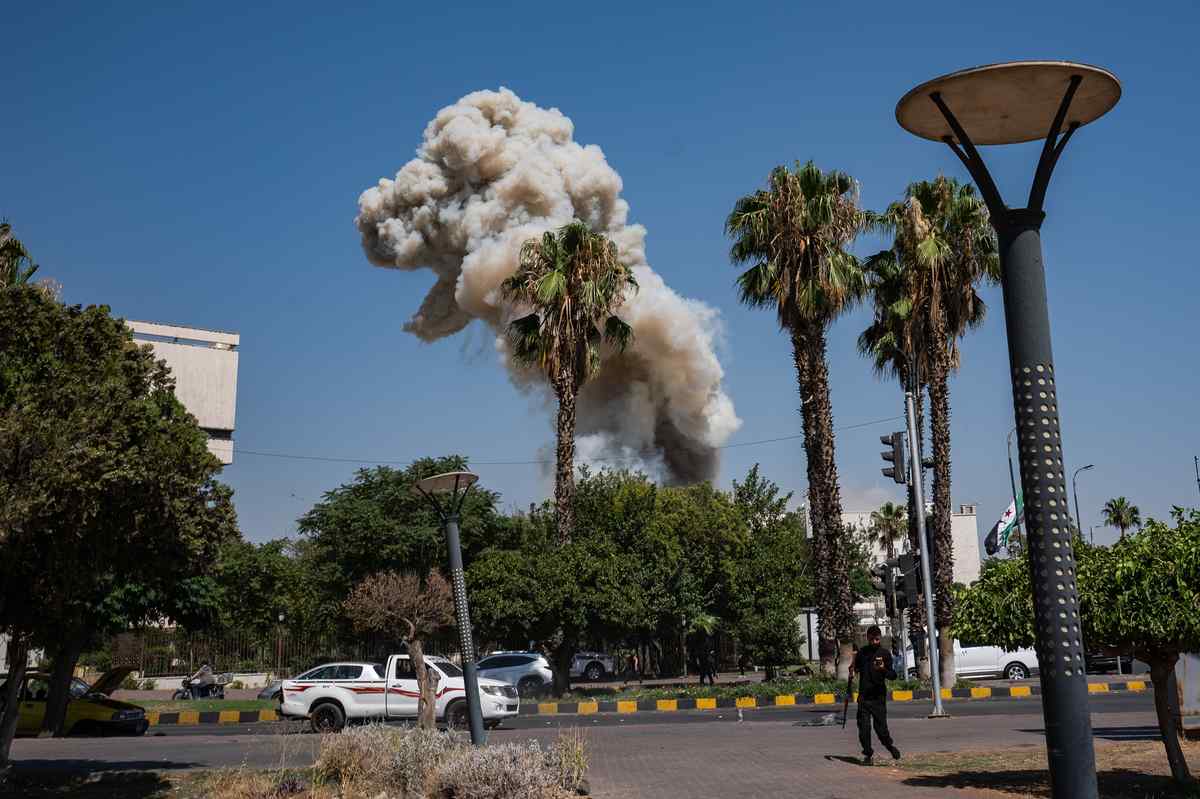
Israeli airstrikes hit Syria’s defense ministry in Damascus on Wednesday.
16:16 JST, July 17, 2025
DAMASCUS, Syria – Israel on Wednesday launched what it said were “dozens” of strikes across Syria, including in the capital, escalating a conflict with a fledgling government that was already grappling with domestic unrest in which scores of people have been killed.
Israel tied Wednesday’s strikes and others this week to that internal conflict, saying it was attacking forces of the new Islamist government to protect the Druze minority.
The Trump administration, which has pursued warmer relations with Syria following the toppling last year of dictator Bashar al-Assad, including by easing sanctions, said it was trying to calm tensions. Secretary of State Marco Rubio, speaking at the White House on Wednesday, blamed the violence on a “misunderstanding” between Israel and Syria stemming from the sectarian conflict in Syria’s south.
“We’ve been engaged with them all morning long and all night long, with both sides,” he said. “We think we’re on our way towards real de-escalation,” he said.
Israeli Defense Minister Israel Katz said the Israel Defense Forces would “continue to operate forcefully in Sweida to destroy the forces that attacked the Druze until their full withdrawal.”
“The painful blows have begun,” Katz wrote on X, sharing a video from Syrian television of an anchor ducking for cover as the Defense Ministry in Damascus was struck.
Israel hit the ministry multiple times Wednesday, including with two large strikes around 3 p.m., as bystanders and journalists including a Washington Post photographer were in the vicinity, looking for damage from an earlier Israeli strike.
Another airstrike landed near the presidential palace in Damascus. At least three people were killed and 34 were wounded in the strikes on the capital, Syrian media reported.
The Israeli attacks coincided with efforts by Syrian troops to intervene in a bout of sectarian violence that has raged for days in southern Syria. It began with clashes between the Druze and Bedouins around Druze-majority Sweida, a city of tens of thousands.
At least 169 people have been killed and more than 200 wounded since Sunday in clashes, extrajudicial killings and Israeli airstrikes, the Syrian Network for Human Rights said, in what it called a preliminary tally.
Druze leaders have long bristled at the presence of government forces in Sweida. They have maintained their own militias while expressing fears of the new government led by Ahmed al-Sharaa, the former leader of an al-Qaeda affiliate in Syria who spearheaded the rebel drive that deposed Assad in December.
Israel has bombed and set up military outposts in Syria since Assad’s fall, in what Israeli officials say is an effort to secure their borders from a government they view as extremist. Critics have warned that Israel’s occupation, outreach to minority leaders and demand that the entire south of Syria be demilitarized are thwarting the new government’s attempts to establish sovereignty.
“It’s dangerous,” said Orwa Ajjoub, a Syria researcher and doctoral candidate at Malmo University in Sweden. “On the one hand, you are claiming you are trying to protect the Druze. On the other, you are destabilizing the whole region.”
Before this week, Sharaa’s government had shown little, if any, antipathy to Israel – it was negotiating with Prime Minister Benjamin Netanyahu’s government for a security pact or more robust deal, in talks backed by the United States. But on Wednesday, the Syrian Foreign Ministry condemned the “treacherous Israeli aggression that targeted government institutions and civilian facilities” in Damascus and Sweida.
Israel’s assault was part of a “deliberate policy” to “inflame tensions, spread chaos and undermine security and stability,” the ministry said. For the first time since Sharaa took power, Syria’s state news agency is now referring to Israel as an “occupation” force.
Syrian government troops advanced toward Sweida this week in a bid to restore security. The government declared a ceasefire early Tuesday and Druze leaders called on the community’s armed factions to stand down, but fighting soon resumed. Hikmat al-Hijri, a Druze spiritual leader who opposes the Damascus government, alleged Tuesday that Syrian troops were continuing to attack civilians and called on his supporters to keep fighting.
During the unrest, along with the reports of extrajudicial killings, videos posted to social media appeared to show Syrian government troops abusing or humiliating Druze residents. Sharaa on Wednesday acknowledged “violations” and called them “criminal and illegal behavior.”
“Any party responsible for these acts, whether individuals or outlaw organizations, will be held accountable under strict legal procedures and we will not allow them to go unpunished,” he said in a statement.
But similar accusations have been leveled at government fighters for months during a series of deadly episodes, including sectarian violence that killed hundreds of people in Syria’s coastal region in March. Violence in some cases has been fueled by Assad regime supporters, but also fighters belonging to former anti-Assad rebel groups that were accused of abuses.
The hasty reorganization of the rebels under the banner of the national army did not change their nature, Ajjoub said. “It is extremely difficult to discipline them.”
The violence continued Wednesday amid conflicting reports of another ceasefire. “The shelling is heavier than yesterday and civilian houses are being hit,” one Sweida man told The Washington Post in a voice message. The 52-year-old teacher, like others in this report, spoke on the condition of anonymity for his security. He and his family have been sheltering in their house. He said they were quickly running out of food, water and essential supplies but were afraid to leave.
A neighbor in his 70s was killed by what the man believed to be sniper fire while trying to flee the city. The fighting has cut off roads in the city, the man said, which prevented ambulances from reaching the neighbor, who died on the street before his family could move him inside.
“We are peaceful people here,” the man said. “We need this massacre to stop.”
Omar Obeid, the head of the doctors’ syndicate in Sweida, said road closures and indiscriminate shelling had kept him from reaching the city’s main hospital. Talat Amer, one of Sweida’s most prominent doctors, was killed by a sniper Wednesday as he tried to reach the hospital, Obeid said. He called it “a loss for all of Syria.”
A medical assistant at Sweida National Hospital said it was barely functioning Wednesday because of water and electricity shortages. She said about 100 unidentified bodies were inside.









Most Read
Popular articles in the past 24 hours
-

Green Tea Exports Hit Record High in 2025 Amid Growing Demand, Li...
-

Tokyo Had 65,000 More People Move In Than Out In 2025; Osaka Area...
-

Hunting for Small Details in PokéPark KANTO, Keep a Sharp Eye Out...
-

Japan's Nikkei Stock Average Slips after Sharp Gain as Software F...
-

Sapporo Snow Festival Opens with 210 Snow and Ice Sculptures at 3...
-

TEPCO’s Restructuring Plan: Develop Business Partnership Plans fo...
-

Astronomers Unveil Map of Dark Matter’s Distribution
-

Japan, Nepal Agree to Strengthen Friendship; Nations’ Leaders Mee...
Popular articles in the past week
-

Australian Woman Dies After Mishap on Ski Lift in Nagano Prefectu...
-
Foreign Snowboarder in Serious Condition After Hanging in Midair ...
-

Chinese Embassy in Japan Reiterates Call for Chinese People to Re...
-

Narita Airport, Startup in Japan Demonstrate Machine to Compress ...
-

Toyota Motor Group Firm to Sell Clean Energy Greenhouses for Stra...
-

Beer Yeast Helps Save Labor, Water Use in Growing Rice; Govt Hope...
-

Japan Tourism Agency Calls for Strengthening Measures Against Ove...
-

‘Jujutsu Kaisen’ Voice Actor Junya Enoki Discusses Rapid Action S...
Popular articles in the past month
-

Univ. in Japan, Tokyo-Based Startup to Develop Satellite for Disa...
-
JAL, ANA Cancel Flights During 3-day Holiday Weekend due to Blizz...
-

China Confirmed to Be Operating Drilling Vessel Near Japan-China ...
-

China Eyes Rare Earth Foothold in Malaysia to Maintain Dominance,...
-

Japan Institute to Use Domestic Commercial Optical Lattice Clock ...
-
M6.2 Earthquake Hits Japan's Tottori, Shimane Prefectures; No Tsu...
-

Japan, Qatar Ministers Agree on Need for Stable Energy Supplies; ...
-

Japan, Italy to Boost LNG Cooperation; Aimed at Diversifying Japa...
Top Articles in News Services
-

Prudential Life Expected to Face Inspection over Fraud
-

Arctic Sees Unprecedented Heat as Climate Impacts Cascade
-

South Korea Prosecutor Seeks Death Penalty for Ex-President Yoon over Martial Law (Update)
-

Trump Names Former Federal Reserve Governor Warsh as the Next Fed Chair, Replacing Powell
-

Suzuki Overtakes Nissan as Japan’s Third‑Largest Automaker in 2025
JN ACCESS RANKING
-
Univ. in Japan, Tokyo-Based Startup to Develop Satellite for Disaster Prevention Measures, Bears
-
JAL, ANA Cancel Flights During 3-day Holiday Weekend due to Blizzard
-
China Confirmed to Be Operating Drilling Vessel Near Japan-China Median Line
-
China Eyes Rare Earth Foothold in Malaysia to Maintain Dominance, Counter Japan, U.S.
-
Japan Institute to Use Domestic Commercial Optical Lattice Clock to Set Japan Standard Time