
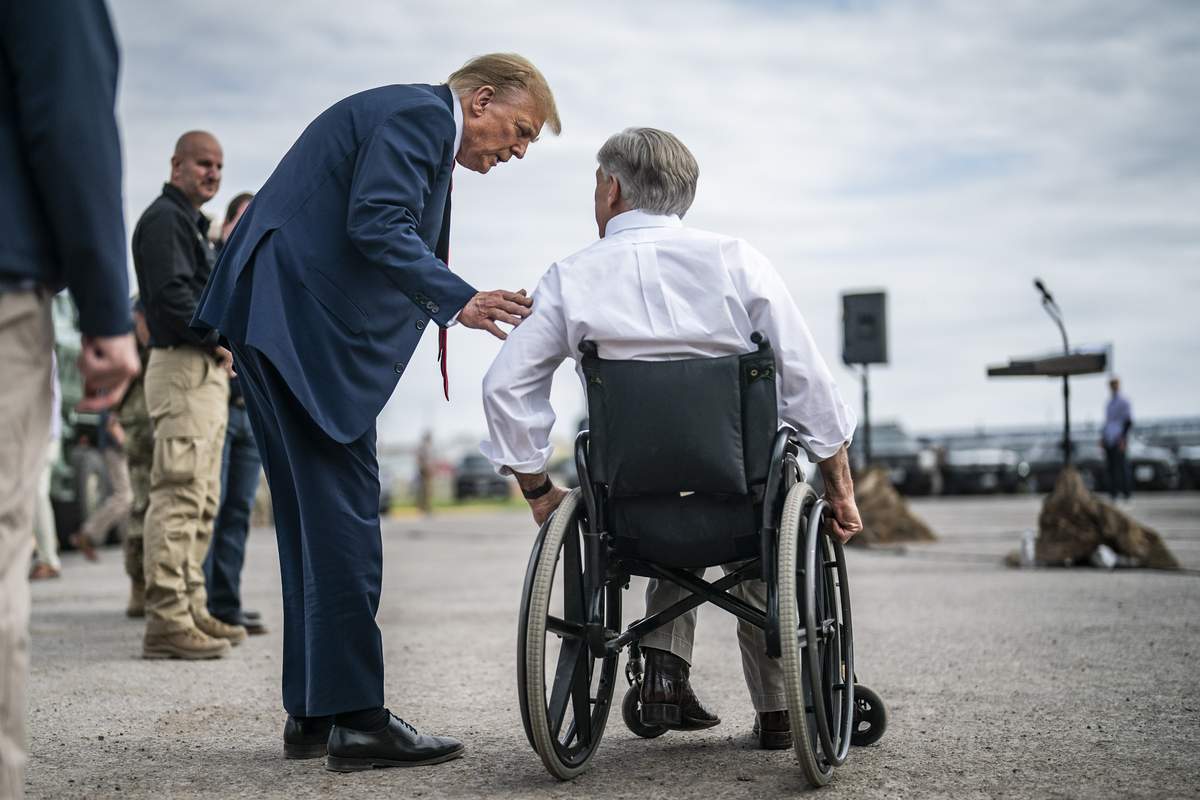
Donald Trump, then running for president, with Texas Gov. Greg Abbott (R) during a tour of the U.S.-Mexico border on Feb. 29, 2024.
12:15 JST, July 15, 2025
Weeks before flash floods devastated the Texas Hill Country, Gov. Greg Abbott participated in the first meeting of a new council to overhaul the Federal Emergency Management Agency. He criticized FEMA as “slow and clunky,” arguing that states are able to respond “more nimbly, more swiftly, more effectively” to disasters.
But since the July 4 floods that killed dozens in his state, the Texas governor has spoken much more positively about federal disaster response.
“This is the fastest that I’m aware of any administration responding so swiftly, so collaboratively, so coordinated,” said Abbott (R), appearing alongside President Donald Trump during his visit to Texas last week. In a statement, an Abbott spokesperson cited FEMA as an “exceptional” partner.
Abbott’s shifting rhetoric reflects thinking at the White House, where talk of abolishing the agency has been replaced by talk of “rebranding.” His opinions will become even more important in the months ahead: Abbott is one of two sitting governors on the FEMA Review Council, giving him direct influence over how the administration will implement Trump’s vague ideas about limiting Washington’s role in disaster coordination and handing more responsibility to the states.
The administration is pointing to Abbott’s response to the flooding as an example of how FEMA can work most effectively. But FEMA has always deferred to the states to lead disaster management, putting in question just how drastically the administration wants to alter its role.
The debate over FEMA comes as Texans are relying heavily on the agency, which coordinates the immediate federal response to a disaster and supports state and local governments in what can be years-long recovery efforts. Since January 2015, FEMA has supported Texas in 16 federally declared disasters, and the state has received nearly $15 billion in federal disaster funds, according to data from the Carnegie Endowment for International Peace’s Disaster Dollar Database.
“This is incredibly high stakes for governors and state legislatures,” said Sarah Labowitz, a senior fellow at the Carnegie Endowment who studies disaster response. “I think the hard part is that we don’t know [what exactly will happen to FEMA]. It’s sort of a bumper-sticker slogan to say get rid of FEMA as we know it. What does that actually mean to people who are living through disasters?”
Abbott and state lawmakers are preparing for a July 21 special session where flood prevention and federal relief funding are on the agenda. And the governor is planning to ask FEMA to reimburse the Texas emergency management department for the millions of dollars it spent tapping search-and-rescue assistance from a state-to-state mutual agreement, according to a document seen by the The Washington Post.
Abbott, meanwhile, plans to keep working on the FEMA Review Council.
In a statement, Abbott’s office said his work on the council “will continue bringing Texas’ proven leadership in emergency management to ensure state and local governments are empowered to better serve their citizens.” He suggested during the council’s first meeting that he wanted to help “fill in the details” of the administration’s plan to revamp FEMA.
Abbott is planning to ask for several things during the upcoming special legislative session, including improved warning systems in flood-prone areas, better communication between first responders and relief funding for the affected region – including from FEMA.
Abbott has a long track record of managing crises in his state, including Hurricane Harvey in 2017 and the Uvalde school massacre in 2022, and endured the scrutiny of the state response that has followed each one.
“I worked with Governor Abbott on several disasters during my time as administrator, and I don’t have anything bad to say about how he approaches it. He understands disaster management,” said Deanne Criswell, who led FEMA under President Joe Biden.
But some Texas Democrats are criticizing Abbott for simultaneously defending the administration’s moves to trim down FEMA.
“With the Trump administration gutting FEMA, it’s had significant consequences,” said Rep. Julie Johnson, a North Texas Democrat. “Abbott is showing fidelity to the president, not fidelity to the residents and the citizens of the state of Texas.”
FEMA activated in the state after Abbott requested that a state of emergency be declared on July 5, the day after the flooding, sources at the agency said, and Trump signed it the next day. FEMA can’t send responders into a state without an invitation from the governor. The agency also said it would make grants available for recovery efforts in Texas.
But the agency’s response was not as proactive as it could have been, Criswell said. The former administrator said FEMA could have had more resources in position to enter the state as soon as Abbott requested federal assistance but was bogged down by new constraints requiring Homeland Security Secretary Kristi L. Noem’s approval for larger deployments.
FEMA did not respond to a request for comment.
Before the flooding, the Trump administration’s desire to shift more responsibility to states was criticized as a misunderstanding of FEMA’s role, which is already to financially support overwhelmed state-led disaster management efforts. Staffing reductions have also put in question the agency’s effectiveness.
Noem said at the first meeting of the FEMA Review Council in May that it would “very much look to” Abbott for ideas to improve the agency. Abbott avoided Trump’s talk of ending the agency, instead discussing the need to “streamline” and “restructure” it.
On Capitol Hill and in state capitals, there does not appear to be much support for getting rid of FEMA altogether. Criswell acknowledged that there have been bipartisan frustrations for years with the FEMA bureaucracy to secure recovery funding.
During the council’s second meeting, which was held Wednesday, Noem said some of FEMA’s response to the Texas flooding “is exactly how President Trump imagined that this agency would operate, immediately making decisions, getting them resources and dollars that they need so that they can conduct the response that they need to do on the ground.”
But Noem’s characterization has mystified disaster response experts, who say Abbott appears to be directing an effort consistent with how states normally interact with the agency. FEMA supplements state governments when they are overwhelmed and need financial assistance or coordination with other federal agencies, Criswell said, but state and local governments ultimately lead the response and recovery efforts.
Criswell said Abbott’s disaster management strategy this time didn’t appear different from when they worked together. Labowitz agreed that the coordination looked the same.
Texas has infrastructure and resources to respond to disasters that other states don’t have, according to disaster response experts. But, as Labowitz noted, such states are “in a strong position in large part because of the backing of the federal government.”
The state’s uniquely robust infrastructure has been built from decades of experience responding to hurricanes, tornadoes, ice storms and other natural disasters. Texas also maintains a multibillion-dollar “rainy day fund” to help finance disaster recovery. Even with those resources, the state has repeatedly relied on federal assistance.
“It’s not realistic to expect every state to develop the same type of resources that the federal government can provide,” Criswell said. “It’s a much better use of our taxpayer dollars, whether it’s state tax dollars or federal tax dollars, to have this centralized resource capability.”
Texas has still faced criticism for not adequately preparing the Hill Country for catastrophic floods. The region is known to be at risk for flash flooding, but Kerr County was denied state assistance to prepare for flooding, including federal funds administered by the state, multiple times.
“The fact Texas denied their request for grant funding to ensure proper siren notifications is a problem. And that is a failure of Greg Abbott,” Johnson said. “It is a failure of Texas Republicans.”
Abbott, who has been governor since 2015, has enjoyed a warm working relationship with Trump since his first term, forged through multiple tragedies that have struck the state and demanded federal support. At the helm of the most populous red state in the country, Abbott has been a reliable political ally for Trump, though other state GOP leaders, such as Lt. Gov. Dan Patrick, have been more enthusiastic in their support for Trump.
“We’ve become very, very close, politically and personally,” the president said of Abbott as he led a roundtable with local officials Friday in Kerrville. “We’ve had a tremendous relationship with Texas. I guess Texas brought us together. We were together fine, but now we’re together a lot more.”
Unlike another governor who has had to deal with Trump on disaster response in his second term – California Democrat Gavin Newsom – Abbott does not harbor national political ambitions. Abbott quickly shot down Trump’s floating of him as a running mate last year and is widely expected to seek a fourth term next year.
The federal response to the floods has drawn scrutiny from Democrats, with several members of the state’s congressional delegation demanding an oversight hearing. The lawmakers raised concerns about breakdowns in the public alert systems, with many residents and visitors in the area – including attendees of summer camps – not receiving warnings of the coming floods.
Abbott shut down a question when asked about who was to blame for the floods’ devastation. Speaking to reporters Wednesday, he said: “The losing teams are the ones that try to point out who’s to blame. The championship teams are the ones that say, ‘Don’t worry about it, man, we got this.’”
Kendall Scudder, chairman of the Texas Democratic Party, argued that the floods were a consequence of Abbott and other Texas Republicans long prioritizing divisive social issues over “bread-and-butter issues that people are counting on their government to deliver on.” Johnson said Abbott’s football metaphor was an “unconscionable” attempt to skirt accountability.
Abbott has weathered criticism of his disaster response before. His remarks that the Uvalde school shooting “could have been worse” if not for the law enforcement response became a rallying cry for critics in his 2022 reelection race against Democrat Beto O’Rourke, whom Abbott defeated by a comfortable margin.







Most Read
Popular articles in the past 24 hours
-

Green Tea Exports Hit Record High in 2025 Amid Growing Demand, Li...
-

Tokyo Had 65,000 More People Move In Than Out In 2025; Osaka Area...
-

Hunting for Small Details in PokéPark KANTO, Keep a Sharp Eye Out...
-

Japan's Nikkei Stock Average Slips after Sharp Gain as Software F...
-

Sapporo Snow Festival Opens with 210 Snow and Ice Sculptures at 3...
-

TEPCO’s Restructuring Plan: Develop Business Partnership Plans fo...
-

Astronomers Unveil Map of Dark Matter’s Distribution
-

Japan, Nepal Agree to Strengthen Friendship; Nations’ Leaders Mee...
Popular articles in the past week
-
Australian Woman Dies After Mishap on Ski Lift in Nagano Prefectu...
-
Foreign Snowboarder in Serious Condition After Hanging in Midair ...
-

Chinese Embassy in Japan Reiterates Call for Chinese People to Re...
-

Narita Airport, Startup in Japan Demonstrate Machine to Compress ...
-

Toyota Motor Group Firm to Sell Clean Energy Greenhouses for Stra...
-

Beer Yeast Helps Save Labor, Water Use in Growing Rice; Govt Hope...
-

Japan Tourism Agency Calls for Strengthening Measures Against Ove...
-

‘Jujutsu Kaisen’ Voice Actor Junya Enoki Discusses Rapid Action S...
Popular articles in the past month
-

Univ. in Japan, Tokyo-Based Startup to Develop Satellite for Disa...
-
JAL, ANA Cancel Flights During 3-day Holiday Weekend due to Blizz...
-
China Confirmed to Be Operating Drilling Vessel Near Japan-China ...
-
China Eyes Rare Earth Foothold in Malaysia to Maintain Dominance,...
-

Japan Institute to Use Domestic Commercial Optical Lattice Clock ...
-
M6.2 Earthquake Hits Japan's Tottori, Shimane Prefectures; No Tsu...
-

Japan, Qatar Ministers Agree on Need for Stable Energy Supplies; ...
-

Japan, Italy to Boost LNG Cooperation; Aimed at Diversifying Japa...
Top Articles in News Services
-

Prudential Life Expected to Face Inspection over Fraud
-

Arctic Sees Unprecedented Heat as Climate Impacts Cascade
-

South Korea Prosecutor Seeks Death Penalty for Ex-President Yoon over Martial Law (Update)
-
Trump Names Former Federal Reserve Governor Warsh as the Next Fed Chair, Replacing Powell
-

Suzuki Overtakes Nissan as Japan’s Third‑Largest Automaker in 2025
JN ACCESS RANKING
-
Univ. in Japan, Tokyo-Based Startup to Develop Satellite for Disaster Prevention Measures, Bears
-
JAL, ANA Cancel Flights During 3-day Holiday Weekend due to Blizzard
-
China Confirmed to Be Operating Drilling Vessel Near Japan-China Median Line
-
China Eyes Rare Earth Foothold in Malaysia to Maintain Dominance, Counter Japan, U.S.
-
Japan Institute to Use Domestic Commercial Optical Lattice Clock to Set Japan Standard Time