
Penal Code Changes Allow More Flexible Approach to Inmates; Marks Shift to Rehabilitation, Preventing New Offenses
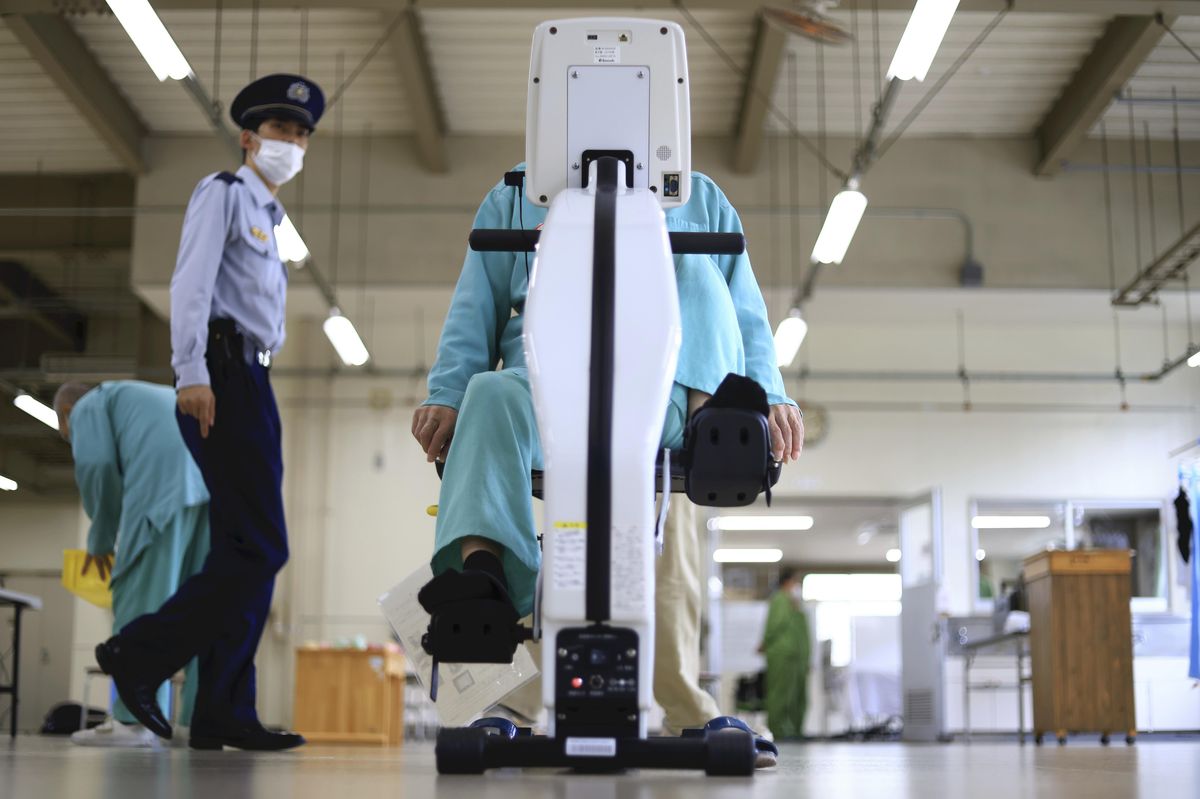
An inmate at Fuchu Prison in Fuchu, western Tokyo, uses an exercise machine to maintain his physical functions on May 12.
20:00 JST, May 29, 2025
Changes in the Penal Code’s sentencing categories — the first since the law was established in 1907 — mark a significant shift toward a more flexible system with a greater focus on rehabilitation and preventing recidivism after an inmate is released.
The code’s categories of “imprisonment with labor” and “imprisonment without labor” will be abolished as of Sunday and replaced by a single “confinement” category. This will allow for a more flexible, personalized approach to individual inmates that combines conventional prison work with new forms of guidance and education. Prisons across Japan have been conducting such programs on a trial basis, but success will require addressing a range of issues, including changing the mindset of prison staff and providing support for social reintegration after inmates are released.
The “confinement” sentence will require inmates to be detained in a penal institution, but the revised law stipulates that “necessary” assigned work will be done and “necessary guidance” can be provided to help prisoners rehabilitate and better themselves. Prison labor will no longer be mandatory. The “imprisonment with labor” and “imprisonment without labor” categories will be abolished.
These changes are being introduced against a backdrop of a graying prison population and worsening recidivism rates.
In 2023, a record-high 14.3% of the people who entered the prison system were aged 65 or older. Many of these elderly prisoners are unable to keep up with prison work due to their declining physical strength and cognitive function. Of the people arrested for Penal Code offences that year, 47% were repeat offenders.
“The way we deal with inmates needs to place greater emphasis on helping them get back on their feet,” a senior Justice Ministry official said.
Five years ago, Fuchu Prison in Fuchu, western Tokyo, began conducting activities designed to “improve physical functions” as a de facto form of rehabilitation for elderly inmates. Prisoners who find it difficult to do regular labor such as assembling furniture instead engage in strength training, including riding exercise bicycles, and mental exercises, which involve memory tests on digital devices.
“I had a back pain, so before I could do only simple tasks like folding cloth,” said an 86-year-old inmate currently behind bars for a ninth time because he repeatedly shoplifted due to hardship. “My back is much better now thanks to the rehabilitation program. After I leave prison, I want to register at a human resources center for elderly people, find a job and get my life back on track.”
Inmate-specific groups
The criteria used to divide prisoners into groups also will be overhauled under the revised law.
Until now, the ministry has mainly split inmates into first-time offenders and repeat offenders. This uniform standard has been dubbed a “uniaxial assessment” that in some cases resulted in inmates who were repeat shoplifters doing prison labor at the same location as members of organized crime syndicates.
This will change from June with the introduction of new standards that provide a “multiaxial assessment.” Under this system, prisoners will be divided into groups based on specific details such as age, physical health and whether they have a disability.
Inmates will be split into 24 different groups, including “elderly care” mainly for prisoners aged 70 or older and who struggle to live independently due to dementia and other reasons, and “addiction recovery” for prisoners who have a history of using drugs.
Support after release crucial
About 34,000 inmates are held at penal institutions across the nation. According to a senior Justice Ministry official, it is estimated that about only 20% to 30% of the prison population, especially elderly inmates, will be handled with a focus on personalized guidance and education. The majority of inmates will continue to mostly do prison labor during their sentence.
Nevertheless, prison staffers will face a raft of challenges adapting to this new system of dealing with prisoners. These staffers will need to acquire the necessary expertise and also change their way of thinking. Another senior ministry official said, “It’ll take some time until every prison officer adjusts their mindset to place the focus of their job on helping inmates rehabilitate.”
The ministry plans to provide thorough training for prison staffers on this issue.
Support for inmates after their return to society also will be essential. Data shows that about 70% of prisoners who reoffended and returned to prison had been unemployed, so inmates who are unable to find a job after being released are likely to again turn to crime.


-250x171.jpg)





Most Read
Popular articles in the past 24 hours
-

Israeli Ambassador to Japan Speaks about Japan’s Role in the Reco...
-

Japan’s Govt Sets Goal for World’s No. 3 in Number of Highly Cite...
-
‘Bonbon Drop’ 3D Stickers Fly Off Shelves in Japan
-

Visitors Enjoy Early Blooming Flowers Set Against Mt. Fuji
-
Japan IT Groups Urge Apple, Google to Waive New Commissions
-

Japan’s Nikkei Stock AverageRallies on Earnings in Unsteady Trade...
-

Milano Cortina 2026: Japan’s Ayumu Hirano Points toward Com...
-

Shirakawa Ice Pillars Hit Seasonal Peak in Nagano Pref.
Popular articles in the past week
-

Man Infected with Measles May Have Come in Contact with Many Peop...
-

Australian Woman Dies After Mishap on Ski Lift in Nagano Prefectu...
-
Foreign Snowboarder in Serious Condition After Hanging in Midair ...
-

Chinese Embassy in Japan Reiterates Call for Chinese People to Re...
-
Narita Airport, Startup in Japan Demonstrate Machine to Compress ...
-

Toyota Motor Group Firm to Sell Clean Energy Greenhouses for Stra...
-

BTS to Hold Comeback Concert in Seoul on March 21; Popular Boy Ba...
-

Beer Yeast Helps Save Labor, Water Use in Growing Rice; Govt Hope...
Popular articles in the past month
-

Univ. in Japan, Tokyo-Based Startup to Develop Satellite for Disa...
-

JAL, ANA Cancel Flights During 3-day Holiday Weekend due to Blizz...
-

Japan Institute to Use Domestic Commercial Optical Lattice Clock ...
-

China Eyes Rare Earth Foothold in Malaysia to Maintain Dominance,...
-
China Confirmed to Be Operating Drilling Vessel Near Japan-China ...
-
Man Infected with Measles May Have Come in Contact with Many Peop...
-

Japan, Qatar Ministers Agree on Need for Stable Energy Supplies; ...
-
Australian Woman Dies After Mishap on Ski Lift in Nagano Prefectu...
Top Articles in Politics
-
Japan Tourism Agency Calls for Strengthening Measures Against Overtourism
-

Japan Seeks to Enhance Defense Capabilities in Pacific as 3 National Security Documents to Be Revised
-

Japan’s Prime Minister: 2-Year Tax Cut on Food Possible Without Issuing Bonds
-

Voters Using AI to Choose Candidates in Japan’s Upcoming General Election; ChatGPT, Other AI Services Found Providing Incorrect Information
-

Japan-South Korea Leaders Meeting Focuses on Rare Earth Supply Chains, Cooperation Toward Regional Stability
JN ACCESS RANKING
-
Univ. in Japan, Tokyo-Based Startup to Develop Satellite for Disaster Prevention Measures, Bears
-
JAL, ANA Cancel Flights During 3-day Holiday Weekend due to Blizzard
-
Japan Institute to Use Domestic Commercial Optical Lattice Clock to Set Japan Standard Time
-
China Eyes Rare Earth Foothold in Malaysia to Maintain Dominance, Counter Japan, U.S.
-
Man Infected with Measles May Have Come in Contact with Many People in Tokyo, Went to Store, Restaurant Around When Symptoms Emerged