
Explore the World Expo: Significance of the Event / Osaka-Kansai Expo 2025 Provides Opportunities, Challenges for Talented Young Japanese; Expo Keeps Eye on Future
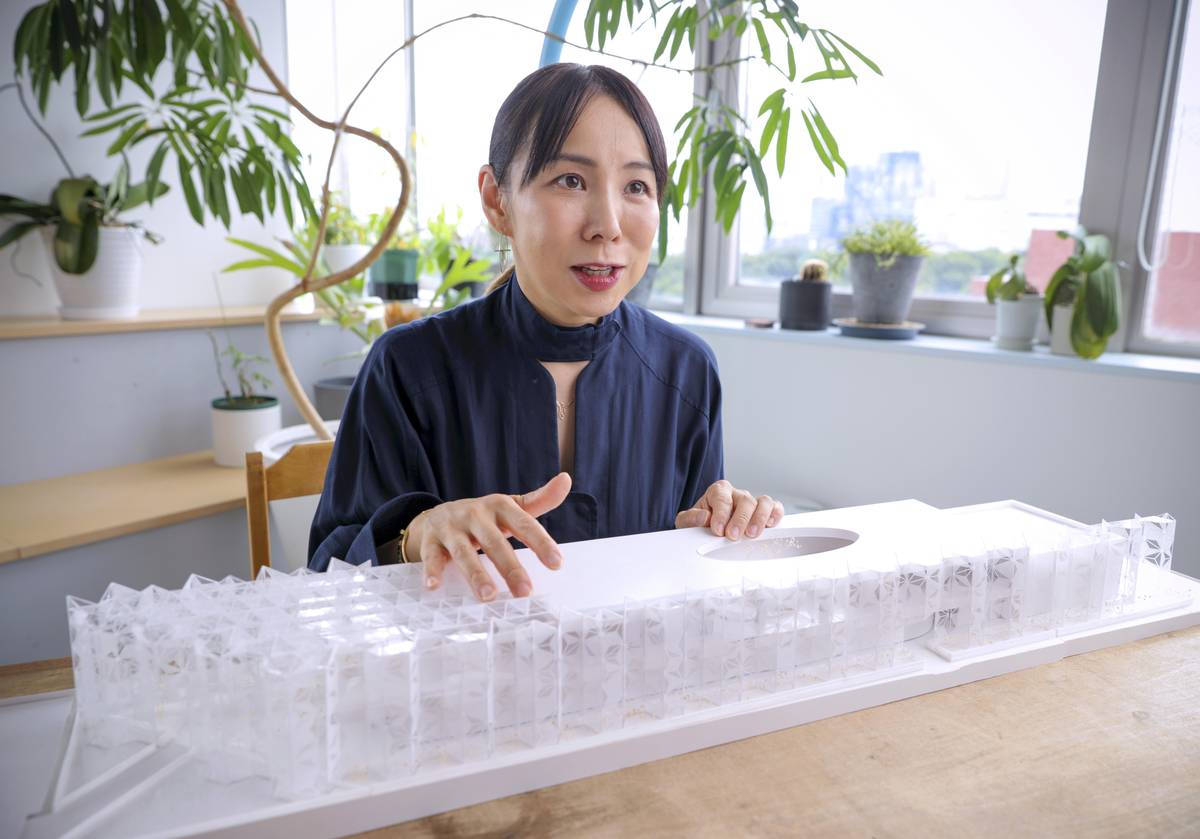
Yuko Nagayama talks about her desire that the upcoming expo can make young people have dreams as she shows a miniature model of the Women’s Pavilion, in Shinjuku Ward, Tokyo.
7:00 JST, December 24, 2024
This is the third installment of a series on the significance of the World Expo.
***
OSAKA — The venue of the 1970 Osaka Expo inspired images of the near future.
Pavilions with outrageous appearances lined the venue. Two were particularly notable: the Takara Beautilion Pavilion, which was made of combined capsules, and the Toshiba IHI Pavilion, which comprised a red dome supported by black steel grids.
They were designed by Kisho Kurokawa, an architect who died in 2007. Kurokawa, who was 35 when the 1970 Expo opened, became a legend who had a major influence on world architecture.
The avant-garde uniforms that the staff wore in the pavilions and elsewhere at the Expo were designed by Junko Koshino, 85, a famous fashion designer.
The architecture of the Pavilion Textiles, which involved a dome sticking out of the center of a ramp-like structure, was designed by Tadanori Yokoo, 88, a modern artist.
Those innovative designs had people predicting great achievements for those who created them.
In the same way as the 1970 Osaka Expo, a wide variety of talented people are taking up new challenges for 2025 Osaka-Kansai Expo.
Yuko Nagayama, a 49-year-old architect, designed the Women’s Pavilion, which introduces successful women in Japanese society.
“If I communicate messages at the Expo, which is a venue for experimental ideas for the future, I can change society’s consciousness about architecture,” she said enthusiastically.
In the process of building the pavilion, construction materials with hemp leaf patterns on the surfaces were reused. The materials were used to build the Japan Pavilion — which Nagayama designed — for the previous expo in Dubai.
The plan is attracting attention as a pioneering attempt to reuse construction materials from one expo to the next on a large scale.
However, the plan faces many challenges, for example, financing the cost of implementing it. Although ordinary decommissioning of pavilions is covered by the government’s budgets, decommissioning and transporting each item for reuse are not covered by those funds.
Nagayama took the initiative to search for companies that would cooperate, and some firms that helped build the Japan Pavilion in Dubai agreed to work with her. They include major general contractor Obayashi Corp. and general logistics company Sankyu Inc.
The number of the items that she brought back to Japan exceeded 10,000.
Globally reusing construction materials faces a barrier of standards that are different among countries.
Because the construction materials used for the Japan Pavilion in Dubai were made under European standards, certificates for the Japanese Industrial Standards (JIS) were needed to reuse the items in Japan.
However, the pavilion for the 2025 Expo is only going to be used as a temporary building during the exposition, so the Osaka city government allowed an exception and the materials are not subject to the JIS.
“I hope steps will be taken in society also during ordinary times to reuse construction materials, including the revision of laws,” Nagayama said. “I hope we can convey the message that taking on challenges can give us a big reward.”
The Japan Association for the 2025 World Exposition publicly solicited architects aged 45 or younger with the aim of finding those who can become a second Kisho Kurokawa. Twenty teams are taking part in designing facilities, including bathrooms.
Shingo Saito, a 37-year-old architect, designed toilets that take into consideration people of different genders and those with disabilities.
“Toilets, which everybody uses, are a condensed version of society that shows how it should be,” he said. “How should I express with architecture a diverse society? I want to exhibit one form.”
He adjusted the size of each restroom stall and the heights of handrails after hearing opinions from wheelchair users, people with visual impairments and caregivers.
Chie Konno, a 43-year-old architect who is taking part in a gallery, said, “Things that we had regarded just as waste can be resources for shaping our daily life.”
Konno compressed used tea leaves and coffee grounds into panels that are utilized as construction materials.
Architecture has been designed with a nod toward the future, and its large size is appealing to the eye.
“Now that digitalization is occurring in society, it is important to present values that people can feel only in these venues,” said Shoichi Inoue, 69, a director of the International Research Center for Japanese Studies who is familiar with expo buildings.







Most Read
Popular articles in the past 24 hours
-

Japan's Snow-Clad Beauty: Camellia Flowers Seen in Winter Bloom a...
-

Monkey Strikes Junior High School Girl from Behind in Japan's Yam...
-

Foreign and Security Policy: Political Parties Must Discuss How T...
-
Genichiro Inokuma's Mural in Ueno Station That Gave Hope in Postw...
-
Senior Japanese Citizens Return to University to Gain Knowledge, ...
-
Heavy Snow Linked to 30 Deaths across Japan since Late Jan.; JMA ...
-

Tokyo Police Arrest Head of Resignation Assistance Firm
-

Japan’s Nikkei Stock Average Jumps near 4%, Closes at Record High...
Popular articles in the past week
-

Japan Institute to Use Domestic Commercial Optical Lattice Clock ...
-
Australian Woman Dies After Mishap on Ski Lift in Nagano Prefectu...
-
Foreign Snowboarder in Serious Condition After Hanging in Midair ...
-

Chinese Embassy in Japan Reiterates Call for Chinese People to Re...
-
Narita Airport, Startup in Japan Demonstrate Machine to Compress ...
-

Toyota Motor Group Firm to Sell Clean Energy Greenhouses for Stra...
-

Sakie Yokota, Last Surviving Parent of a North Korea Abductee, Ur...
-

Beer Yeast Helps Save Labor, Water Use in Growing Rice; Govt Hope...
Popular articles in the past month
-

Univ. in Japan, Tokyo-Based Startup to Develop Satellite for Disa...
-

JAL, ANA Cancel Flights During 3-day Holiday Weekend due to Blizz...
-

China Confirmed to Be Operating Drilling Vessel Near Japan-China ...
-

China Eyes Rare Earth Foothold in Malaysia to Maintain Dominance,...
-
Japan Institute to Use Domestic Commercial Optical Lattice Clock ...
-
M6.2 Earthquake Hits Japan's Tottori, Shimane Prefectures; No Tsu...
-

Japan, Qatar Ministers Agree on Need for Stable Energy Supplies; ...
-

Japan, Italy to Boost LNG Cooperation; Aimed at Diversifying Japa...
Top Articles in Society
-
JAL, ANA Cancel Flights During 3-day Holiday Weekend due to Blizzard
-
Record-Breaking Snow Cripples Public Transport in Hokkaido; 7,000 People Stay Overnight at New Chitose Airport
-
Australian Woman Dies After Mishap on Ski Lift in Nagano Prefecture
-
Foreign Snowboarder in Serious Condition After Hanging in Midair from Chairlift in Nagano Prefecture
-
Train Services in Tokyo Resume Following Power Outage That Suspended Yamanote, Keihin-Tohoku Lines (Update 4)
JN ACCESS RANKING
-
Univ. in Japan, Tokyo-Based Startup to Develop Satellite for Disaster Prevention Measures, Bears
-
JAL, ANA Cancel Flights During 3-day Holiday Weekend due to Blizzard
-
China Confirmed to Be Operating Drilling Vessel Near Japan-China Median Line
-
China Eyes Rare Earth Foothold in Malaysia to Maintain Dominance, Counter Japan, U.S.
-
Japan Institute to Use Domestic Commercial Optical Lattice Clock to Set Japan Standard Time