
SDF 70 yrs on — Expanding Roles / Front Line of Japan’s MSDF Shifts to South China Sea; Japan to Prioritize Procurement of Unmanned Surface Vehicles in Future
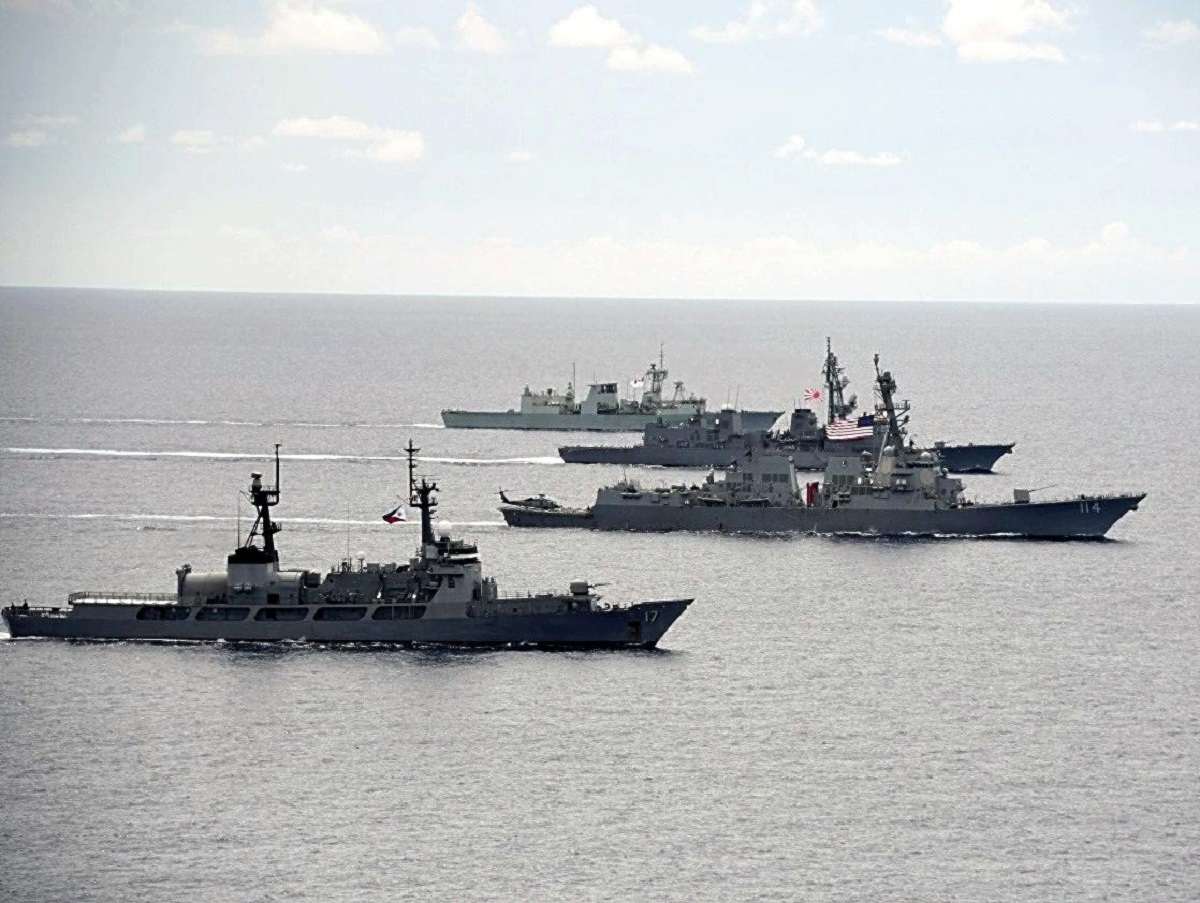
From front, combat ships from the Philippines, the United States, Japan and Canada conduct a joint exercise in the South China Sea on June 16.
1:00 JST, July 12, 2024
In the 70 years since the Self-Defense Forces were established on July 1, 1954, Japan’s security environment has changed drastically, with the breakup of the Soviet Union and the rise of China. This is the second article in a series on the growing role of the SDF.
***
Four ships from Japan, the United States, Canada and the Philippines sailed through the South China Sea in formation near Luzon Island in the Philippines on June 16.
The formation was part of a multilateral maritime exercise among countries that agree on the idea of a free and open Indo-Pacific.
During the drill, the ships — the Maritime Self-Defense Force’s Kirisame destroyer, a U.S. destroyer, a Canadian Navy frigate and a Philippine Navy offshore patrol vessel — confirmed collaborative actions and changed positions after communicating with each other.
In the same area in early April, the MSDF destroyer Akebono conducted a joint drill with vessels including a U.S. Navy littoral combat ship, an Australian Navy frigate and a Philippine Navy offshore patrol vessel.
Chinese ships have repeatedly used coercive behaviors, such as using water cannons on and colliding with Philippine vessels, in the South China Sea. Some people on the Philippine side were injured as a result of those actions.
The South China Sea can be described as a confrontational front line between China and the United States, which is an ally of the Philippines.
Japan participated in the joint drills to show that it will not tolerate any unilateral moves to change the status quo, as well as strengthen its deterrence capabilities against China.
For the Philippines, cooperating with the United States and other countries on defense is essential to counter China’s moves.
“If Japan does not help the Philippines, countries such as Indonesia, Malaysia and Vietnam, all of which have to deal with China’s hostile actions in the South China Sea, might believe that Japan and the United States will not help them if the worst happens,” said a senior official of the Defense Ministry.
Standoff
The MSDF’s initial role was to defend sea routes from Soviet Union submarines. Its role has expanded as the security environment around Japan has changed.
Today, at least one Aegis-equipped destroyer is always in the Sea of Japan as a measure against North Korea’s ballistic missile launches, and two MSDF surface combat ships have been patrolling near the Senkaku Islands in Okinawa Prefecture while Chinese warships operate nearby.
China has been increasing the number of its warships and enhancing their capabilities in recent years. The number of modern destroyers and frigates reached 88 in 2023, almost double of what it was 10 years ago.
In contrast, the number of MSDF surface combat ships has been hovering at about 50.
While China’s Navy has become more active in the seas around Japan, the MSDF has been short on surface combat ships. The MSDF has had to conduct warning and surveillance missions by also using vessels including supply ships and mine-sweeping ships. Japan Coast Guard patrol vessels have also been dispatched to certain areas, such as the Osumi Strait off Kagoshima Prefecture.
The Agano, a new Mogami-class frigate, was handed over to the MSDF at Mitsubishi Heavy Industries Ltd.’s Nagasaki Shipyard on June 20.
To address the labor shortage, the Mogami-class ships, which are called FFM, can be operated by 90 crew members, about half the number compared to conventional ones.
While some combat ships will be retired, the MSDF is planning to build 22 to 24 FFM combat ships and increase the total to 54 within about 10 years.
“It’s possible to utilize [the ship] for various missions, and we have high hopes for it,” said the Chief of Staff of the MSDF Ryo Sakai, at the handover ceremony.
Unmanned surface vehicles
Some have said that the MSDF has been slow to introduce unmanned surface vehicles (USVs).
It has been reported that Ukraine attacked Russia’s warships in the Black Sea, and on one occasion, the USVs sunk a Russian patrol ship after a collision.
USVs are expected to be able to attack effectively while minimizing the number of human casualties. However, the MSDF does not possess USVs for attack purposes.
“From now on, [procuring] unmanned assets will become a priority, and it’ll be important to put our energy into doing that,” said Akira Saito, commander in chief of the Self-Defense Fleet, at a press conference on June 27.









Most Read
Popular articles in the past 24 hours
-

Voters Using AI to Choose Candidates in Japan's Upcoming General ...
-

Japan's Snow-Clad Beauty: Camellia Flowers Seen in Winter Bloom a...
-

Monkey Strikes Junior High School Girl from Behind in Japan's Yam...
-

Genichiro Inokuma's Mural in Ueno Station That Gave Hope in Postw...
-

Senior Japanese Citizens Return to University to Gain Knowledge, ...
-

Foreign and Security Policy: Political Parties Must Discuss How T...
-
Heavy Snow Linked to 30 Deaths across Japan since Late Jan.; JMA ...
-

Tokyo Police Arrest Head of Resignation Assistance Firm
Popular articles in the past week
-

Japan Institute to Use Domestic Commercial Optical Lattice Clock ...
-
Australian Woman Dies After Mishap on Ski Lift in Nagano Prefectu...
-
Foreign Snowboarder in Serious Condition After Hanging in Midair ...
-
Chinese Embassy in Japan Reiterates Call for Chinese People to Re...
-
Narita Airport, Startup in Japan Demonstrate Machine to Compress ...
-

Toyota Motor Group Firm to Sell Clean Energy Greenhouses for Stra...
-

Sakie Yokota, Last Surviving Parent of a North Korea Abductee, Ur...
-

Beer Yeast Helps Save Labor, Water Use in Growing Rice; Govt Hope...
Popular articles in the past month
-
Univ. in Japan, Tokyo-Based Startup to Develop Satellite for Disa...
-
JAL, ANA Cancel Flights During 3-day Holiday Weekend due to Blizz...
-
China Confirmed to Be Operating Drilling Vessel Near Japan-China ...
-

China Eyes Rare Earth Foothold in Malaysia to Maintain Dominance,...
-
M6.2 Earthquake Hits Japan's Tottori, Shimane Prefectures; No Tsu...
-
Japan Institute to Use Domestic Commercial Optical Lattice Clock ...
-
Japan, Qatar Ministers Agree on Need for Stable Energy Supplies; ...
-

Japan, Italy to Boost LNG Cooperation; Aimed at Diversifying Japa...
Top Articles in Society
-
JAL, ANA Cancel Flights During 3-day Holiday Weekend due to Blizzard
-
Record-Breaking Snow Cripples Public Transport in Hokkaido; 7,000 People Stay Overnight at New Chitose Airport
-
Australian Woman Dies After Mishap on Ski Lift in Nagano Prefecture
-
Foreign Snowboarder in Serious Condition After Hanging in Midair from Chairlift in Nagano Prefecture
-
Train Services in Tokyo Resume Following Power Outage That Suspended Yamanote, Keihin-Tohoku Lines (Update 4)
JN ACCESS RANKING
-
Univ. in Japan, Tokyo-Based Startup to Develop Satellite for Disaster Prevention Measures, Bears
-
JAL, ANA Cancel Flights During 3-day Holiday Weekend due to Blizzard
-
China Confirmed to Be Operating Drilling Vessel Near Japan-China Median Line
-
China Eyes Rare Earth Foothold in Malaysia to Maintain Dominance, Counter Japan, U.S.
-
Japan Institute to Use Domestic Commercial Optical Lattice Clock to Set Japan Standard Time