
Organ Donation Constraints / Information Spread Can Help Create Society Open to Organ Donation

Kim Gun Hye after receiving a marriage proposal from her boyfriend. South Korean media outlets showed the photo in their reporting of her case, saying, “Her death saved the lives of four people.” The photo was taken in December 2022.
6:00 JST, June 17, 2024
This is the final installment in a series which compares the organ transplant system in Japan with the United States and South Korea, which are among world leaders in the field. This installment discusses how the availability of information can help increase of the number of donations.
***
A woman living in the outskirts of Seoul holds on to newspaper clippings about the death of her 27-year-old daughter with great care. The headline of one clipping reads, “A 27-year-old bride-to-be goes to heaven after donating her heart, liver and kidneys.”
Kim Gun Hye, 27, drowned in August 2023. Her 54-year-old mother, Kim Bo Jung, was told at the hospital of the possibility that she was brain-dead. Bo Jung was given an explanation about organ donation, but initially refused to donate her daughter’s organs. She said that she felt guilty and was afraid to harm her daughter. However, after discussing the situation with other family members, she agreed to donate her daughter’s organs.
In South Korea, the official Korea Organ Donation Agency (KODA) shares information about donors on its website and other places with the consent of their family. Information includes what the donor was like as a person, the story of their donation and their photos. Gun Hye’s organ donation was also reported in newspapers and on TV. An acquaintance of Bo Jung told her, “I didn’t know much about organ donation, but now I want to donate my organs when the time comes, too.”
“Growing reports on donors will help expand the circle of people who view organ donation positively,” Bo Jung said. “I also want to tell people my daughter’s story.”
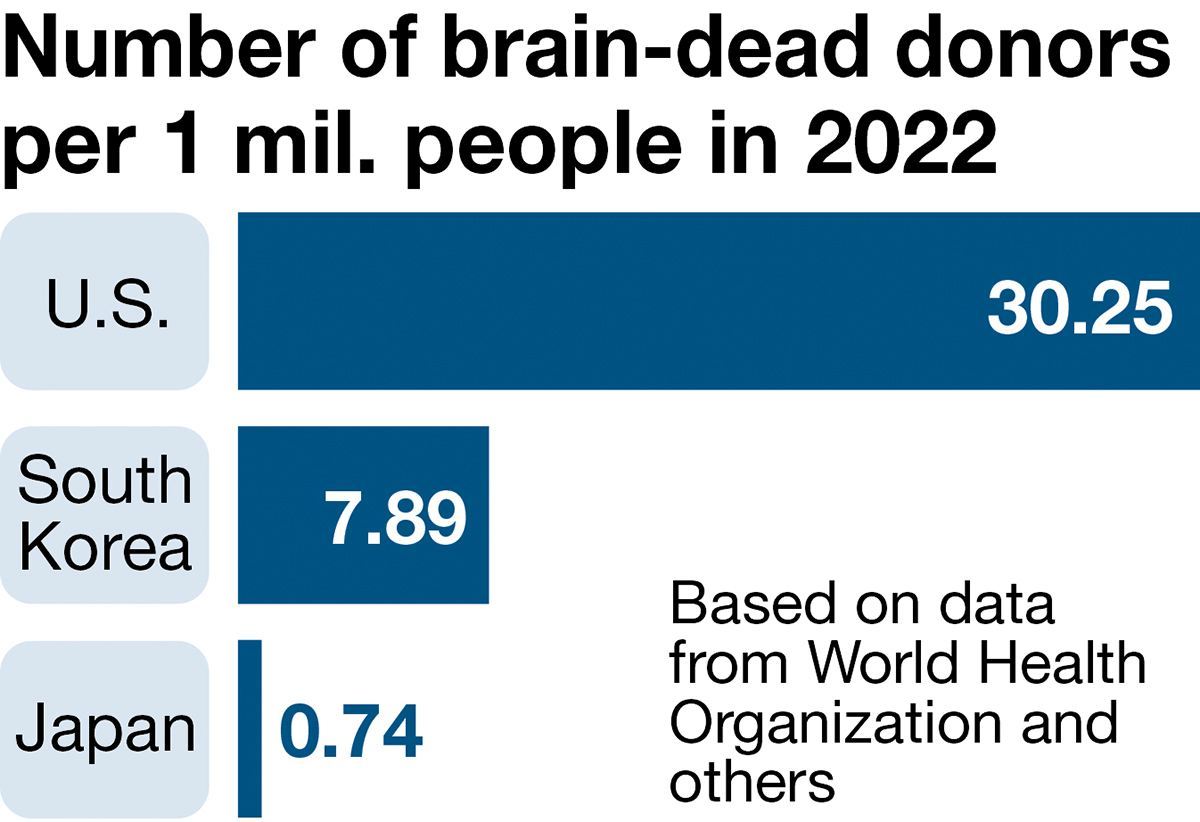
In South Korea, there was a series of news reports on organ donations by celebrities in 2008 and 2009, which led to an increased awareness of organ donation among the citizens. As a result, the number of organ donors in the country increased. Starting in 2011, it was required by law that medical institutions notify KODA of patients who are possibly brain-dead. The per capita rate of brain-dead organ donors in South Korea was 10 times higher than that of Japan in 2022.
In the United States, the per capita brain-dead donor rate is 40 times higher than that of Japan. The brain death reporting system first began 30 years ago in Pennsylvania. In 1994, the state enacted a law to establish the reporting system and an organ donor registry connected to driver’s licenses. This allows state residents to express their intention to donate organs and they can agree to become an organ and tissue donor when they get their driver’s license.
According to the organ donation agency Gift of Life Donor Program in Pennsylvania, there was a 40% increase in the number of organ donors in areas covered by the agency within three years of the law’s implementation. The law became a national model for donor registration and similar systems were introduced across the United States.
Not only does the United States have well-developed systems to allow people to express their intention to donate organs, but transplants are widely accepted in the country. According to a survey conducted in 2020 by the U.S.-based nonprofit organization Research!America, 85% of U.S. respondents supported organ and tissue donation for transplant at death.
There is no similar donor registration system in Japan. Laura Siminoff, a professor at Temple University in the United States specializing in health communication and treatment decision-making with a focus on organ donation and cancer, said to The Yomiuri Shimbun, “Having the option for individuals to join a legally binding government registry, as it is throughout the U.S., would be a key to increasing donations.”
The Uonuma Kikan Hospital is surrounded by rice paddies and mountains in Minami-Uonuma, Niigata Prefecture, a city famous for rice production. From its opening in 2015 to the end of 2023, 20 people at the hospital have been declared brain-dead after being admitted due to subarachnoid hemorrhage, head trauma and other reasons and become organ donors. The per capita rate of brain-dead organ donors in the city over the past two years has been almost the same as in Europe and the United States.
At the hospital, family members of patients who may become brain-dead are in principle, informed of organ donation options soon after the patients are admitted. Seigo Yamaguchi, the head of the hospital’s regional emergency medical care center, said nearly 40% of families consider donating organs of their loved ones after receiving an explanation from the hospital. “Donating organs sometimes helps grieving family members move on. It is important that doctors give them the option without hesitation and carefully listen to the desires of family members,” Yamaguchi said.
The number of medical institutions that actively present organ donation options like Uonuma Kikan Hospital is still relatively low.
In addition, there is no obligation in Japan for medical institutions to report information on patients in a brain-dead state, and it is up to the doctor whether to confirm the patient’s intention to donate organs. The reality is that doctors who are committed to saving lives are reluctant to discuss organ donation with family members.
However, even if the number of organ donors increases thanks to such information reporting system and donor registration system, it is impossible to implement their noble intentions without sufficient organ donation agencies and transplanting facilities. Also, Japanese citizens need to gain a better understanding of the issue.
Japan now stands at a crossroads in developing the country’s transplant medicine.







Most Read
Popular articles in the past 24 hours
-

Voters Using AI to Choose Candidates in Japan's Upcoming General ...
-

Japan's Snow-Clad Beauty: Camellia Flowers Seen in Winter Bloom a...
-
Monkey Strikes Junior High School Girl from Behind in Japan's Yam...
-
Genichiro Inokuma's Mural in Ueno Station That Gave Hope in Postw...
-
Senior Japanese Citizens Return to University to Gain Knowledge, ...
-

Foreign and Security Policy: Political Parties Must Discuss How T...
-

Heavy Snow Linked to 30 Deaths across Japan since Late Jan.; JMA ...
-
Tokyo Police Arrest Head of Resignation Assistance Firm
Popular articles in the past week
-

Japan Institute to Use Domestic Commercial Optical Lattice Clock ...
-
Australian Woman Dies After Mishap on Ski Lift in Nagano Prefectu...
-
Foreign Snowboarder in Serious Condition After Hanging in Midair ...
-

Chinese Embassy in Japan Reiterates Call for Chinese People to Re...
-
Narita Airport, Startup in Japan Demonstrate Machine to Compress ...
-

Toyota Motor Group Firm to Sell Clean Energy Greenhouses for Stra...
-
Sakie Yokota, Last Surviving Parent of a North Korea Abductee, Ur...
-

Beer Yeast Helps Save Labor, Water Use in Growing Rice; Govt Hope...
Popular articles in the past month
-
Univ. in Japan, Tokyo-Based Startup to Develop Satellite for Disa...
-
JAL, ANA Cancel Flights During 3-day Holiday Weekend due to Blizz...
-
China Confirmed to Be Operating Drilling Vessel Near Japan-China ...
-

China Eyes Rare Earth Foothold in Malaysia to Maintain Dominance,...
-
M6.2 Earthquake Hits Japan's Tottori, Shimane Prefectures; No Tsu...
-
Japan Institute to Use Domestic Commercial Optical Lattice Clock ...
-

Japan, Qatar Ministers Agree on Need for Stable Energy Supplies; ...
-

Japan, Italy to Boost LNG Cooperation; Aimed at Diversifying Japa...
Top Articles in Society
-
JAL, ANA Cancel Flights During 3-day Holiday Weekend due to Blizzard
-
Record-Breaking Snow Cripples Public Transport in Hokkaido; 7,000 People Stay Overnight at New Chitose Airport
-
Australian Woman Dies After Mishap on Ski Lift in Nagano Prefecture
-
Foreign Snowboarder in Serious Condition After Hanging in Midair from Chairlift in Nagano Prefecture
-
Train Services in Tokyo Resume Following Power Outage That Suspended Yamanote, Keihin-Tohoku Lines (Update 4)
JN ACCESS RANKING
-
Univ. in Japan, Tokyo-Based Startup to Develop Satellite for Disaster Prevention Measures, Bears
-
JAL, ANA Cancel Flights During 3-day Holiday Weekend due to Blizzard
-
China Confirmed to Be Operating Drilling Vessel Near Japan-China Median Line
-
China Eyes Rare Earth Foothold in Malaysia to Maintain Dominance, Counter Japan, U.S.
-
Japan Institute to Use Domestic Commercial Optical Lattice Clock to Set Japan Standard Time