
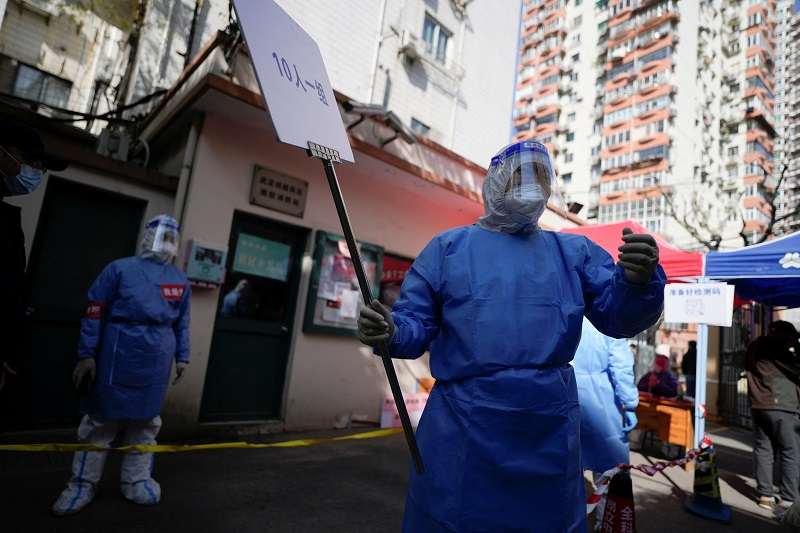
Workers in protective suits direct residents lining up for nucleic acid testing during the second stage of a two-stage lockdown to curb the spread of the coronavirus disease (COVID-19) in Shanghai on April 4.
12:32 JST, April 5, 2022
SHANGHAI (Reuters) – The major Chinese financial centre of Shanghai extended restrictions on transportation on Tuesday after a day of intensive city-wide testing saw new COVID-19 cases surge to more than 13,000, with no end to the lockdown yet in sight.
After originally taking a more piecemeal approach aimed at minimising economic disruptions, Shanghai imposed a two-stage lockdown last week as authorities struggled to contain what had become the city’s biggest ever COVID-19 outbreak.
The lockdown was originally set to end on Tuesday in the city’s western districts, but has now been extended until further notice.
Shanghai reported a record 13,086 new asymptomatic coronavirus cases on April 4, the city government said on its official WeChat channel on Tuesday, up from 8,581 the previous day, after a city-wide surveillance testing programme that saw more than 25 million people swabbed in 24 hours.
Symptomatic cases fell on Monday to 268, from 425 a day earlier. The proportion of official symptomatic infections remains far lower than the rest of the world, which experts have attributed to the city’s proactive screening process.
At least 38,000 personnel have been deployed to Shanghai from other regions in what state media has described as the biggest nationwide medical operation since the shutdown of Wuhan in early 2020.
Authorities announced late on Monday that further restrictions would be placed on the city transportation networks from Tuesday, with more subway lines suspended.
Sun Chunlan, China’s vice-premier in charge of the COVID-19 response, said during an inspection of testing sites in Shanghai on Monday that prevention and control work was now at a “critical point” and it was vital that every resident was tested.
As members of the public continued to express concerns about Shanghai’s draconian measures, sharing videos across social media, Sun urged grassroots Party organisations to “do everything possible” to help residents solve their problems.
Analysts outside China have been warning about the economic costs of the country’s unyielding campaign to curb infections.
“What is most striking in Shanghai is the difficulty that the authorities are having in managing logistics, particularly conditions in centralised quarantine facilities,” said Michael Hirson, China analyst with the Eurasia Group consultancy.
“Given that Shanghai has a highly capable government, current problems pose a warning for local governments across China where capacity is not as high and major outbreaks could stretch resources further to the limits,” he added.
Nationwide, China reported 1,235 confirmed coronavirus cases for April 4, down from 1,405 a day earlier, including 1,173 local transmissions. The number of new asymptomatic cases stood at 15,355, compared with 11,862 a day earlier.








Most Read
Popular articles in the past 24 hours
-

‘King Kazu’ Discusses His Connection to Fukushima
-

JR Tokai Breaks Ground on Yamanashi Maglev Station; Will Be Part ...
-

The Japan News / Weekly Edition (3/13-3/19)
-

White House Takes First Step toward Permanent Fix for Illegal Tar...
-

Honda Expects Up to 690 B. Yen in Net Loss for FY 2025
-
Japan Big Firms’ Biz Sentiment Remains Positive in Jan.-March
-
South Korea, Japan Finance Ministers to Hold Bilateral Meeting on...
-
Raise Interest Rate, Stop Yen’s Fall to Stabilize Prices
Popular articles in the past week
-

Japan Figure Skating Legend Yuzuru Hanyu Is Proud Disaster Surviv...
-

Nippon Life Insurance's U.S. Arm Sues OpenAI Over Legal Assistanc...
-
Govt to Utilize ODA for Ensuring Economic Security; Securing Ener...
-
Massive Sewer Pipe Found Jutting Out of Highway in Osaka
-

Beckoning Cats Get Makeover to Fit Modern Lifestyles with Sleek D...
-
Japan Govt Survey Finds Just 10% of Workers Want Working Hours to...
-

Japan's 2nd Round of U.S. Investments May Be Worth Over $100 Bill...
-
Japan Govt to Tighten Requirements to Receive Permanent Residency...
Popular articles in the past month
-

Producer Behind Pop Group XG Arrested for Cocaine Possession
-

Japan PM Takaichi’s Cabinet Resigns en Masse
-

Man Infected with Measles Reportedly Dined at Restaurant in Tokyo...
-

Videos Plagiarized, Reposted with False Subtitles Claiming ‘Ryuky...
-
Japan Figure Skating Legend Yuzuru Hanyu Is Proud Disaster Surviv...
-

iPS Treatments Pass Key Milestone, but Broader Applications Far f...
-

Sanae Takaichi Elected Prime Minister of Japan; Keeps All Cabinet...
-

Nepal Bus Crash Kills 19 People, Injures 25 Including One Japanes...
Top Articles in News Services
-
Survey Shows False Election Info Perceived as True
-

Japan’s Nikkei Stock Average Falls as US-Iran Tensions Unsettle Investors (UPDATE 1)
-
Japan’s Nikkei Stock Average Rises on Tech Rally and Takaichi’s Spending Hopes (UPDATE 1)
-

Japan to Ban Use of Power Banks on Airplanes
-

North Korea Unveils Image of Kim Jong Un’s Teenage Daughter Firing Rifle
JN ACCESS RANKING
-
Producer Behind Pop Group XG Arrested for Cocaine Possession
-
Japan PM Takaichi’s Cabinet Resigns en Masse
-
Man Infected with Measles Reportedly Dined at Restaurant in Tokyo Station
-
Videos Plagiarized, Reposted with False Subtitles Claiming ‘Ryukyu Belongs to China’; Anti-China False Information Also Posted in Japan
-
Japan Figure Skating Legend Yuzuru Hanyu Is Proud Disaster Survivor and Gold Medalist, Vows to Continue Support Efforts