
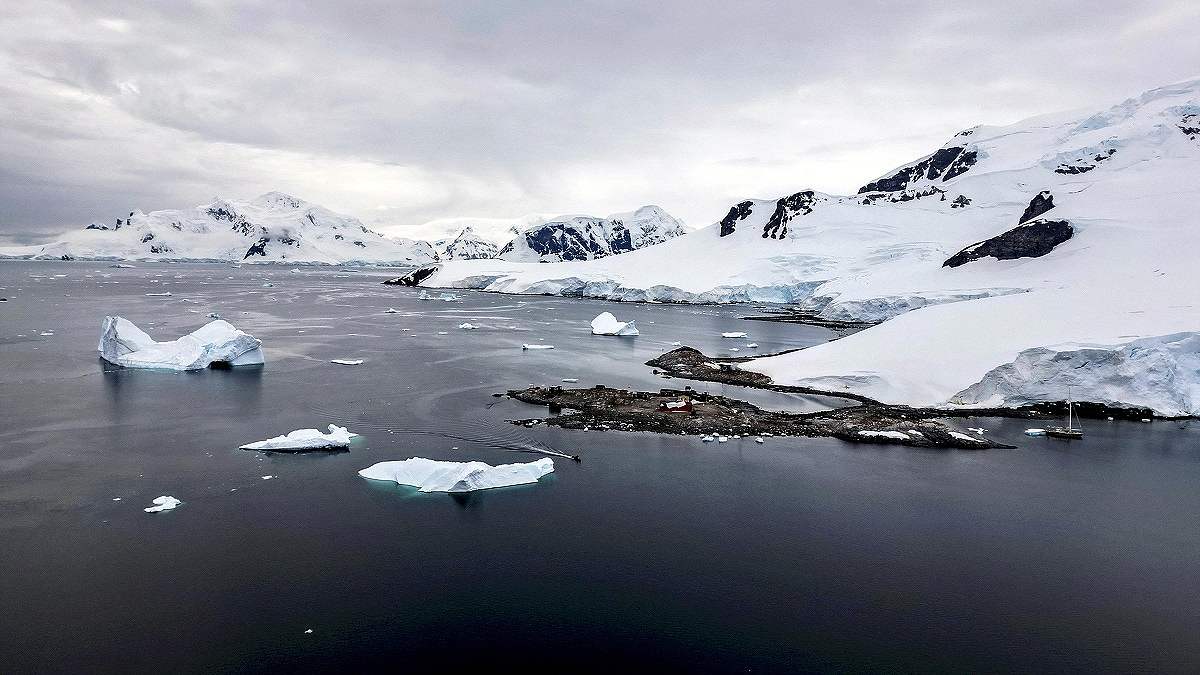
View of the Gerlache Strait
16:23 JST, February 3, 2024
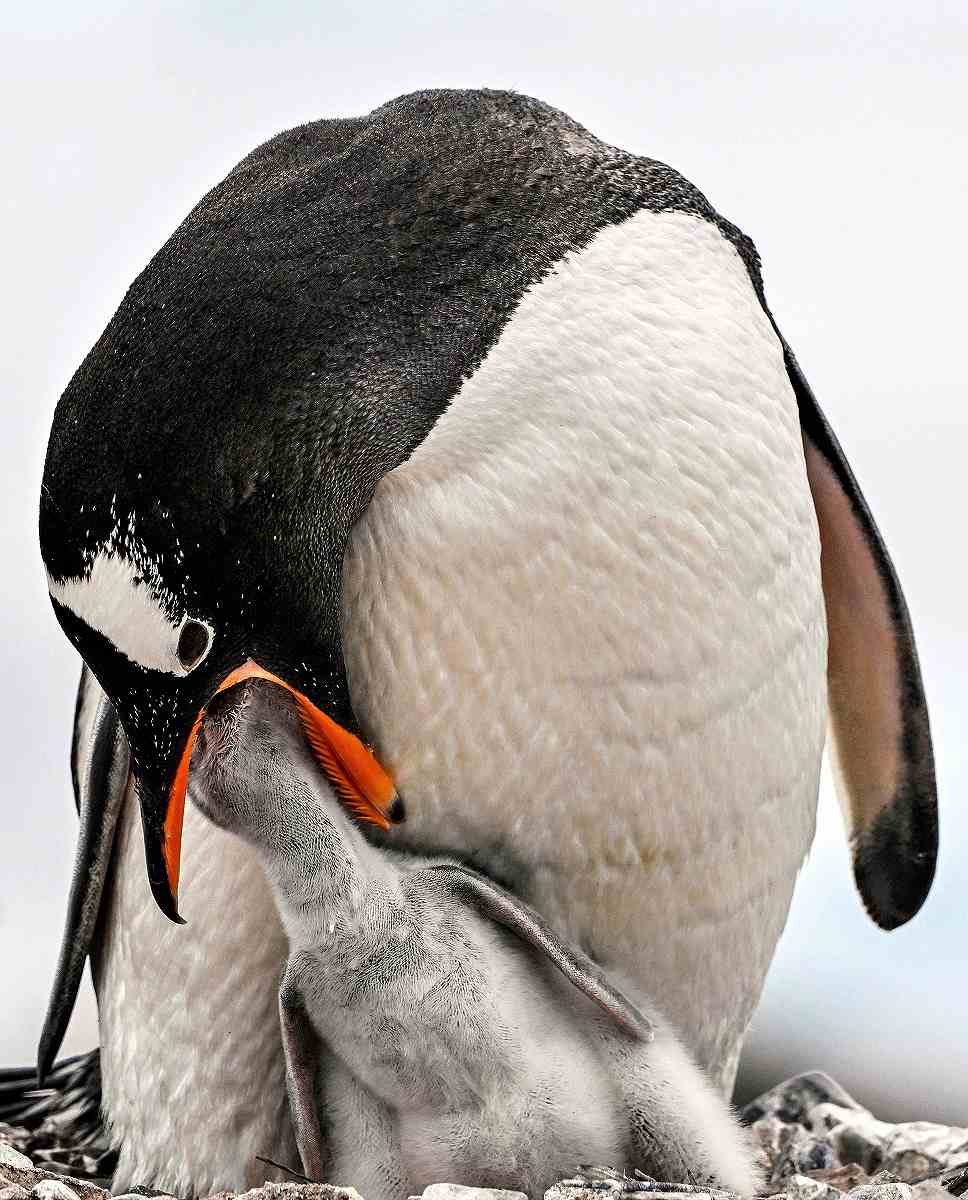
A gentoo penguin with its hatchling is seen at the Paraiso island in the Gerlache Strait, Antarctica. All photos were taken between Jan. 18 and 20.
ABOARD THE ARC SIMON BOLIVAR (AFP-Jiji) — Colombia’s 10th Antarctic Expedition is making its way to the far reaches of the continent, exploring remote and almost untouched places inhabited by penguins, whales and the occasional seal.
The Colombian Navy’s ARC Simon Bolivar is taking aquatic samples in Antarctica and advancing scientific research on climate change amid huge blocks of ice and frost.
“Antarctica is the world’s refrigerator,” Pablo Araujo, a researcher at the Central University of Ecuador, told AFP on board the ship, which is home to 39 researchers, 11 Colombian projects and nine international cooperation projects with four countries.
“What we want to see is how climate change is affecting the world’s refrigerator and how that affects the whole quantity of nutrients [in the sea],” said the white-coated scientist.
On board the ship, the Ecuadoran researcher is carrying out a project to model Antarctic ecosystems using machine learning techniques, a branch of artificial intelligence focused on the study of statistical algorithms.
With the application of these models and the use of satellite images, researchers are studying the dynamics of greenhouse gas fluxes in Antarctic ecosystems.
One Colombian team is launching a battery of Niskin bottles, used to take water samples, into the ocean.
“Once [they] come to the surface, we proceed to take these samples for later analysis,” said Alexis Grattz, a researcher from the Directorate General of Maritime Affairs, wearing a thick red mackintosh, gloves and a hat.
At the Ecuadoran scientific station, located at Punta Fort Williams on Greenwich Island, the maritime authority installed a portable weather station to record atmospheric pressure oscillations in the area.
These measurements are taken to “determine and help us understand more about these variations in sea level, understanding it as … an important indicator in the evolution of climate change,” said Maritza Moreno, another researcher at the Directorate General of Maritime Affairs.
A Turkish mission, meanwhile, is studying the levels of polycyclic aromatic hydrocarbons (PAHs) — which result from burning fossil fuels, wood, trash and tobacco — in Antarctic soil.
Burak Karacik, a professor at Istanbul Technical University, said he is collecting sediment samples.
“I will analyze these sediment samples for persistent organic pollutants, and we will look at the effects of humans, here, in this environment,” he added.

Colombian research vessel ARC Simon Bolivar
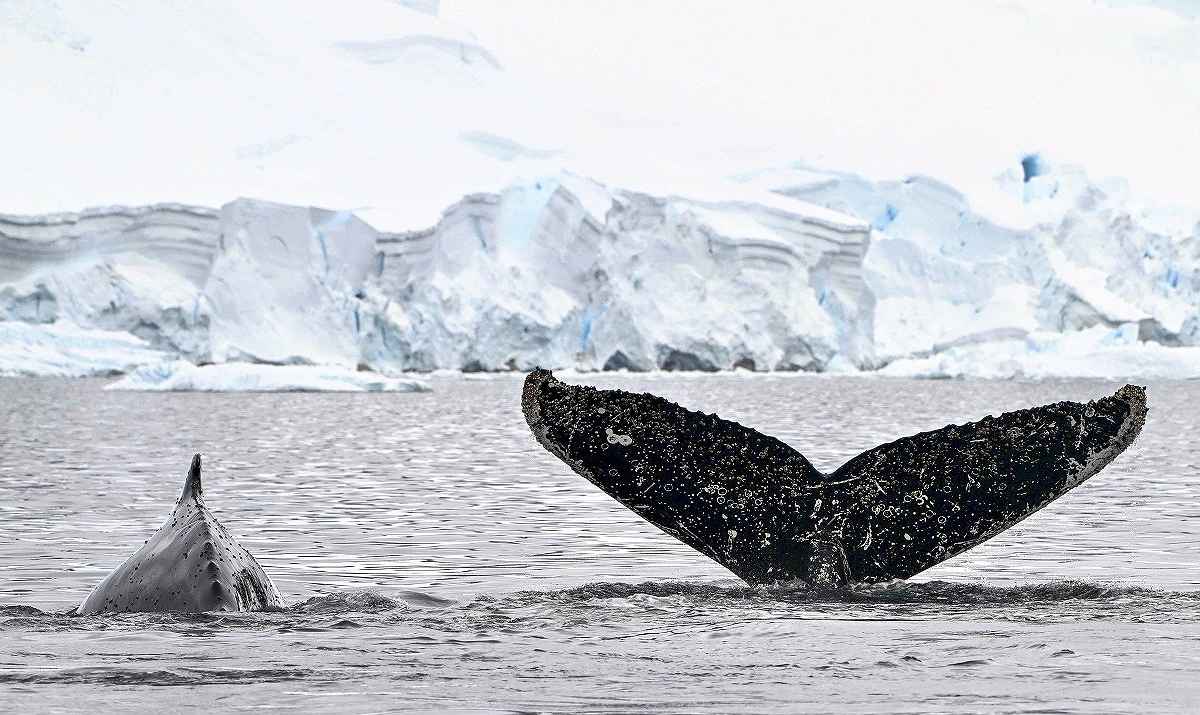
A humpback whale at the Gerlache Strait


Most Read
Popular articles in the past 24 hours
-

3,000 Accounts Posting, Spreading Content Critical of Japan on X;...
-

Milano Cortina 2026: Sakamoto Serves as Flag Bearer; Japan Earns ...
-

My Spendthrift Mother Constantly Asks Me for Money
-
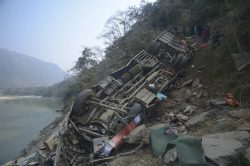
A Packed Bus Plunges off a Nepal Highway, Killing 19 and Injuring...
-

Milano Cortina 2026: There Were Cheers across the Country, after ...
-

Luna Sea Drummer Shinya Dies at 56; Powerful Drummer Behind ‘Desi...
-

Milano Cortina 2026: ‘Magical’ Italian Games Close wi...
-

Milano Cortina 2026: Riku-Ryu Duo Stick Together During Closing C...
Popular articles in the past week
-

Japan PM Takaichi’s Cabinet Resigns en Masse
-

Man Infected with Measles Reportedly Dined at Restaurant in Tokyo...
-

Sanae Takaichi Elected Prime Minister of Japan; Keeps All Cabinet...
-

Japan's Govt to Submit Road Map for Growth Strategy in March, PM ...
-

Bus Carrying 40 Passengers Catches Fire on Chuo Expressway; All E...
-

U.S. Firm to Build Training Hub in Fukushima N-plant for Debris R...
-

Japan, U.S. Name 3 Inaugural Investment Projects; Reached Agreeme...
-

Riku-Ryu Pair Wins Gold Medal: Their Strong Bond Leads to Major C...
Popular articles in the past month
-
Japan PM Takaichi’s Cabinet Resigns en Masse
-

Japan Institute to Use Domestic Commercial Optical Lattice Clock ...
-

Israeli Ambassador to Japan Speaks about Japan’s Role in the Reco...
-
Man Infected with Measles Reportedly Dined at Restaurant in Tokyo...
-

Videos Plagiarized, Reposted with False Subtitles Claiming ‘Ryuky...
-

Man Infected with Measles May Have Come in Contact with Many Peop...
-

Prudential Life Insurance Plans to Fully Compensate for Damages C...
-

Woman with Measles Visited Hospital in Tokyo Multiple Times Befor...
Top Articles in Science & Nature
-
Japan Institute to Use Domestic Commercial Optical Lattice Clock to Set Japan Standard Time
-

iPS Treatments Pass Key Milestone, but Broader Applications Far from Guaranteed
-
Record 700 Startups to Gather at SusHi Tech Tokyo in April; Event Will Center on Themes Like Artificial Intelligence and Robotics
-
iPS Cell Products for Parkinson’s, Heart Disease OK’d for Commercialization by Japan Health Ministry Panel
-
Japan to Ban Use of Power Banks on Airplanes
JN ACCESS RANKING
-
Japan PM Takaichi’s Cabinet Resigns en Masse
-
Japan Institute to Use Domestic Commercial Optical Lattice Clock to Set Japan Standard Time
-
Israeli Ambassador to Japan Speaks about Japan’s Role in the Reconstruction of Gaza
-
Man Infected with Measles Reportedly Dined at Restaurant in Tokyo Station
-
Videos Plagiarized, Reposted with False Subtitles Claiming ‘Ryukyu Belongs to China’; Anti-China False Information Also Posted in Japan