
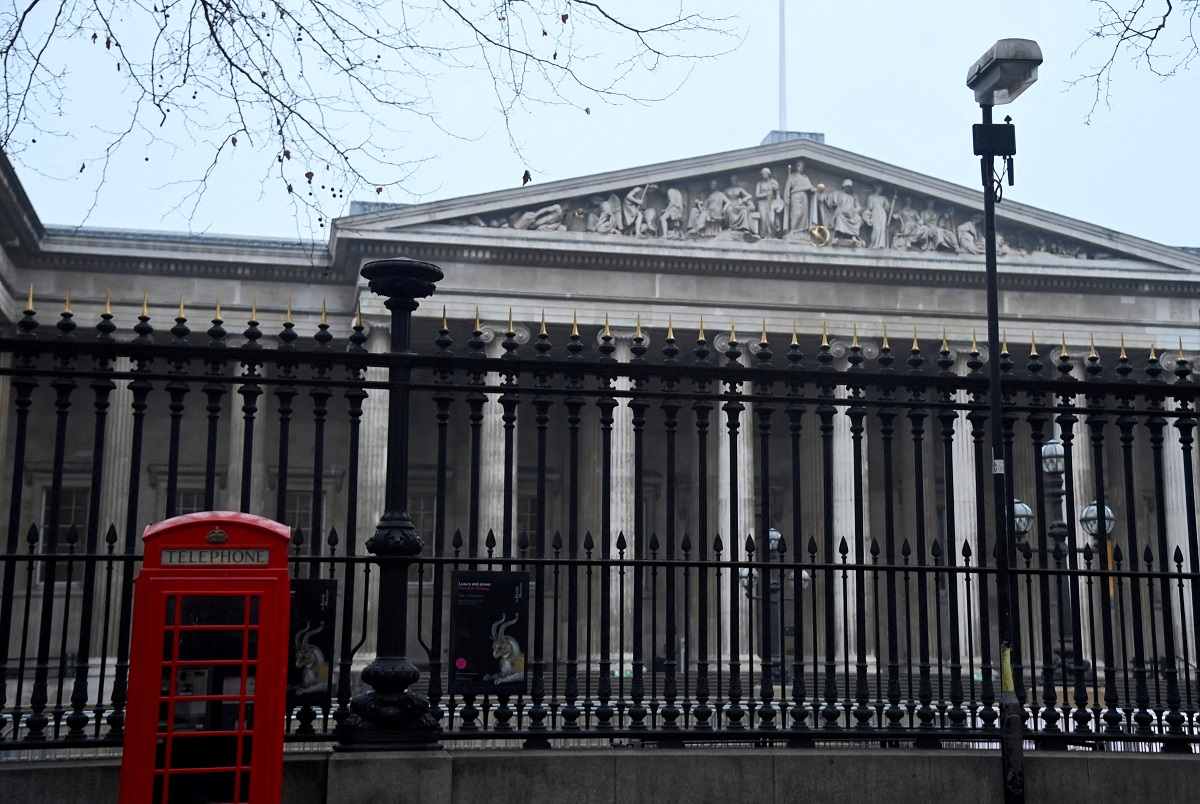
A sign for the British Museum which houses the Parthenon sculptures is seen in London, Britain, January 25, 2023.
16:23 JST, August 17, 2023
The British Museum dismissed an employee after it found that gold jewelry, gems and glass dating back as far as the 15th century BC were missing from a storeroom. In a news release, the museum said it opened an independent review of security and would take legal action against the person, whom they accused of stealing and damaging the items.
“The British Museum has been the victim of theft,” former trustee Nigel Boardman, who is helping lead the independent review of security, said in a statement. “We are absolutely determined to use our review in order to get to the bottom of what happened.”
The museum launched a recovery program to ensure the items are returned, which Boardman described as a “painstaking job, involving internal and external experts” but an “absolute priority – however long it takes.”
The items were all “small pieces kept in a storeroom” of one the museum collections, none of which had recently been on public display, the statement said. The artifacts included gold jewelry and gems of semiprecious stones and glass from between the 15th century BC and 19th century AD, kept primarily for academic and research purposes.
“This is a highly unusual incident,” museum director Hartwig Fischer said in a statement. “But we have now brought an end to this – and we are determined to put things right.”
British Museum Chair George Osborne said in a statement that the trustees learned of the theft earlier this year and that they used “all the disciplinary powers” available on the person believed to be responsible. “It’s a sad day for all who love our British Museum,” he added.
Museum spokesman Connor Watson declined to provide additional details about the identity or role of the alleged thief.
The Metropolitan Police’s Economic Crime Command is also investigating. “We are bound by the police investigation and would not want to prejudice any potential action,” Watson told The Washington Post by email.
Some on social media were quick to identify what they called the irony of the museum taking a stand over the apparent theft of ancient treasures, pointing out that many of the objects in the museum’s collection were looted from other countries during the British imperial era.
The museum acknowledges some of these “contested objects” on its website, including the Benin Bronzes that were plundered by British colonial soldiers in 1897, and the marble Parthenon Sculptures, dating to between 447 BC and 432 BC, that were taken from the Acropolis in Athens.
Pressure has grown for the museum to return the objects, among others, to their home countries.
“‘We will throw our efforts into recovering the stolen goods that we previously stole’ may not be the flex that the national museum spin-doctors think it is,” Dan Hicks, an Oxford professor of contemporary archaeology, wrote on the social media platform, X, previously known as Twitter.







Most Read
Popular articles in the past 24 hours
-

Exhibition Featuring Yoshiharu Tsuge’s Manga World Underway in Ch...
-

Japanese Watermelon Shipments Starts in Leading Production Distri...
-

Tokyo Skytree Observation Deck Remains Closed for Inspection afte...
-

Takeshima Day: Persistently Demanding Resolution from South Korea...
-

Impact on Japanese Economy Unclear with Trump’s New Tariffs, Shif...
-

CARTOON OF THE DAY (February 25)
-

Hanzomon Line Service Suspended between Kudanshita, Oshiage Stati...
-
Hanzomon Line Service Resumes
Popular articles in the past week
-

Producer Behind Pop Group XG Arrested for Cocaine Possession
-

iPS Treatments Pass Key Milestone, but Broader Applications Far f...
-

Japan, U.S. Name 3 Inaugural Investment Projects; Reached Agreeme...
-

Tokyo Skytree's Elevator Stops, Trapping 20 People; All Rescued (...
-

Director Naomi Kawase's New Film Explores Heart Transplants in Ja...
-

Japan’s Major Real Estate Firms Expanding Overseas Businesses to ...
-

Baby Monkey Punch Captures Hearts at Chiba Pref. Zoo, on Social M...
-

Milano Cortina 2026: Japanese Figure Skater Kaori Sakamoto’...
Popular articles in the past month
-
Producer Behind Pop Group XG Arrested for Cocaine Possession
-

Japan PM Takaichi’s Cabinet Resigns en Masse
-

Japan Institute to Use Domestic Commercial Optical Lattice Clock ...
-

Man Infected with Measles Reportedly Dined at Restaurant in Tokyo...
-

Israeli Ambassador to Japan Speaks about Japan’s Role in the Reco...
-

Videos Plagiarized, Reposted with False Subtitles Claiming ‘Ryuky...
-

Man Infected with Measles May Have Come in Contact with Many Peop...
-

Prudential Life Insurance Plans to Fully Compensate for Damages C...
Top Articles in News Services
-

Survey Shows False Election Info Perceived as True
-

Hong Kong Ex-Publisher Jimmy Lai’s Sentence Raises International Outcry as China Defends It
-

Japan’s Nikkei Stock Average Touches 58,000 as Yen, Jgbs Rally on Election Fallout (UPDATE 1)
-
Japan’s Nikkei Stock Average Falls as US-Iran Tensions Unsettle Investors (UPDATE 1)
-

Trump Names Former Federal Reserve Governor Warsh as the Next Fed Chair, Replacing Powell
JN ACCESS RANKING
-
Producer Behind Pop Group XG Arrested for Cocaine Possession
-
Japan PM Takaichi’s Cabinet Resigns en Masse
-
Man Infected with Measles Reportedly Dined at Restaurant in Tokyo Station
-
Israeli Ambassador to Japan Speaks about Japan’s Role in the Reconstruction of Gaza
-
Videos Plagiarized, Reposted with False Subtitles Claiming ‘Ryukyu Belongs to China’; Anti-China False Information Also Posted in Japan