
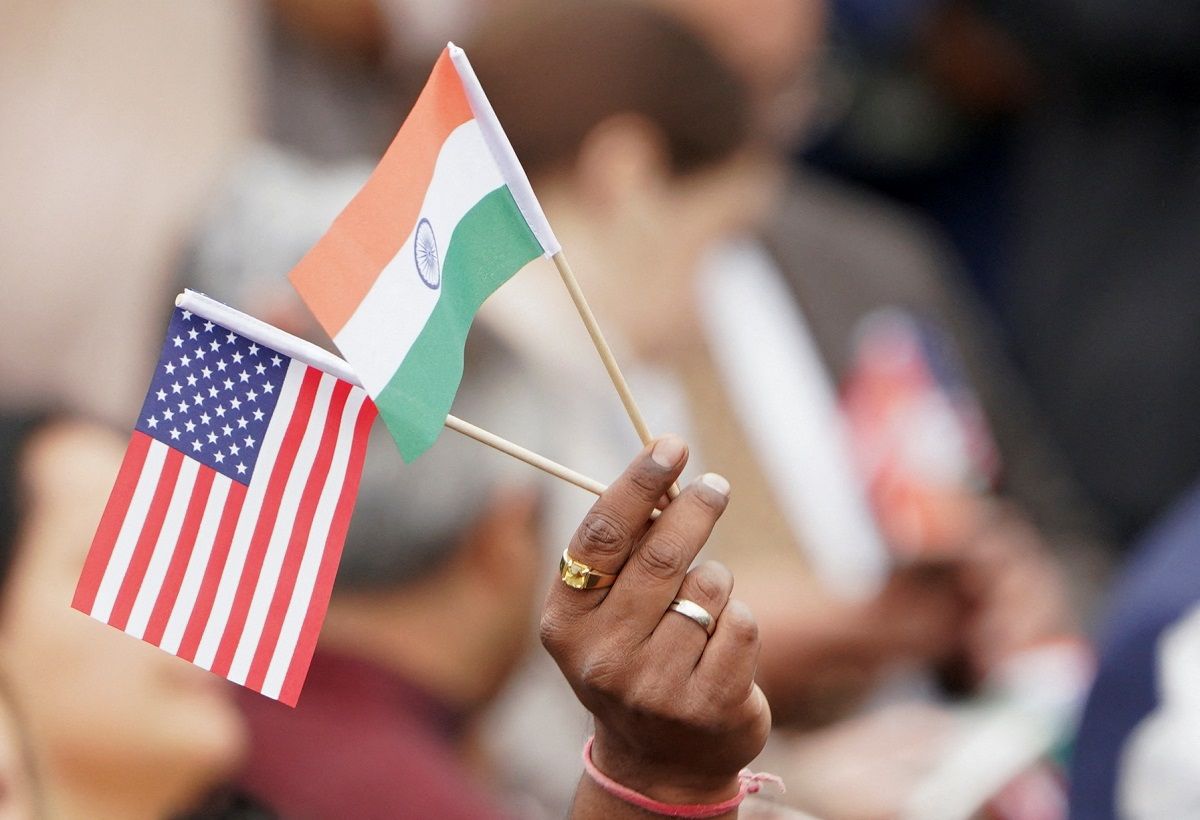
An attendee holds U.S. and India’s flags as they gather on the South Lawn of the White House to watch an official State Arrival ceremony as U.S. President Joe Biden hosts India’s Prime Minister Narendra Modi for a State Visit at the White House in Washington, U.S., June 22, 2023.
16:23 JST, June 29, 2023
WASHINGTON (Reuters) – The United States expects a greater partnership with India in the South China Sea, where China has been at the center of numerous territorial disputes with regional countries, the top U.S. diplomat for East Asia said on Wednesday.
The United States and India declared themselves “among the closest partners in the world” last week during a state visit to Washington by Indian Prime Minister Narendra Modi and emphasized adherence to international law in addressing challenges to the maritime rules-based order, including in the South China Sea.
The U.S. has seen a “clear and upward trend” of Chinese “coercion” in the disputed waters, Daniel Kritenbrink told Washington’s Center for Strategic and International Studies.
Asked whether India would have a growing role in the South China Sea and greater cooperation with the U.S. there, Kritenbrink said “Yes,” adding that there would be greater collaboration among a group of regional powers – the U.S., India, Japan and Australia – known as the Quad.
He said the U.S. focus in the region was on building capacity of allies, partners and friends that share a vision for a peaceful and stable world.
“We will welcome cooperation with any country that embraces that vision. That of course includes India,” Kritenbrink said.
“Large countries should not bully smaller ones,” he added, referring to China’s disputes with other South China Sea claimants.
Tensions are high in contested parts sea, one of the world’s most important trade routes and a conduit for more than $3 trillion of annual ship-borne commerce.
China claims almost the entire sea as its territory and says disputes should be left to countries in the region to settle without outside interference.
The spokesperson for China’s Washington embassy said Beijing’s South China Sea position had a solid historical and legal basis, whereas the U.S. was not a party to the disputes and should not be conducting military operations in the area.
“If the U.S. really cares about the stability of the South China Sea and wants to avoid accidents, I think it needs to stop the reconnaissance operations against China,” Liu Pengyu told a news briefing.
The United States has been seeking to revive direct military-to-military contact with China to avoid misunderstandings that could lead to unintended conflict, but China has resisted this.
Though not a South China Sea claimant, India has in recent years stepped up security ties in the region, signaling its intent to play a bigger role in efforts to counter China.
India’s navy said on Wednesday it was sending an active duty missile corvette to Vietnam as a gift, the first warship it has given to any country.
Kritenbrink referred to “unsafe maneuvers” by Chinese vessels inside Vietnam’s exclusive economic zone last month, particularly in the waters around oil and gas installations.
“(China’s) provocative behavior exacerbates risks for businesses, effectively pushing out competition and paving the way for the PRC to push a joint development deal with its state owned firms,” he said.








Most Read
Popular articles in the past 24 hours
-

Yokohama to Test Out Renewable-Powered Offshore Floating Data Cen...
-

Ishinomaki Man Plush Toy Offers Hope to Children in Times of Disa...
-
Nikkei Tops 59,000 for First Time
-

Microsoft Japan Raided by Antitrust Watchdog for Allegedly Blocki...
-

Japan Eyes Introducing Prescreening System for Foreign Travelers,...
-

Dodgers' Roki Sasaki Erratic in First Spring Training Outing, Giv...
-

Pokémon Celebrates 30 Years with Japanese Pro Baseball Collab
-
New U.S. Tariff Unlikely to Significantly Impact Japan, BOJ Gov. ...
Popular articles in the past week
-

Producer Behind Pop Group XG Arrested for Cocaine Possession
-

iPS Treatments Pass Key Milestone, but Broader Applications Far f...
-

Japan, U.S. Name 3 Inaugural Investment Projects; Reached Agreeme...
-

Tokyo Skytree's Elevator Stops, Trapping 20 People; All Rescued (...
-

Milano Cortina 2026: Japanese Gold Medalist Figure Skater Miura S...
-

Japan’s Major Real Estate Firms Expanding Overseas Businesses to ...
-

Nepal Bus Crash Kills 19 People, Injures 25 Including One Japanes...
-

Baby Monkey Punch Captures Hearts at Chiba Pref. Zoo, on Social M...
Popular articles in the past month
-
Producer Behind Pop Group XG Arrested for Cocaine Possession
-

Japan PM Takaichi’s Cabinet Resigns en Masse
-

Japan Institute to Use Domestic Commercial Optical Lattice Clock ...
-

Man Infected with Measles Reportedly Dined at Restaurant in Tokyo...
-

Israeli Ambassador to Japan Speaks about Japan’s Role in the Reco...
-

Videos Plagiarized, Reposted with False Subtitles Claiming ‘Ryuky...
-

Man Infected with Measles May Have Come in Contact with Many Peop...
-

Prudential Life Insurance Plans to Fully Compensate for Damages C...
Top Articles in News Services
-
Survey Shows False Election Info Perceived as True
-
Hong Kong Ex-Publisher Jimmy Lai’s Sentence Raises International Outcry as China Defends It
-
Japan’s Nikkei Stock Average Touches 58,000 as Yen, Jgbs Rally on Election Fallout (UPDATE 1)
-
Japan’s Nikkei Stock Average Falls as US-Iran Tensions Unsettle Investors (UPDATE 1)
-
Trump Names Former Federal Reserve Governor Warsh as the Next Fed Chair, Replacing Powell
JN ACCESS RANKING
-
Producer Behind Pop Group XG Arrested for Cocaine Possession
-
Japan PM Takaichi’s Cabinet Resigns en Masse
-
Man Infected with Measles Reportedly Dined at Restaurant in Tokyo Station
-
Israeli Ambassador to Japan Speaks about Japan’s Role in the Reconstruction of Gaza
-
Videos Plagiarized, Reposted with False Subtitles Claiming ‘Ryukyu Belongs to China’; Anti-China False Information Also Posted in Japan