
Malaria Infections in Africa a Result of Poverty, Not Geography, International Funding Critical to Preventing Infections
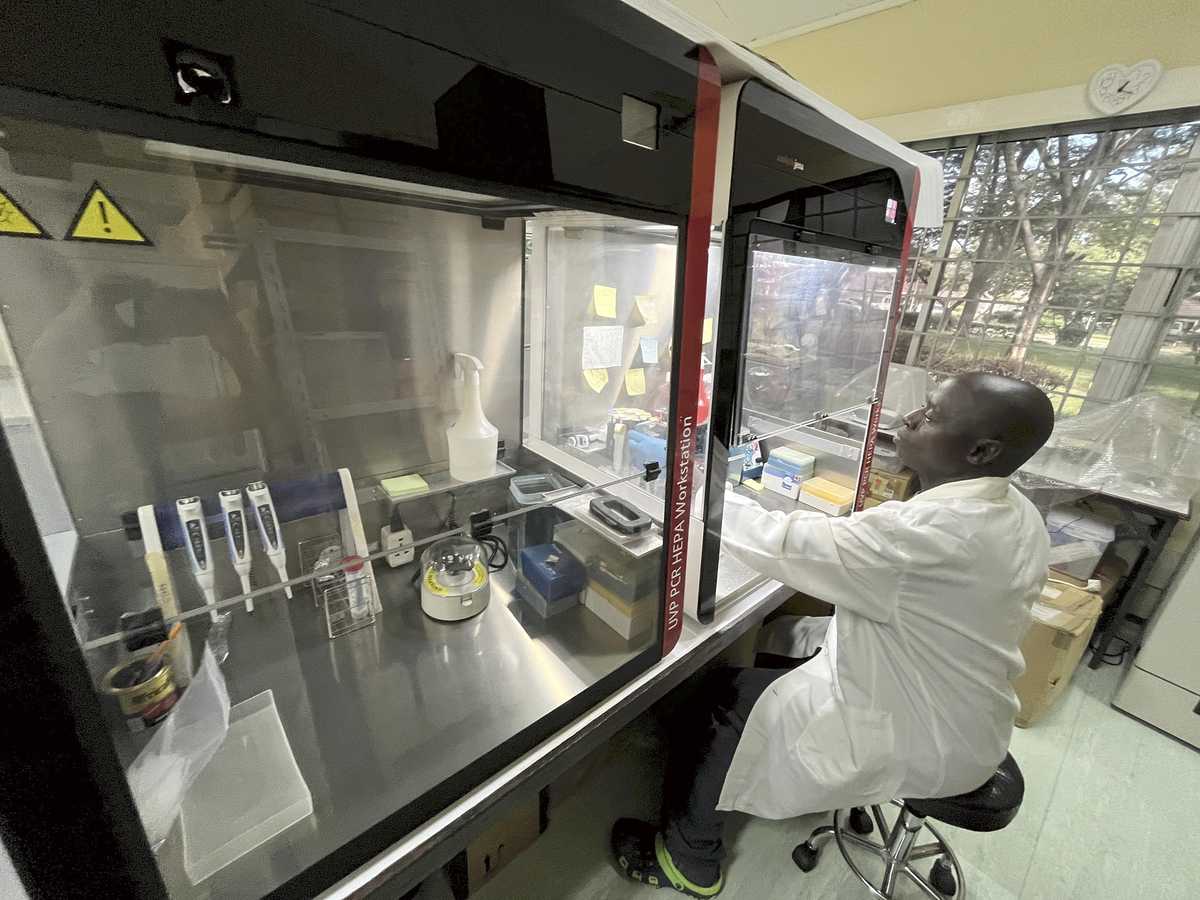
A worker is seen at the Kenya Medical Research Institute in Kisumu, western Kenya, on July 7. The institute is at the forefront of malaria research.
6:00 JST, August 23, 2025
JOHANNESBURG — Malaria is a major obstacle to Africa’s development. The Tokyo International Conference on African Development (TICAD), led by the Japanese government, was held in Yokohama from Aug. 20 to 22 to discuss the continent’s development and what support it needs, including measures to counter malaria. I recently visited the affected region in Africa to examine its challenges.
Living conditions a factor
“Malaria not only kills people, but also eats up our money,” said a 27-year-old farmer on Mfangano Island in Lake Victoria in western Kenya. Their monthly income is about 2,800 Kenyan shillings (about ¥3,200), and in the past the cost of each malaria treatment has ranged from 1,000 to 3,000 Kenyan shillings (about ¥1,100 to ¥3,400). Since their children were infected with malaria almost every month, most of the family’s income was spent on treatment.
One of the causes of infection is the living environment. Mosquitoes that transmit malaria bite people from evening to early morning.
The family’s house, made of earthen walls and a corrugated iron roof, has gaps that allow mosquitoes to enter. The toilet is outdoors, and cooking is done in the yard. The five children sleeping in the living room were constantly exposed.
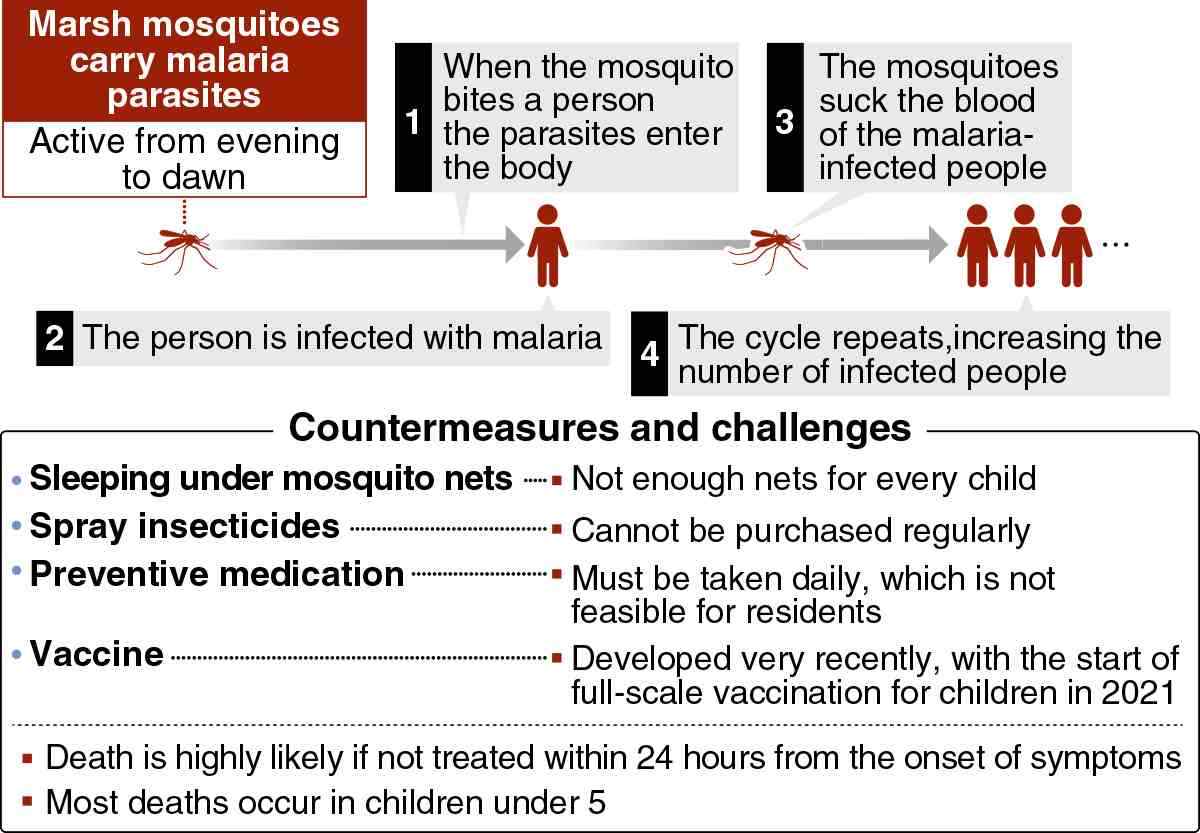
Three years ago, a research team led by Akira Kaneko, a specially appointed professor at Osaka Metropolitan University, installed a mosquito net that completely covers the house. Since then, the family have been infected with malaria less frequently, with only one infection this year.
“When my children get malaria, I can’t work and can’t earn money. Thanks to the mosquito net, our life has improved,” the farmer said.
It is estimated that in 2023, 263 million malaria infections occurred in 83 countries, killing 597,000 people that year. Of those infected worldwide, 94% live in sub-Saharan Africa, where poverty is a grave problem. Malaria infections are closely related to poverty.
Economic conditions key
In Japan, malaria infections spread immediately after the end of World War II. The number of infections decreased with thorough preventive measures and economic growth. In 1962, there were no domestic infections, including in Okinawa Prefecture.
China also had 30 million infections per year in the 1940s, but it achieved no domestic infections by 2021.
In other Asian nations, Singapore and Brunei became infection free in the 1980s, with Sri Lanka and the Maldives following in the 2010s. India, Nepal, Vietnam and Cambodia have also seen a 63% or more reduction compared to 2015.
Living in well-built houses and regularly purchasing mosquito nets and insecticides decrease infections. Prevention is more affected by economic conditions than geographical conditions.
Relying on aid
Malaria control efforts in Africa rely on international aid. Organizations such as the Global Fund to Fight AIDS, Tuberculosis and Malaria contribute 67% (2010-2023 average) of funds for malaria control in the world. About 80% of the funds are allocated to sub-Saharan Africa.
The African Union set a target in 2001 to increase the proportion of government spending on health care to at least 15%, but the average remains at around 7%.
Asian nations that attained zero domestic infections made the achievement by combining international aid with their own efforts.
By contrast, in Africa, when the contracts of local staff hired by aid organizations expire, it means there will be nobody who leads local malaria-related activities.
“There are many things that residents can do on their own as volunteers, such as awareness-raising activities,” a source related to Japanese aid activities suggested.
Multiple factors hinder malaria fight
Researchers are increasingly concerned about mosquitoes that have developed resistance to drugs and insecticides, as well as species adapting to urban environments. In Africa, many countries established their capitals in high-altitude areas to avoid malaria. Nairobi, the capital of Kenya, sits at an elevation of about 1,700 meters. However, Stephen Munga, senior research scientist at the Kenya Medical Research Institute, warns that climate change is altering mosquito behavior.
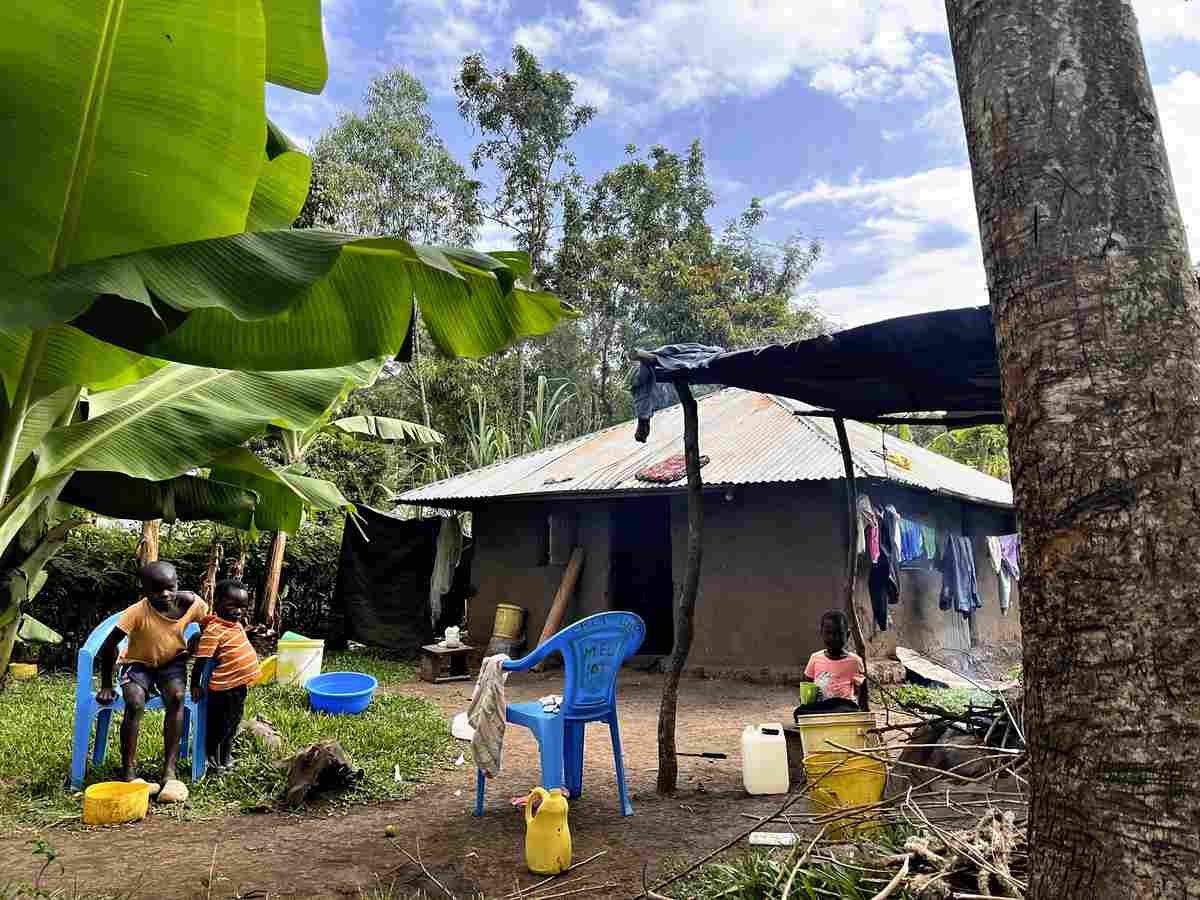
People are seen outdoors on Mfangano Island, western Kenya, on July 6.
Temperature, humidity and rainfall affect mosquito survival, and changes in those factors are creating more environments suitable for the insects to breed. Studies show that global warming is expanding mosquito habitats upward in elevation by about 6.5 meters per year, in addition to spreading the insects’ range both north and south. Munga said that this is a problem that also concerns developed countries.
Selling medical devices
In early July, Japanese medical equipment giant Sysmex Corp. opened its East African regional office in Nairobi. The company is promoting blood measurement devices capable of diagnosing malaria infection in just one minute — a task that used to require several dozen minutes using a microscope. Sysmex plans to expand to a 20-person operation by the end of the year.
By 2049, Africa is projected to account for one quarter of the world’s population. “The number of blood tests is proportional to population size, so Africa’s growing population represents a business opportunity,” said Yuki Hyogu, head of Sysmex’s Africa operations. The global total of direct investment in Africa has been increasing, surpassing $1 trillion (about ¥147.4 trillion) in 2021.
However, for Japanese companies, the number of African business bases rose from 520 in 2010 to 910 in 2019, but has since leveled off. This is because a middle class with purchasing power is not expanding in proportion to population growth.
The United Nations has set a goal of reducing global malaria infections by 90% by 2030 compared to 2015 levels. According to Malaria No More U.K., achieving this could boost Africa’s combined GDP by $126.9 billion (about ¥18.7 trillion). At the previous TICAD conference, Japan pledged up to $1.08 billion (about ¥159 billion) in new contributions to the Global Fund to fight infectious diseases. Mary Muriuki, principal secretary at Kenya’s Health Ministry, called for linking malaria control, which directly contributes to poverty eradication, with initiatives for economic development, education, and resilience to climate change.


Related Tags





Most Read
Popular articles in the past 24 hours
-

Japan Figure Skating Legend Yuzuru Hanyu Is Proud Disaster Surviv...
-

Massive Sewer Pipe Found Jutting Out of Highway in Osaka
-

Japan-U.S. Summit Likely to Focus on Middle East; Takaichi to Fac...
-

Hawaii Museum on Tsunami Including Japan's 2011 Disaster at Risk ...
-

15 Years since Great East Japan Earthquake: How Can Affected Area...
-
Japan Holds Memorial Events to Mark 15th Anniversary of 2011 Eart...
-

Japan’s Nikkei Stock Average Rise Lifted by AI Stocks, Easing Con...
-

Parents in Japan to Get Instagram Notifications When Teens Repeat...
Popular articles in the past week
-

Ibaraki Pref.'s 1st Foreign Bus Driver Hired in Tsukuba
-

Nippon Life Insurance's U.S. Arm Sues OpenAI Over Legal Assistanc...
-
Japan Figure Skating Legend Yuzuru Hanyu Is Proud Disaster Surviv...
-
Govt to Utilize ODA for Ensuring Economic Security; Securing Ener...
-
Amid Strait of Hormuz Blockade, Shipping Companies Scramble to Ge...
-
Massive Sewer Pipe Found Jutting Out of Highway in Osaka
-
Japan Govt Survey Finds Just 10% of Workers Want Working Hours to...
-

Beckoning Cats Get Makeover to Fit Modern Lifestyles with Sleek D...
Popular articles in the past month
-

Producer Behind Pop Group XG Arrested for Cocaine Possession
-

Japan PM Takaichi’s Cabinet Resigns en Masse
-

Man Infected with Measles Reportedly Dined at Restaurant in Tokyo...
-

Videos Plagiarized, Reposted with False Subtitles Claiming ‘Ryuky...
-

iPS Treatments Pass Key Milestone, but Broader Applications Far f...
-

Sanae Takaichi Elected Prime Minister of Japan; Keeps All Cabinet...
-

Nepal Bus Crash Kills 19 People, Injures 25 Including One Japanes...
-

South Korea Tightens Rules on Foreigners Buying Homes in Seoul Me...
Top Articles in World
-
Videos Plagiarized, Reposted with False Subtitles Claiming ‘Ryukyu Belongs to China’; Anti-China False Information Also Posted in Japan
-
Nepal Bus Crash Kills 19 People, Injures 25 Including One Japanese National
-
South Korea Tightens Rules on Foreigners Buying Homes in Seoul Metro Area
-
Govt to Utilize ODA for Ensuring Economic Security; Securing Energy, Critical Minerals Sought
-

Ukrainian Ambassador Closely Watching Japan’s Revision of Defense Export Rules, Hopes for Future Arms Support
JN ACCESS RANKING
-
Producer Behind Pop Group XG Arrested for Cocaine Possession
-
Japan PM Takaichi’s Cabinet Resigns en Masse
-
Man Infected with Measles Reportedly Dined at Restaurant in Tokyo Station
-
Videos Plagiarized, Reposted with False Subtitles Claiming ‘Ryukyu Belongs to China’; Anti-China False Information Also Posted in Japan
-
iPS Treatments Pass Key Milestone, but Broader Applications Far from Guaranteed