
11:38 JST, November 15, 2025
The Association of Southeast Asian Nations, which was established as an anti-communist alliance during the Cold War, is undergoing a shift in its unity and cohesion due to China’s growing influence and the multipolarity of power in the world.
Member states are strengthening their “two-wheel” strategies of using both independent diplomacy and cooperation within ASEAN.
However, such a strategy could be a double-edged sword as it affects the bloc’s cohesion.
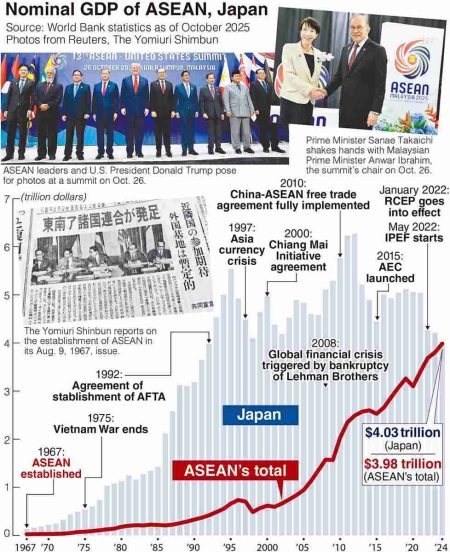
At the ASEAN summit held in Kuala Lumpur in late October, East Timor was approved as the 11th member of the group, the first new entrant in 26 years. When the bloc consisted of 10 members, their total gross domestic product began escalating in the 2000s, when trade liberalization began to take hold, and grew at an even faster pace in the 2010s. ASEAN’s total GDP was expected to nearly equal that of Japan by 2024 and is expected to overtake it within 2025.
The history of ASEAN can be divided into five phases. The first phase lasted until the 1980s, a time marked by confrontation between superpowers during the Cold War and developmental dictatorships in member countries.
The region was unstable, particularly due to the Vietnam War and the genocide in Cambodia. After gaining independence, respective member states had strong leaders, such as Indonesia’s former President Suharto and Singapore’s former Prime Minister Lee Kuan Yew, and they pursued developmental dictatorships in which they employed authoritarian methods while attracting aid and investment from Japan and the West.
The second phase is the 1990s following the end of the Cold War, when ASEAN expanded and began to seek free trade.
Vietnam, Laos, Myanmar and Cambodia, which had once confronted each other, joined ASEAN, bringing the total number of member states to 10. The bloc created the ASEAN Free Trade Area (AFTA) out of fear that the association might have a weaker presence amid the expansion of Western free trade zones.
The third phase is the 2000s, when ASEAN sought market integration with countries outside the bloc. Singapore’s former Prime Minister Goh Chok Tong and Thailand’s former Prime Minister Thaksin Shinawatra strongly promoted ASEAN’s free trade agreements with Japan, China and other countries. The two leaders also worked to set the clear goal of launching the ASEAN Economic Community.
The trend toward free trade gained momentum in the 2010s, when massive integrated markets were created. This is the fourth phase for ASEAN, which saw the emergence of mega FTAs such as the Trans-Pacific Partnership and the Regional Comprehensive Economic Partnership.
China’s influence
This fourth phase is also when China’s influence expanded. This was clearly seen at the ASEAN foreign ministers’ meeting held in Phnom Penh in July 2012.
While a joint statement was yet to be released, the news came out at night that the Philippine delegation had left to return to their country. This was because the Philippines and Vietnam — both of which were at odds with China over South China Sea issues — had failed to agree with Cambodia — a pro-China country and the host of the meeting — over the wording of the joint statement.
ASEAN was thrown into an unexpected situation in which it failed to issue a joint statement for the first time, which highlighted the rifts among the member states.
What has happened in Myanmar following the coup d’etat has also exposed the limitations of ASEAN’s response. While Malaysia and Singapore are among the members critical of Myanmar’s military regime, Thailand, Cambodia and Laos are seen as not critical of the situation. Even though ASEAN has urged Myanmar to stop repressing its people, its military regime has ignored the call, as it is more concerned about relations with China.
Eyes beyond bloc
Until the phase of the creation of huge integrated markets, ASEAN had basically worked as a unit of 10 members. Since around 2015, however, some countries have pursued FTAs with countries outside ASEAN or sought membership in other organizations outside the bloc. This new trend can be defined as the fifth phase for ASEAN.
Indonesia, Thailand, Malaysia, Vietnam and the Philippines have been following Singapore in terms of concluding or seeking to conclude FTAs with countries outside ASEAN. Vietnam has signed an FTA with the European Union on its own, boosting its capabilities to attract foreign investment and enhance exports.
In January, Indonesia joined the BRICS group led by China, Russia, India and Brazil, while Vietnam, Malaysia and Thailand are waiting for approval to become partner countries in that bloc. These countries have joined or have been seeking to join BRICS apparently not in a bid to strengthen relations with China and Russia, but to build closer economic relationships with emerging countries for their growing markets.
Indonesia and Thailand are now in the process of joining the Organization for Economic Cooperation and Development.
ASEAN members have been seeking independent diplomacy as they believe that they should act swiftly on their own because the global economy is undergoing rapid changes while it takes time for their bloc to make its decisions. However, it may be the stronger this tendency becomes, the less united and competitive ASEAN will be.
The members tend to be inward-looking when it comes to politics. As ASEAN member countries today do not have strong leaders who are capable of outlining a future vision for the entire region like the group had at the time of its foundation, the bloc is embarking on a new phase.
***
U.S., China take different approaches
The United States and China are taking different approaches toward ASEAN.
While the Chinese side has been leveraging a variety of tools to increase its clout over ASEAN, the United States has lacked consistency in its stance across different administrations.
In the early 2000s, China began its southward advancement based on three pillars: the economy, diplomacy and security.
Beijing made progress in the region each year since 2001: reaching an agreement to sign an FTA; concluding a declaration on a code of conduct aimed at preventing conflicts in the South China Sea; and signing the Treaty of Amity and Cooperation in Southeast Asia, a mutual nonaggression treaty. Thus, China has framed itself as a “good neighbor” to deepen its ties with ASEAN member countries.
Beijing has used the FTA with the bloc and its Belt and Road Initiative to enhance its sphere of influence. At the ASEAN summit in October, Beijing revised the agreement to include stipulations regarding the digital economy and supply chains, based on changes in the global economy.
In the geopolitical realm, China has been enthusiastic in its attempts to win over Myanmar, through which it has access to the Indian Ocean. With regard to the Philippines and Vietnam, in contrast, Beijing has refused to give an inch when it comes to disputes in the South China Sea.
Meanwhile, the administration of U.S. President Donald Trump showed little interest in ASEAN in his first term, drawing distrust from member countries.
The succeeding administration of President Joe Biden showed its focus on ASEAN through such actions as establishing the Indo-Pacific Economic Framework for Prosperity.
In his second term as president, Trump attended the October summit, saying, “The United States is with you 100%.”
The United States has signed trade accords or memorandums with Vietnam, Malaysia and two other ASEAN countries. However, as these bilateral deals prioritize U.S. interests, such as demanding the opening of Southeast Asian countries’ markets, a close watch must be kept to determine Washington’s future commitment to ASEAN as a whole.
According to a survey by the ISEAS-Yusof Ishak Institute in Singapore, this year, Japan ranked as the “most trusted” world power by people in ASEAN member countries for the seventh consecutive year, well ahead of the European Union, the United States and China.
Japan should leverage its trust in the region to encourage the United States to turn its focus on ASEAN, as well as to help maintain a balance between the United States and China.
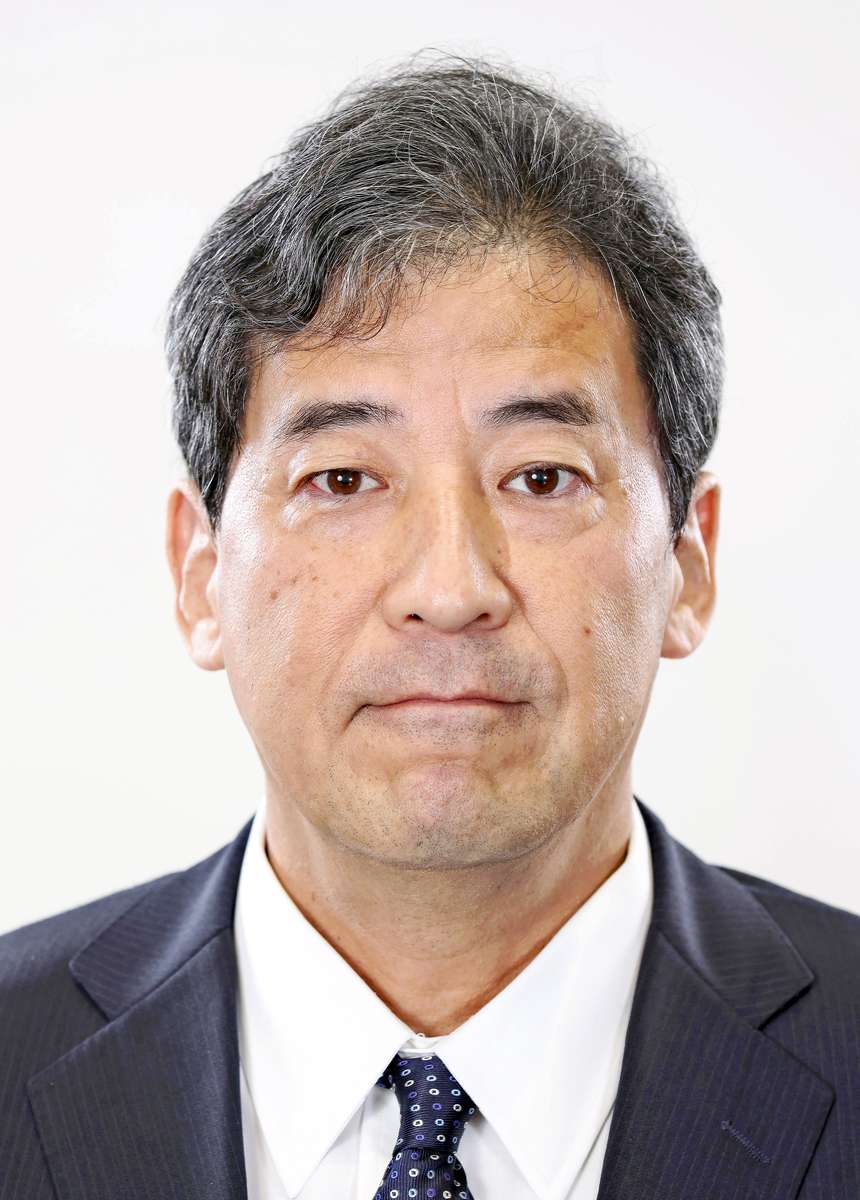
Junichi Fukasawa
Yomiuri Shimbun Director and Senior Writer


Most Read
Popular articles in the past 24 hours
-

Japanese Shipping Giants Halt Strait of Hormuz Transit as Iran Co...
-

U.S. Launches Attacks on Iran: Avoid Escalation of Conflict by An...
-
Sawtooth Roof Factory Stands as Monument to Ashikaga Textile Hist...
-
Parents of Japanese Teen Shot in U.S. Strive for Gun Control
-

Rental Lab Space in Tokyo Area More Than Doubles Since 2010, Offe...
-

Disinformation Spreads About Team Mirai, Ballot Readers; Online P...
-
Asahi Breweries to Stage Comeback with New Product in April; Comp...
-
Bank of Japan Deputy Governor Says Rate Hikes Likely to Continue
Popular articles in the past week
-

Nepal Bus Crash Kills 19 People, Injures 25 Including One Japanes...
-
Milano Cortina 2026: Japanese Gold Medalist Figure Skater Miura S...
-
Tokyo Spends Big on Children, Wins Over Parents
-

McDonald's Japan Raises Prices; Big Mac to Cost ¥500, Double Chee...
-
Japan’s Miura, Kihara Announce Withdrawal from Figure Skating Wor...
-

‘Dry Bonsai’ Gives New Life to Withered Trees, Allows Free Artist...
-

Exhibition Featuring Yoshiharu Tsuge’s Manga World Underway in Ch...
-

Yokohama to Test Out Renewable-Powered Offshore Floating Data Cen...
Popular articles in the past month
-

Producer Behind Pop Group XG Arrested for Cocaine Possession
-

Japan PM Takaichi’s Cabinet Resigns en Masse
-

Man Infected with Measles Reportedly Dined at Restaurant in Tokyo...
-

Israeli Ambassador to Japan Speaks about Japan’s Role in the Reco...
-

Videos Plagiarized, Reposted with False Subtitles Claiming ‘Ryuky...
-

Man Infected with Measles May Have Come in Contact with Many Peop...
-

Prudential Life Insurance Plans to Fully Compensate for Damages C...
-

Woman with Measles Visited Hospital in Tokyo Multiple Times Befor...
Top Articles in Editorial & Columns
-

Riku-Ryu Pair Wins Gold Medal: Their Strong Bond Leads to Major Comeback Victory
-
Reciprocal Tariffs Ruled Illegal: Judiciary Would Not Tolerate President’s High-Handed Approach
-
China Provoked Takaichi into Risky Move of Dissolving House of Representatives, But It’s a Gamble She Just Might Win
-
Japan’s Plan for Investment in U.S.: Aim for Mutual Development by Ensuring Profitability
-
Flu Cases Surging Again: Infection Can Also Be Prevented by Humidifying Indoor Spaces
JN ACCESS RANKING
-
Producer Behind Pop Group XG Arrested for Cocaine Possession
-
Japan PM Takaichi’s Cabinet Resigns en Masse
-
Man Infected with Measles Reportedly Dined at Restaurant in Tokyo Station
-
Israeli Ambassador to Japan Speaks about Japan’s Role in the Reconstruction of Gaza
-
Videos Plagiarized, Reposted with False Subtitles Claiming ‘Ryukyu Belongs to China’; Anti-China False Information Also Posted in Japan