
Sumo Scene / For Rikishi Fighting Solitary Battles, Mothers Are Often Their Greatest Supporters
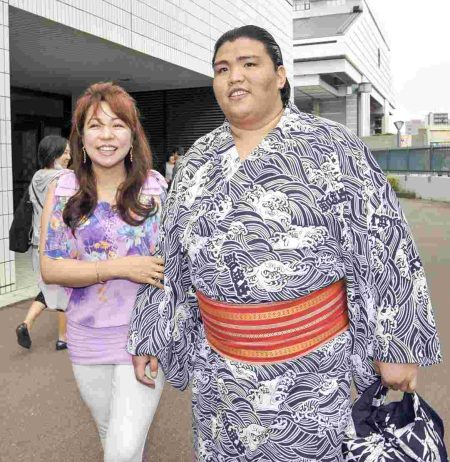
Margarita Omichi, left, walks beside her son Mitakeumi when he was in the third-tier makushita division in May 2015.
11:14 JST, October 15, 2025
For sumo wrestlers who step into the ring to fight solitary battles, the presence of family must be an irreplaceable source of comfort. Often, the attachment of wrestlers to their mothers seems to be particularly strong.
Many wrestlers who dedicate themselves to sumo from a young age receive strict guidance from their fathers. Perhaps this is why mothers, taking the opposite role, tend to be gentler with their sons.
Before the recent Autumn Grand Tournament, former ozeki and now top-tier makuuchi wrestler Mitakeumi lost his mother, who was only 55. Margarita Omichi had frequented the Ryogoku Kokugikan since his very first day as a trainee and cheered him on passionately.
The sudden loss of his beloved mother must have been a profound shock. Just before the start of the tourney, Mitakeumi rushed back to his hometown in Agematsu, Nagano Prefecture, to bid a final farewell before returning to Tokyo.
Three years ago, in January 2022, when Mitakeumi was promoted to ozeki, Margarita watched her son’s proud appearance at the ceremony for promotion held at the Dewanoumi Stable in Tokyo. She expressed her heartfelt joy, saying, “I’ll keep praying you don’t get injured.”
Throughout the Autumn tourney, Mitakeumi refrained from answering questions about his mother, desperately focusing on his tasks in the ring. Of course, his heart must have been overflowing with gratitude for the mother who raised him so well.
Former komusubi Takamisakari — now sumo elder and coach Azumazeki — was also particularly close to his mother. Affectionately nicknamed “RoboCop” for his robotic prematch routine, he grew up as the third son of an apple farmer. His mother, Hisako Kato, used to watch her somewhat clumsy son with a worried expression.
Referring to Takamisakari’s unusual prematch routine, which he used to pump himself up, Hisako said he did this because, “My boy can be nervous at times.” His mother was his greatest supporter and also eased his loneliness in the dohyo.
Sumo is a symbol of a man’s world. Yet, the power provided by women — not just mothers, but wives and daughters, too — is immense.
— Kamimura is a sumo expert.





Most Read
Popular articles in the past 24 hours
-
Japanese High School Student Aims to Share Kaiten History Through...
-
PM Takaichi Spells out Plans to Advance Bold Policy Shifts in Spe...
-
Chronic Issues Erode Thailand’s Economy as Political Confusion Pe...
-
Tottori: 95-Year-Old Japanese Descendent from Philippines Visits ...
-

Japan to Monitor Trump Administration's Response to U.S. Supreme ...
-
Milano Cortina 2026: Speed Skater Takagi Finishes 6th in the 1,50...
-
Osaka: 40 Ninjas Display Shuriken Throwing Skills at Japan Champi...
-

Miyazaki: Japanese Woman Walks in Footsteps of Samurai Ancestor W...
Popular articles in the past week
-

Japan PM Takaichi’s Cabinet Resigns en Masse
-

Man Infected with Measles Reportedly Dined at Restaurant in Tokyo...
-

Sanae Takaichi Elected Prime Minister of Japan; Keeps All Cabinet...
-

Japan's Govt to Submit Road Map for Growth Strategy in March, PM ...
-

Bus Carrying 40 Passengers Catches Fire on Chuo Expressway; All E...
-

Milano Cortina 2026: Figure Skaters Riku Miura, Ryuichi Kihara Pa...
-

Japan, U.S. Name 3 Inaugural Investment Projects; Reached Agreeme...
-

U.S. Firm to Build Training Hub in Fukushima N-plant for Debris R...
Popular articles in the past month
-
Japan PM Takaichi’s Cabinet Resigns en Masse
-

Japan Institute to Use Domestic Commercial Optical Lattice Clock ...
-

Israeli Ambassador to Japan Speaks about Japan’s Role in the Reco...
-
Man Infected with Measles Reportedly Dined at Restaurant in Tokyo...
-

Videos Plagiarized, Reposted with False Subtitles Claiming ‘Ryuky...
-

Man Infected with Measles May Have Come in Contact with Many Peop...
-

Prudential Life Insurance Plans to Fully Compensate for Damages C...
-

Woman with Measles Visited Hospital in Tokyo Multiple Times Befor...
Top Articles in Sports
-
Aonishiki Tops Atamifuji in Playoff to Win New Year Grand Sumo Tournament in Ozeki Debut
-
Milano Cortina 2026: Figure Skaters Riku Miura, Ryuichi Kihara Pair Win Gold; Dramatic Comeback from 5th Place in SP
-

Milano Cortina 2026: Kokomo Murase Comes Out on Top After Overcoming Obstacles, Aiming for Greater Heights in Competition
-
Milano Cortina 2026: Riku Miura, Ryuichi Kihara Clinch Japan’s 1st Gold in Pairs Figure Skating, Rebounding from Disappointing Short Program
-

Milano Cortina 2026: Olympics-Torch Arrives in Co-Host Cortina on Anniversary of 1956 Games
JN ACCESS RANKING
-
Japan PM Takaichi’s Cabinet Resigns en Masse
-
Japan Institute to Use Domestic Commercial Optical Lattice Clock to Set Japan Standard Time
-
Israeli Ambassador to Japan Speaks about Japan’s Role in the Reconstruction of Gaza
-
Man Infected with Measles Reportedly Dined at Restaurant in Tokyo Station
-
Videos Plagiarized, Reposted with False Subtitles Claiming ‘Ryukyu Belongs to China’; Anti-China False Information Also Posted in Japan