
Inclusive Society / Japanese, Foreign Residents in Housing Complexes Build Trust; Multilingual Support, Outreach Helps Fonn Cross-cultural Bonds
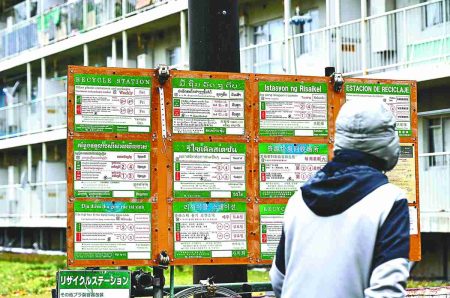
Multilingual notices are displayed where recycling is placed in Icho Danchi housing complex in Yamato, Kanagawa Prefecture.
7:00 JST, January 15, 2026
This is the fifth installment in a series of articles on coexistence with foreign residents and visitors.
***
Seventy-six buildings line both shores of a river in Kanagawa Prefecture, like huge walls. A store selling nam-pla, glass noodles and other Asian foods stands on the corner of one street, while the smell of aromatic herbs emanate from a Vietnamese restaurant.
The buildings, part of the prefectural government-run Icho Danchi housing complex, straddle Yamato and Yokohama.
The complex comprises about 3,600 units. As of April last year, about 20% of the 2,824 households living there were foreign residents.
Just after the end of the Vietnam War in 1975, many refugees from Indochina came to Japan.
In 1980, the government opened a resettlement promotion center offering Japanese language education and other services near the housing complex in Yamato. As a result, many of the refugees moved into the nearby complex.
In 1990, a revision was made to the Immigration Control and Refugee Recognition Law, enabling people in other countries who descend from Japanese, up to the third generation, to work in Japan. The revision led to the housing complex seeing an increase in foreign nationals from Central and South American countries.
“There was trouble caused by differences in dietary cultures and living habitats,” recalled Takeo Endo, 84, head of a federation of residents’ associations on the Yamato side.
Some foreign residents used to dry raw meat on their porches, ate together outdoors and did not sort their garbage, so the federation frequently received complaints.
Members of the federation put up multilingual posters displaying garbage collection dates, taught the foreign residents how to cook miso soup and had them carry mikoshi portable shrines in local festivals.
Teruya Katyhusca, a 51-year-old resident from Bolivia, found life hard when she first came to Japan due to the language barrier. She said she deepened ties with the Japanese residents by serving them dishes from her home country.
“I formed good relationships with them because they reached out to me,” she said.
In December, children from foreign households participated in an event where they enjoyed lunch and activities with Japanese residents.
“This is the result of our long-term efforts to build trustful relationships,” Endo said.
About half of the residents at the housing complexes are 65 or older, so the federation has come to a turning point.
Endo is thinking to resign from his post in the federation in spring next year.
“Building relationships in which residents can see each other’s faces is important for mutually helping each other in the event of a disaster,” he said. “I hope the relationships we’ve built can be passed on to future generations, regardless of their nationalities.”
According to the 2020 national census, about 84,000 foreign households reside in danchi housing complexes or similar facilities run by the local government or the Urban Renaissance Agency (UR), an incorporated administrative agency. Over the past decade, the number of foreign households in the complexes has increased by about 11,000.
One of the reasons foreigners favor danchi housing complexes run by the UR is thought to be that it does not require guarantors or non-refundable “key money.”
Many Vietnamese live in the Otokoyama Danchi housing complex in Yawata, Kyoto Prefecture. The complex, which is run by the UR, comprises about 4,500 house units.
Otokoyama Danchi was built in the 1970s, and many people with children used to live there partly because of its easy access to Osaka and Kyoto. As its residents aged, however, vacant units increased.
With more Vietnamese working in food-processing and manufacturing industries, the UR has rented units in the complex to companies to use as dormitories for their employees. As a result, the occupancy rate has stayed at around 90%.
Trouble with noise and other issues have occurred at the complex, prompting the city government and residents’ associations to make pamphlets detailing the rules and previous cases of violations.
“Barriers have been disappearing little by little,” said Mitsuo Adachi, 79, who runs a Japanese language school near the housing complex. “It’d be good if [foreign residents] could fit in to our community after attending my language school.”
Nguyen Thuc Duyen, 34, had lived in Otokoyama Danchi until autumn last year.
“Japanese mothers who are my friends gave me advice on how to raise kids,” she said. “I also want to be a bridge between [Japanese and foreign residents].”
“Danchi housing complexes with foreign nationals living in them symbolize our society,” said Kazuki Murakami, an associate professor at Toyo University and researcher of global sociology.
“With the power of local communities waning, the task at hand is how to get young generations involved, including foreign nationals. People in local communities need to put their heads together to figure out how to build an environment that is easy for foreign residents to join.”


Related Tags



Most Read
Popular articles in the past 24 hours
-

Toronto Blue Jays’ Kazuma Okamoto Blasts 1st HR of Spring
-
20 Trapped in Tokyo Skytree Lift, Rescued 5½ Hours Later
-
Japan Seeks to Counter China's Expanding Influence in Pacific by ...
-
Japan's Diet Begins Debate on Takaichi's Budget Plans, ‘Proactive...
-
Japan Asks U.S. Not to Worsen Tariffs; Chief Cabinet Secretary Ki...
-

Exhibition Featuring Yoshiharu Tsuge’s Manga World Underway in Ch...
-

CARTOON OF THE DAY (February 24)
-
Nikkei Rises Over 700 Points to Hit New Intraday High
Popular articles in the past week
-

Producer Behind Pop Group XG Arrested for Cocaine Possession
-

Japan, U.S. Name 3 Inaugural Investment Projects; Reached Agreeme...
-

iPS Treatments Pass Key Milestone, but Broader Applications Far f...
-
Tokyo Skytree's Elevator Stops, Trapping 20 People; All Rescued (...
-

Director Naomi Kawase's New Film Explores Heart Transplants in Ja...
-

Japan’s Major Real Estate Firms Expanding Overseas Businesses to ...
-
Survey Shows False Election Info Perceived as True
-

Milano Cortina 2026: Japan’s Mari Fukada Wins Gold in Women’s Sno...
Popular articles in the past month
-
Producer Behind Pop Group XG Arrested for Cocaine Possession
-

Japan PM Takaichi’s Cabinet Resigns en Masse
-

Japan Institute to Use Domestic Commercial Optical Lattice Clock ...
-

Man Infected with Measles Reportedly Dined at Restaurant in Tokyo...
-

Israeli Ambassador to Japan Speaks about Japan’s Role in the Reco...
-

Videos Plagiarized, Reposted with False Subtitles Claiming ‘Ryuky...
-

Man Infected with Measles May Have Come in Contact with Many Peop...
-

Prudential Life Insurance Plans to Fully Compensate for Damages C...
Top Articles in Society
-
Producer Behind Pop Group XG Arrested for Cocaine Possession
-
Man Infected with Measles Reportedly Dined at Restaurant in Tokyo Station
-
Man Infected with Measles May Have Come in Contact with Many People in Tokyo, Went to Store, Restaurant Around When Symptoms Emerged
-

Woman with Measles Visited Hospital in Tokyo Multiple Times Before Being Diagnosed with Disease
-
Australian Woman Dies After Mishap on Ski Lift in Nagano Prefecture
JN ACCESS RANKING
-
Producer Behind Pop Group XG Arrested for Cocaine Possession
-
Japan PM Takaichi’s Cabinet Resigns en Masse
-
Man Infected with Measles Reportedly Dined at Restaurant in Tokyo Station
-
Israeli Ambassador to Japan Speaks about Japan’s Role in the Reconstruction of Gaza
-
Videos Plagiarized, Reposted with False Subtitles Claiming ‘Ryukyu Belongs to China’; Anti-China False Information Also Posted in Japan