
Reality of overseas organ transplants / Kidney patient enters world of under-the-table payoffs
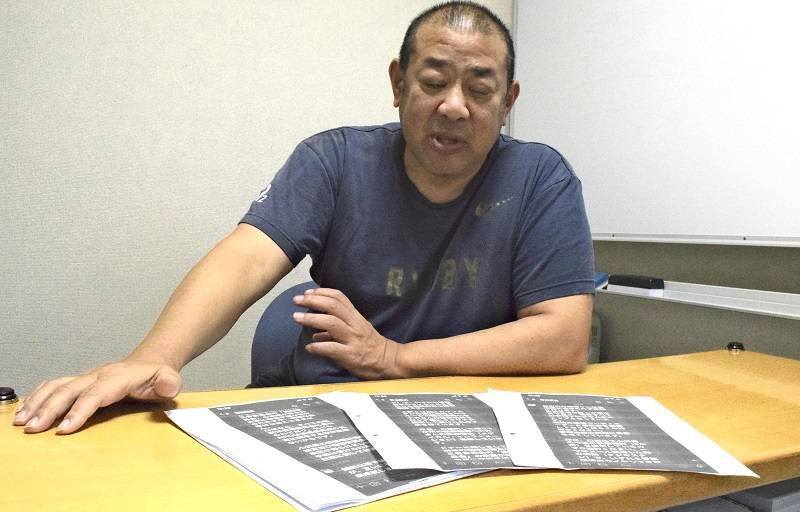
Katsutoshi Ozawa talks about his disheartening trip to Kyrgyzstan in Fujisawa, Kanagawa Prefecture, on Aug. 16. On the table are copies of messages he exchanged with the director of the Intractable Disease Patient Support Association.
6:00 JST, August 23, 2022
In a recently publicized case of suspected organ trafficking, a living donor kidney transplant was conducted overseas with a Tokyo-based nonprofit organization acting as an intermediary. This is the second installment of a series on the current state of transplant operations carried out overseas.
“In this world, no matter what country you go to, everything is under the table.”
That is what Katsutoshi Ozawa, a company manager from Fujisawa, Kanagawa Prefecture, was told last December by the director of the Intractable Disease Patient Support Association, a Tokyo-based nonprofit organization that helps facilitate organ transplants. The words were preserved on recordings obtained by The Yomiuri Shimbun.
Ozawa, 53, who had been a high school and university rugby coach, suffers from serious kidney disease. Desperate for help, he traveled to Kyrgyzstan last December in trip facilitated by the NPO. His total expenses were about ¥21 million, which he scraped together from fund-raising activities done by his students and his own personal savings.
However, a 58-year-old woman from the Kansai region who had undergone a kidney transplant at the hospital in the central Asian country later developed serious complications. And an Israeli, who went to the hospital through a different route, died following surgery. Ozawa was unable to have the operation.
When Ozawa phoned the NPO back in Japan and asked if there was any other way to receive the transplant, the director said, “It’s a matter of fact that a tip is needed to change the order [of transplant operations]. In one sense, organ transplants is a business.”
The director suggested he receive a living donor transplant in Kazakhstan or Tajikistan. “Whatever happens, I don’t want you to say you got [a kidney] from a living person,” the director said. “It will be said that you bought [it] from a poor person.”
Hearing this sowed the seeds of distrust in Ozawa, who rejected the idea and returned to Japan. “I never imagined overseas transplants operated in a world like this,” he recalled.
Getting started
According to the NPO’s website, the 62-year-old director founded a bedding manufacturing company in Yokohama in 1983. In 1998, he moved his operations to Shanghai, and supplied major bedding and furniture companies and other retailers through Japanese trading companies.
One day in or around 2003, a relative asked him, “A former classmate is undergoing dialysis. Is it possible to have a kidney transplant in Shanghai?” In response he visited a university hospital in Shanghai, and that laid the groundwork for becoming involved in organ transplants.
In 2007, Chinese authorities notified medical institutions that priority for organ transplants should go to domestic patients and, in principle, should not be performed on foreigners. However, there were exceptions made, and the NPO continued to provide guidance on organ transplants in China for Japanese patients.
In 2014, a 58-year-old man from the Kansai region underwent a kidney transplant in China, paying about ¥16.5 million to the NPO. The NPO had introduced him to a large hospital in Tianjin near Beijing. At the hotel where he stayed prior to the surgery were about 10 other Japanese also awaiting operations.
From the hospitalization procedure to the operation itself, everything went smoothly, as well as the postoperative process. On the sensitive subject of whether his new organ came from a live person or dead one, he was told, “That’s none of our concern.” He likely never found out.
Caught on tape
Transplants in China was halted in 2020 when the COVID-19 pandemic hit in full force, and the NPO director had to seek help from a new source. That would be from a 58-year-old Turkish middleman — who had been arrested by Ukrainian authorities in 2017 on charges of organ trafficking.
The NPO agreed to pay the Turkish man about $80,000 (about ¥10.7 million) per patient for the operation and other expenses. In the case of last year’s transplant in Kyrgyzstan, about $15,000 (about ¥2 million) of the amount was paid as a “donor fee,” ostensibly compensation for the organ.
According to voice recordings obtained by The Yomiuri Shimbun, the NPO director said during an internal meeting in May that “a donor receives about $15,000.” When another official told him, “We’ll give $16,000 to the donor,” the director replied, “Okay, okay.”
In a separate recording from the same month, an NPO official is heard telling the director that he told a patient’s family that the surgery and other expenses would total $80,000, to which the director responded, “You didn’t tell them how much money the donor will receive, did you?”
In response to media reports citing these remarks and other sources, the NPO posted a statement on its website on Aug. 12. In addition to insisting that the organization “has never been involved in organ trafficking,” it stated that “organ trafficking may have taken place without our knowledge.”
“We will carefully scrutinize the source of donors in the future and, if organ trafficking is suspected, we will take strict actions, including canceling the transplants,” it said.




Most Read
Popular articles in the past 24 hours
-
Japan Govt Aims for 10-Fold Increase in Computing Power of Superc...
-

Fukushima Towns Only Back to 20% of Population Before Nuclear Dis...
-
Reopened Fukushima Municipalities Lure New Residents with Educati...
-
Japan's TEPCO to Raise Electricity Rates for Corporations in Apri...
-

Japan’s Nikkei Stock Average Ends Higher as Traders Gauge Efforts...
-
Rapeseed Flowers Reach Peak Viewing Period at Tokyo's Showa Kinen...
-

Iran Situation: Significance of Rule of Law Must Be Conveyed
-

Trump Says Iran Had a New Site for Developing Nuclear Weapons
Popular articles in the past week
-

Ibaraki Pref.'s 1st Foreign Bus Driver Hired in Tsukuba
-

Amid Strait of Hormuz Blockade, Shipping Companies Scramble to Ge...
-
2 Unpublished Early Novellas by Japan's Kenzaburo Oe Discovered, ...
-
Govt to Utilize ODA for Ensuring Economic Security; Securing Ener...
-
Japan Govt Survey Finds Just 10% of Workers Want Working Hours to...
-
Japan's 2nd Round of U.S. Investments May Be Worth Over $100 Bill...
-

Imperial Family Watches World Baseball Classic Game Against Austr...
-
Donald Keene’s Drinking Buddy and Translator Yukio Kakuchi Pays T...
Popular articles in the past month
-

Producer Behind Pop Group XG Arrested for Cocaine Possession
-

Japan PM Takaichi’s Cabinet Resigns en Masse
-

Man Infected with Measles Reportedly Dined at Restaurant in Tokyo...
-

Videos Plagiarized, Reposted with False Subtitles Claiming ‘Ryuky...
-

iPS Treatments Pass Key Milestone, but Broader Applications Far f...
-

Sanae Takaichi Elected Prime Minister of Japan; Keeps All Cabinet...
-

Nepal Bus Crash Kills 19 People, Injures 25 Including One Japanes...
-

Japan's Govt to Submit Road Map for Growth Strategy in March, PM ...
Top Articles in Society
-
Producer Behind Pop Group XG Arrested for Cocaine Possession
-
Man Infected with Measles Reportedly Dined at Restaurant in Tokyo Station
-

Bus Carrying 40 Passengers Catches Fire on Chuo Expressway; All Evacuate Safely
-

Tokyo Skytree’s Elevator Stops, Trapping 20 People; All Rescued (Update 1)
-

U.S. Firm to Build Training Hub in Fukushima N-plant for Debris Removal; Plans to Establish Training Center by 2029
JN ACCESS RANKING
-
Producer Behind Pop Group XG Arrested for Cocaine Possession
-
Japan PM Takaichi’s Cabinet Resigns en Masse
-
Man Infected with Measles Reportedly Dined at Restaurant in Tokyo Station
-
Videos Plagiarized, Reposted with False Subtitles Claiming ‘Ryukyu Belongs to China’; Anti-China False Information Also Posted in Japan
-
iPS Treatments Pass Key Milestone, but Broader Applications Far from Guaranteed