
Demolition, Removal of Collapsed Houses See Delays in Noto Quake-Affected Areas; Rubble Remains 2 Months After Earthquake
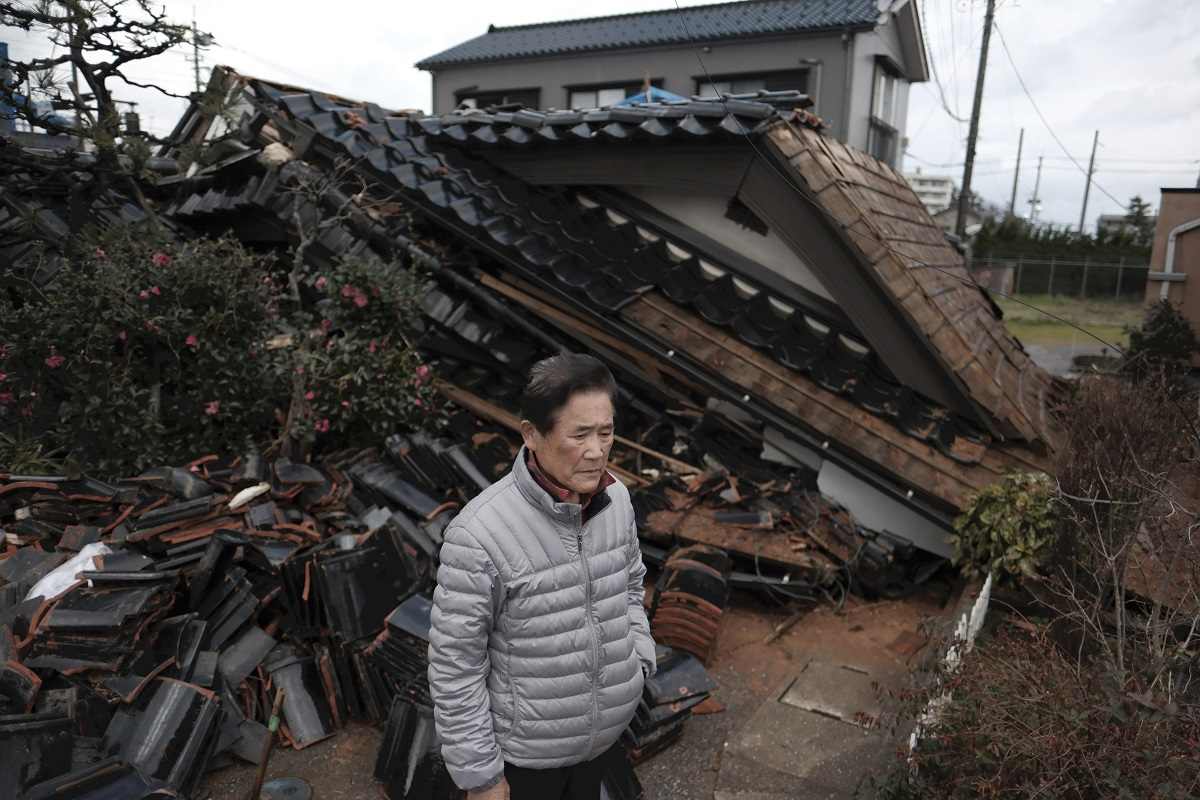
Nobukatsu Kawaguchi stands in front of his destroyed home in Wajima, Ishikawa Prefecture, on Friday.
15:22 JST, March 3, 2024
The rubble of many damaged and collapsed properties following the Noto Peninsula Earthquake remain uncollected due to procedural delays.
Six municipalities in severely affected areas of Ishikawa Prefecture have not began to assign public funds for the purposes of cleaning up collapsed houses because of delays in damage assessment surveys and the issuance of disaster victim certificates. Three of the six municipalities currently have no plans to implement this system.
The delays are hindering recovery efforts in the areas, which are still full of rubble two months after the earthquake struck on Jan. 1.
Under the system, the central and local governments bear the cost of cleaning up collapsed houses to promote recovery in disaster-stricken areas. For the latest disaster, buildings that have been certified as “partially” or “entirely” destroyed are covered, and the central government picks up 97.5% of the cost.
In order for the system to be applied, it is necessary to carry out procedures such as a survey to determine the extent of damage to a house, and a disaster victim certificate has to be applied for. However, there have been delays in issuing certificates. As of the end of February, the six municipalities had issued about 68% out of 54,910 applications. These local governments are severely understaffed and many officials are unfamiliar with the system.
The latest disaster has seen a number of old wooden houses collapse. Of the six municipalities, the city of Wajima has confirmed damage to more than 13,000 houses. The number of affected buildings is likely to be even higher.
The city of Suzu has restricted applications for certificates in some areas, so many residents are still unable to apply.
In communities where rubble still remains, many people are still unable to take steps in rebuilding their lives.
In Wajima, 80-year-old Nobukatsu Kawaguchi was in tears on Friday in front of his house that saw the first floor completely crushed. At the moment, he is not allowed to even apply for a disaster victim certificate to the city office because his house is still outside the scope for receiving a damage assessment survey. As aftershocks persist, the sloping roof of his house poses a risk to the neighboring property, so he comes to check the situation once every two days from his evacuation site in Kanazawa.
“I hope to build a replacement as soon as possible, even if it’s just small,” said Kawaguchi.





Most Read
Popular articles in the past 24 hours
-

Japanese Shipping Giants Halt Strait of Hormuz Transit as Iran Co...
-

U.S. Launches Attacks on Iran: Avoid Escalation of Conflict by An...
-

Japan Shares and Yen Fall, Jgbs Rise as Iran Strikes Continue
-

Takaichi: Japan Striving to Ensure Safety of Japanese Nationals; ...
-

Sawtooth Roof Factory Stands as Monument to Ashikaga Textile Hist...
-

Kyoto Animation President Hideaki Hatta Dies of Illness at 76; Co...
-
Parents of Japanese Teen Shot in U.S. Strive for Gun Control
-

Disinformation Spreads About Team Mirai, Ballot Readers; Online P...
Popular articles in the past week
-

Nepal Bus Crash Kills 19 People, Injures 25 Including One Japanes...
-

Milano Cortina 2026: Japanese Gold Medalist Figure Skater Miura S...
-
Tokyo Spends Big on Children, Wins Over Parents
-

McDonald's Japan Raises Prices; Big Mac to Cost ¥500, Double Chee...
-

Japan’s Miura, Kihara Announce Withdrawal from Figure Skating Wor...
-

Exhibition Featuring Yoshiharu Tsuge’s Manga World Underway in Ch...
-

Yokohama to Test Out Renewable-Powered Offshore Floating Data Cen...
-
BOJ Keeping Eye on Economy and Takaichi's ‘Proactive Fiscal Polic...
Popular articles in the past month
-

Producer Behind Pop Group XG Arrested for Cocaine Possession
-

Japan PM Takaichi’s Cabinet Resigns en Masse
-

Man Infected with Measles Reportedly Dined at Restaurant in Tokyo...
-

Israeli Ambassador to Japan Speaks about Japan’s Role in the Reco...
-

Videos Plagiarized, Reposted with False Subtitles Claiming ‘Ryuky...
-

Man Infected with Measles May Have Come in Contact with Many Peop...
-

Prudential Life Insurance Plans to Fully Compensate for Damages C...
-

Woman with Measles Visited Hospital in Tokyo Multiple Times Befor...
Top Articles in Society
-
Producer Behind Pop Group XG Arrested for Cocaine Possession
-
Man Infected with Measles Reportedly Dined at Restaurant in Tokyo Station
-
Man Infected with Measles May Have Come in Contact with Many People in Tokyo, Went to Store, Restaurant Around When Symptoms Emerged
-
Woman with Measles Visited Hospital in Tokyo Multiple Times Before Being Diagnosed with Disease
-

Bus Carrying 40 Passengers Catches Fire on Chuo Expressway; All Evacuate Safely
JN ACCESS RANKING
-
Producer Behind Pop Group XG Arrested for Cocaine Possession
-
Japan PM Takaichi’s Cabinet Resigns en Masse
-
Man Infected with Measles Reportedly Dined at Restaurant in Tokyo Station
-
Israeli Ambassador to Japan Speaks about Japan’s Role in the Reconstruction of Gaza
-
Videos Plagiarized, Reposted with False Subtitles Claiming ‘Ryukyu Belongs to China’; Anti-China False Information Also Posted in Japan