
Plastic Waste Covers Bottom of Japanese Waters; Items Found Dating Back to Twentieth Century
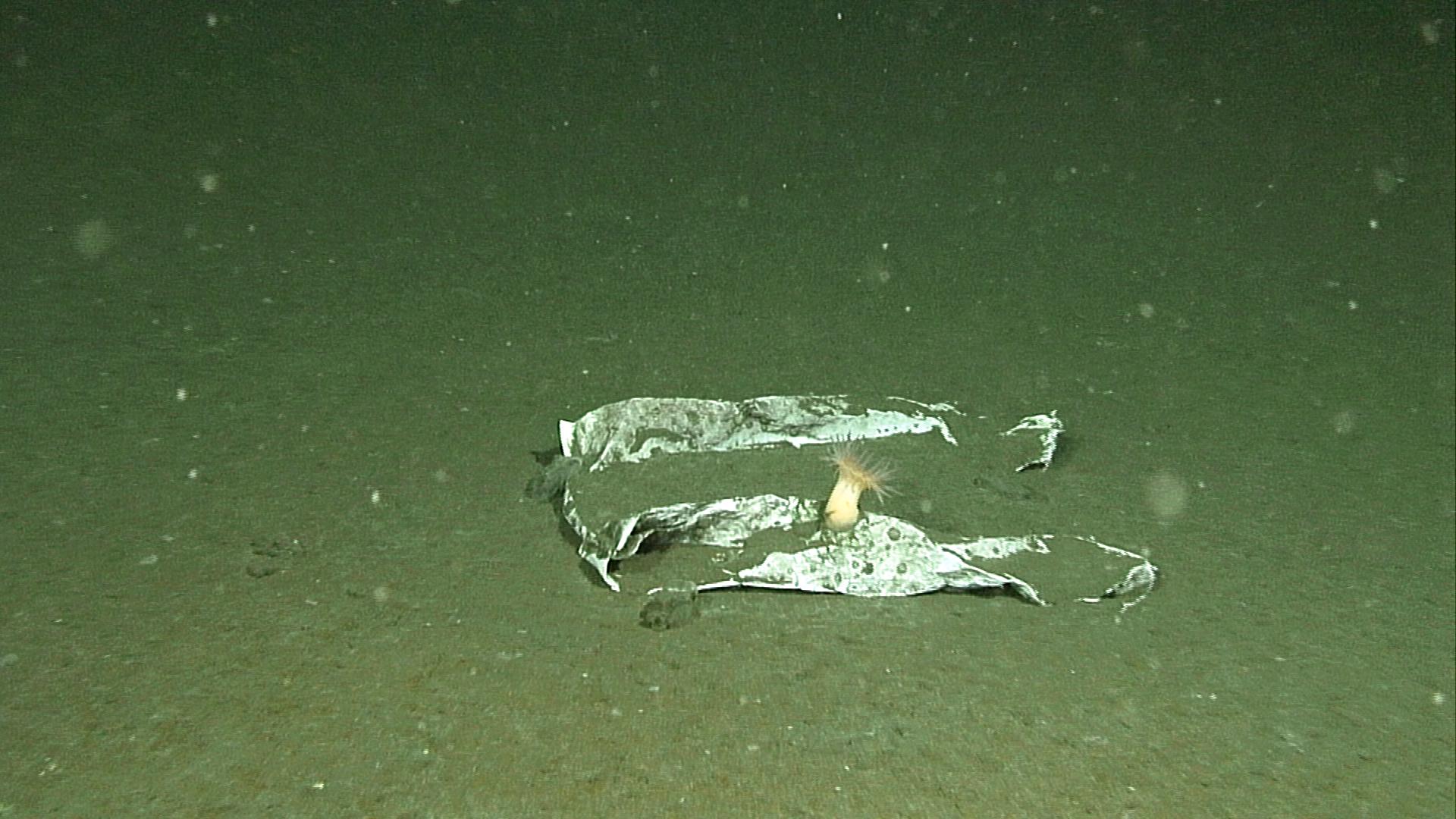
A sea anemone is seen on a plastic bottle at a depth of 2,200 meters.
20:00 JST, August 7, 2025
A huge amount of plastic waste from Japan and elsewhere has been found on the deep seabed around Japan, according to a probe by the Japan Agency for Marine-Earth Science and Technology (JAMSTEC).
Talks by the Intergovernmental Negotiating Committee (INC) to draft a convention to prevent environmental pollution due to plastic waste resumed in Switzerland on Tuesday.
The JAMSTEC team that carried out the research stressed the necessity of using fewer plastic products across the globe.
The agency conducted the probe from 2019 through spring this year, to ascertain the state of plastic waste pollution on the deep ocean floor.
Using the Shinkai 6500, a manned research submarine installed with cameras, researchers probed the ocean floors of the Japan Trench, waters off the Boso Peninsula, Sagami Bay, Suruga Bay, waters off Shikoku and waters off Noto Peninsula. Depths ranged from 800 meters to 7,000 meters.
Vast quantities of plastic were found in all these locations. The most polluted areas contained 10,000 to 40,000 plastic items per square kilometer.
“It’s deeply shocking that so much plastic waste was confirmed in ocean waters tens of kilometers from the coast,” said Ryota Nakajima, a researcher on the team who specializes in biological oceanography.
Of the waste, 70% to 80% was polyethylene bags and plastic shopping bags, and the rest was primarily plastic bottles and food containers. Such waste does not deteriorate quickly in the deep sea due to the lack of light, so some of the waste was identified as products from the Showa era (1926-89).
Some product labels showed that the items had drifted on an oceanic current not only from Japan but also from China, South Korea and Southeast Asian countries and regions.
The research team also confirmed that a massive amount of microplastics — tiny fragments of plastic products — was dispersed in the seawater. Some plastic products contain chemical substances that are harmful to the human body, and it has been said that people’s health may be damaged if they eat fish that have ingested microplastics.
The regulation of plastic production has been on the agenda at the INC meeting, which seeks to draft a convention regarding plastic waste, but opinions are divided on the subject.
“The world is connected by the ocean, in which a massive amount of plastic waste is coming and going. To keep the ocean unpolluted, countries and regions must cooperate with each other. It’s hopeless otherwise,” Nakajima said. He is paying close attention to the outcome of discussions at the meeting.


Most Read
Popular articles in the past 24 hours
-

3,000 Accounts Posting, Spreading Content Critical of Japan on X;...
-

My Spendthrift Mother Constantly Asks Me for Money
-

Japanese Students Use Traditional Pickle to Create Novel Wagashi ...
-

‘Dry Bonsai’ Gives New Life to Withered Trees, Allows Free Artist...
-

A Packed Bus Plunges off a Nepal Highway, Killing 19 and Injuring...
-

Dozens of Jewelry, Other Items Stolen After Glass Door, Showcases...
-

1.2 Mil. Rapeseed Flowers Attract Cute Birds, People in Aichi Pre...
-
Kofu Records 25.3 C; Ome in Western Tokyo Sees 25.1 C
Popular articles in the past week
-

Japan PM Takaichi’s Cabinet Resigns en Masse
-

Man Infected with Measles Reportedly Dined at Restaurant in Tokyo...
-

Sanae Takaichi Elected Prime Minister of Japan; Keeps All Cabinet...
-

Japan's Govt to Submit Road Map for Growth Strategy in March, PM ...
-

Bus Carrying 40 Passengers Catches Fire on Chuo Expressway; All E...
-

U.S. Firm to Build Training Hub in Fukushima N-plant for Debris R...
-

Japan, U.S. Name 3 Inaugural Investment Projects; Reached Agreeme...
-

Riku-Ryu Pair Wins Gold Medal: Their Strong Bond Leads to Major C...
Popular articles in the past month
-
Japan PM Takaichi’s Cabinet Resigns en Masse
-

Japan Institute to Use Domestic Commercial Optical Lattice Clock ...
-

Israeli Ambassador to Japan Speaks about Japan’s Role in the Reco...
-
Man Infected with Measles Reportedly Dined at Restaurant in Tokyo...
-

Videos Plagiarized, Reposted with False Subtitles Claiming ‘Ryuky...
-

Man Infected with Measles May Have Come in Contact with Many Peop...
-

Prudential Life Insurance Plans to Fully Compensate for Damages C...
-

Woman with Measles Visited Hospital in Tokyo Multiple Times Befor...
Top Articles in Society
-

Producer Behind Pop Group XG Arrested for Cocaine Possession
-
Man Infected with Measles Reportedly Dined at Restaurant in Tokyo Station
-
Man Infected with Measles May Have Come in Contact with Many People in Tokyo, Went to Store, Restaurant Around When Symptoms Emerged
-
Woman with Measles Visited Hospital in Tokyo Multiple Times Before Being Diagnosed with Disease
-
Australian Woman Dies After Mishap on Ski Lift in Nagano Prefecture
JN ACCESS RANKING
-
Japan PM Takaichi’s Cabinet Resigns en Masse
-
Japan Institute to Use Domestic Commercial Optical Lattice Clock to Set Japan Standard Time
-
Israeli Ambassador to Japan Speaks about Japan’s Role in the Reconstruction of Gaza
-
Man Infected with Measles Reportedly Dined at Restaurant in Tokyo Station
-
Videos Plagiarized, Reposted with False Subtitles Claiming ‘Ryukyu Belongs to China’; Anti-China False Information Also Posted in Japan