
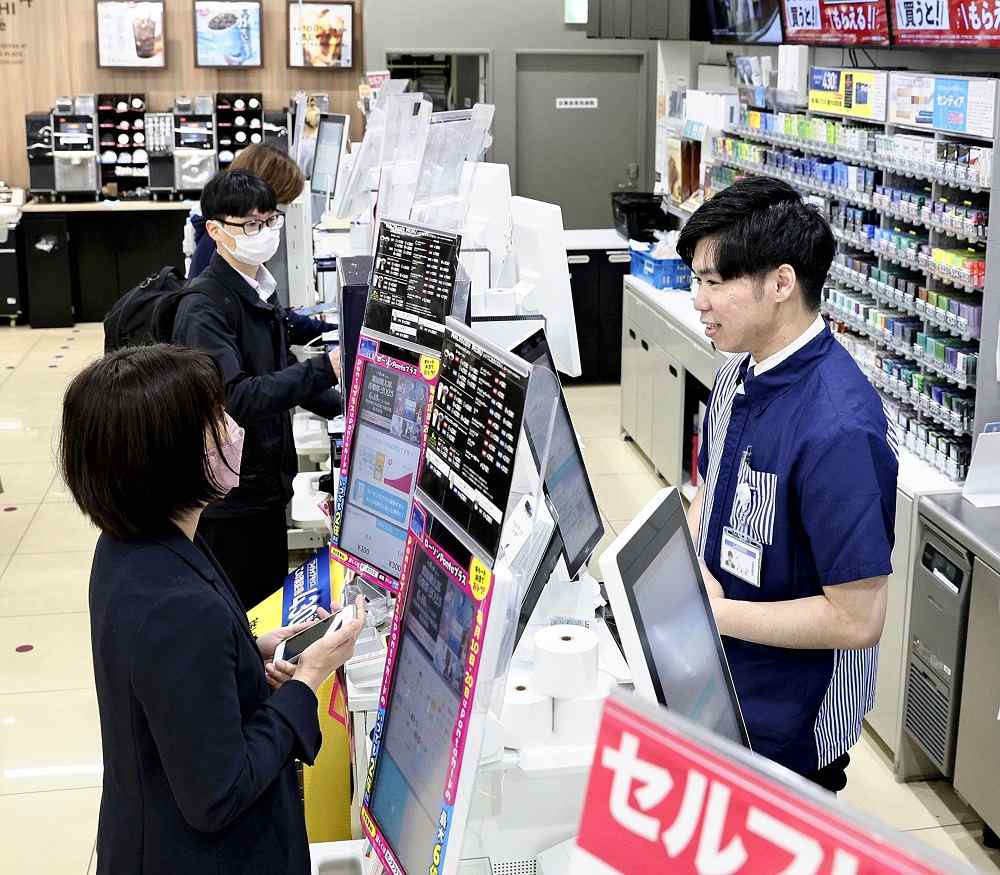
A convenience store employee serves customers at a register where plastic sheets to prevent airborne droplets have been removed in Shinagawa Ward, Tokyo, on Monday.
17:50 JST, May 8, 2023
COVID-19 has been recategorized as a Category V infectious disease as of Monday, placing it at the same level as that of seasonal influenza.
As a result of the change, various restrictions imposed by the central and local governments have ended, and individuals are basically allowed to freely make judgments over how to prevent and recover from infection.
Japan’s response to the novel coronavirus has shifted to be in line with normalizing circumstances about three years and four months since the first infected person was confirmed in the country in January 2020.
“Though I want people to continue to be careful of getting infected, it is no longer a request by the central government,” health minister Katsunobu Kato said Sunday. “Each person makes their own judgment on how to handle it.”
The Infectious Diseases Law sorts diseases into five categories — Category I to V — in accordance with degree of danger.
COVID-19 had been placed in a special category of “new types of influenza and other infectious diseases” equivalent to a Category II disease.
Until the change, prefectural governors were authorized by law to demand that infected people refrain from going out or that they recuperate at home, and to recommend or instruct that patients with serious symptoms be hospitalized.
From Monday, the governors are no longer authorized to do so, and individuals can make their own judgments. As a reference, however, the Health, Labor and Welfare Ministry recommends that people refrain from going out “within five days” of symptoms such as fever appearing.
People who have close contact with infected people are no longer required to stay home and isolate from others.
Payments at hospitals for treatment of COVID-19 have now become the burden of patients, in principle. Measures to lower the financial burden of medicines and hospitalization will remain in place until the end of September.
From October, the government will decide whether to keep or change the measures by considering how fair they are compared to other diseases.
Shots of COVID-19 vaccines are being offered free until the end of March 2024. The government will consider what to do about these vaccinations from April.
The system of treating COVID-19 patients only at limited kinds and numbers of hospitals has ended. There is a gradual shift to a normal phase in which more hospitals can accept hospitalization and outpatients for cases of COVID-19.
The government will complete preparations to ensure that about 8,300 medical institutions can hospitalize up to about 57,600 patients by the end of September.
The system to confirm the number of new COVID-19 patients daily has ended, and from now on, the numbers will be counted at specific sites. The total number of new patients at about 5,000 hospitals is reported every week.
In addition, the special measures law against new strains of influenza is no longer applied to COVID-19, thus the government cannot declare a state of emergency or take similar action.
Daily infection prevention measures, such as whether to wear a mask, have already been left up to the individual.
The central and local governments also cannot issue recommendations or instructions over infection prevention measures based on the special measures law.





Most Read
Popular articles in the past 24 hours
-
Japan Govt to Tighten Requirements to Receive Permanent Residency...
-

Tail of ANA Plane Struck Runway During Landing in Houston; No Inj...
-

Medical Care at Home and Disasters: Ensure Systems to Provide Con...
-

Samurai Japan Holds First Practice in Miami; Team Will Play again...
-

White House Takes First Step toward Permanent Fix for Illegal Tar...
-

CARTOON OF THE DAY (March 12)
-
The Japan News / Weekly Edition (3/13-3/19)
-

Iran Targets Busiest International Airport as Top UN Body Demands...
Popular articles in the past week
-

Japan Figure Skating Legend Yuzuru Hanyu Is Proud Disaster Surviv...
-

Nippon Life Insurance's U.S. Arm Sues OpenAI Over Legal Assistanc...
-
Govt to Utilize ODA for Ensuring Economic Security; Securing Ener...
-
Massive Sewer Pipe Found Jutting Out of Highway in Osaka
-

Beckoning Cats Get Makeover to Fit Modern Lifestyles with Sleek D...
-
Japan Govt Survey Finds Just 10% of Workers Want Working Hours to...
-
Japan's 2nd Round of U.S. Investments May Be Worth Over $100 Bill...
-

Imperial Family Watches World Baseball Classic Game Against Austr...
Popular articles in the past month
-

Producer Behind Pop Group XG Arrested for Cocaine Possession
-

Japan PM Takaichi’s Cabinet Resigns en Masse
-

Man Infected with Measles Reportedly Dined at Restaurant in Tokyo...
-

Videos Plagiarized, Reposted with False Subtitles Claiming ‘Ryuky...
-
Japan Figure Skating Legend Yuzuru Hanyu Is Proud Disaster Surviv...
-

iPS Treatments Pass Key Milestone, but Broader Applications Far f...
-

Sanae Takaichi Elected Prime Minister of Japan; Keeps All Cabinet...
-

Nepal Bus Crash Kills 19 People, Injures 25 Including One Japanes...
Top Articles in Society
-
Producer Behind Pop Group XG Arrested for Cocaine Possession
-
Man Infected with Measles Reportedly Dined at Restaurant in Tokyo Station
-

Bus Carrying 40 Passengers Catches Fire on Chuo Expressway; All Evacuate Safely
-

Ibaraki Pref.’s 1st Foreign Bus Driver Hired in Tsukuba
-
Tokyo Skytree’s Elevator Stops, Trapping 20 People; All Rescued (Update 1)
JN ACCESS RANKING
-
Producer Behind Pop Group XG Arrested for Cocaine Possession
-
Japan PM Takaichi’s Cabinet Resigns en Masse
-
Man Infected with Measles Reportedly Dined at Restaurant in Tokyo Station
-
Videos Plagiarized, Reposted with False Subtitles Claiming ‘Ryukyu Belongs to China’; Anti-China False Information Also Posted in Japan
-
Japan Figure Skating Legend Yuzuru Hanyu Is Proud Disaster Survivor and Gold Medalist, Vows to Continue Support Efforts