
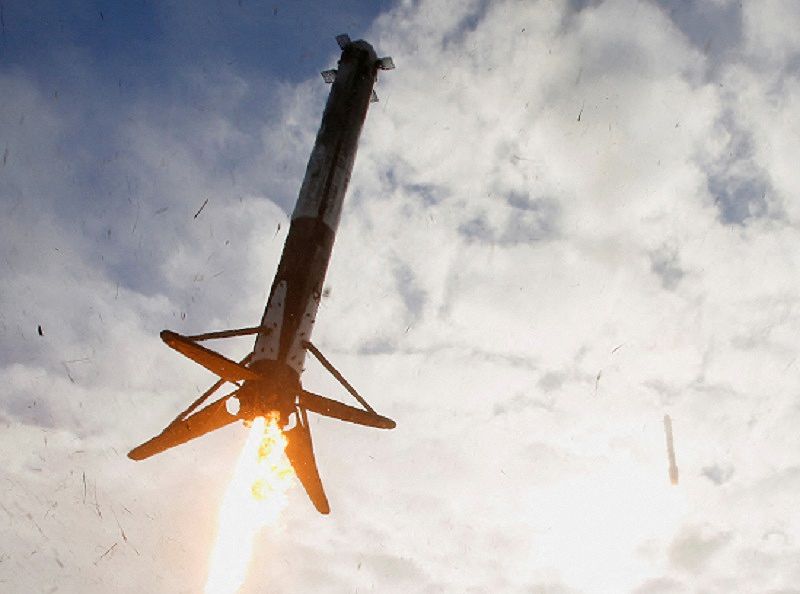
A SpaceX Falcon Heavy rocket booster descends to land, after having helped launch a classified payload for the U.S. Space Force at Cape Canaveral, Fla., on Nov. 1.
16:29 JST, November 17, 2022
SpaceX’s Falcon Heavy, the world’s most-powerful active rocket, lifted off on Nov. 1 for the first time in more than three years through dense fog at Florida’s Cape Canaveral, with Elon Musk’s company sending satellites into orbit for the U.S. Space Force.
The rocket system, consisting of three Falcon 9 boosters strapped side-by-side, took off from a SpaceX launch pad, with two satellites from the Space Force and a group of smaller satellites bound for orbit. The Space Force did not provide details of its satellites and requested that SpaceX end its launch live stream early without showing their deployment.
The mission, the first Falcon Heavy launch since June 2019, had been delayed for years by Space Force, according to SpaceX officials. The rocket’s debut in 2018 sent a red sports car from Elon Musk’s other company, Tesla, into space as a test payload.
The Nov. 1 mission marked the first use of the rocket by the Space Force, a U.S. military branch established under former U.S. President Donald Trump to oversee much of the Pentagon’s defense activities in space.
Roughly three minutes after launch, Falcon Heavy’s two side boosters separated from the rocket’s core stage in synchrony about 29 kilometers above ground, diving backward for a supersonic free-fall toward land.
Minutes later, the pair of boosters, each some five stories tall, reignited their engines and landed almost simultaneously on adjacent concrete slabs, drawing roaring applause from engineers inside SpaceX’s headquarters in Hawthorne, Calif., a company live stream showed.
The core booster did not attempt to land and used the entirety of its fuel to blast the satellites further into space.
SpaceX and its CEO Musk, the billionaire entrepreneur whose universe of high-tech companies now includes social media giant Twitter, has focused heavily in recent years on development of Starship, a bigger and fully reusable rocket intended eventually to succeed the company’s Falcon fleet.
SpaceX hopes to launch Starship into orbit for the first time in December, NASA officials said on Oct. 31.







Most Read
Popular articles in the past 24 hours
-

Japan Figure Skating Legend Yuzuru Hanyu Is Proud Disaster Surviv...
-

Massive Sewer Pipe Found Jutting Out of Highway in Osaka
-

Japan-U.S. Summit Likely to Focus on Middle East; Takaichi to Fac...
-
Hawaii Museum on Tsunami Including Japan's 2011 Disaster at Risk ...
-

15 Years since Great East Japan Earthquake: How Can Affected Area...
-
Japan Holds Memorial Events to Mark 15th Anniversary of 2011 Eart...
-

Japan Train Company to Increase Fares, Including in Tokyo Metropo...
-

Japan’s Mitsui O.S.K. Lines Container Ship Anchored in Persian Gu...
Popular articles in the past week
-

Ibaraki Pref.'s 1st Foreign Bus Driver Hired in Tsukuba
-

Nippon Life Insurance's U.S. Arm Sues OpenAI Over Legal Assistanc...
-
Japan Figure Skating Legend Yuzuru Hanyu Is Proud Disaster Surviv...
-
Govt to Utilize ODA for Ensuring Economic Security; Securing Ener...
-
Massive Sewer Pipe Found Jutting Out of Highway in Osaka
-

Amid Strait of Hormuz Blockade, Shipping Companies Scramble to Ge...
-

Beckoning Cats Get Makeover to Fit Modern Lifestyles with Sleek D...
-
Japan Govt Survey Finds Just 10% of Workers Want Working Hours to...
Popular articles in the past month
-

Producer Behind Pop Group XG Arrested for Cocaine Possession
-

Japan PM Takaichi’s Cabinet Resigns en Masse
-

Man Infected with Measles Reportedly Dined at Restaurant in Tokyo...
-

Videos Plagiarized, Reposted with False Subtitles Claiming ‘Ryuky...
-

iPS Treatments Pass Key Milestone, but Broader Applications Far f...
-

Sanae Takaichi Elected Prime Minister of Japan; Keeps All Cabinet...
-

Nepal Bus Crash Kills 19 People, Injures 25 Including One Japanes...
-

South Korea Tightens Rules on Foreigners Buying Homes in Seoul Me...
Top Articles in Science & Nature
-
iPS Treatments Pass Key Milestone, but Broader Applications Far from Guaranteed
-
Record 700 Startups to Gather at SusHi Tech Tokyo in April; Event Will Center on Themes Like Artificial Intelligence and Robotics
-
iPS Cell Products for Parkinson’s, Heart Disease OK’d for Commercialization by Japan Health Ministry Panel
-
Japan to Ban Use of Power Banks on Airplanes
-
Japan Govt Aims for 10-Fold Increase in Computing Power of Supercomputers for AI Use at Universities, Research Institutions
JN ACCESS RANKING
-
Producer Behind Pop Group XG Arrested for Cocaine Possession
-
Japan PM Takaichi’s Cabinet Resigns en Masse
-
Man Infected with Measles Reportedly Dined at Restaurant in Tokyo Station
-
Videos Plagiarized, Reposted with False Subtitles Claiming ‘Ryukyu Belongs to China’; Anti-China False Information Also Posted in Japan
-
iPS Treatments Pass Key Milestone, but Broader Applications Far from Guaranteed