
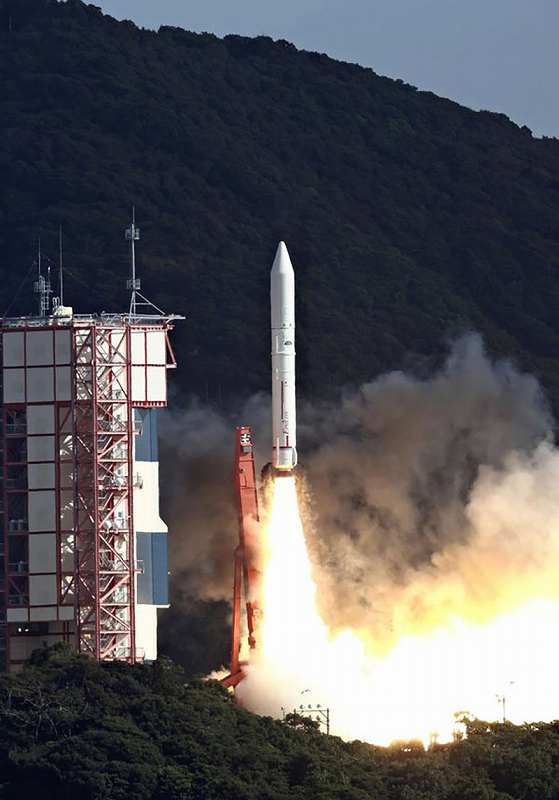
The fifth Epsilon solid-fuel rocket is launched at 9:55 a.m. from JAXA’s Uchinoura Space Center in Kimotsuki in Kagoshima Prefecture.
November 9, 2021
KIMOTSUKI, Kagoshima (Jiji Press) — The Japan Aerospace Exploration Agency, or JAXA, on Tuesday successfully launched its fifth Epsilon solid-fuel rocket carrying nine small satellites.
The rocket was launched at 9:55 a.m. from JAXA’s Uchinoura Space Center in Kimotsuki in Kagoshima Prefecture.
JAXA initially planned to launch the Epsilon-5 rocket Oct. 1, but this was canceled just before the scheduled liftoff time due to a glitch in ground radar equipment. The launch was then postponed twice because of unfavorable weather conditions.
The rocket, which is 26 meters long and weighs 96 tons, injected the rapid innovative payload demonstration satellite-2, or RAISE-2, into orbit about 570 kilometers above Earth around 50 minutes after the liftoff. The other eight satellites were released later. The feat came after all four previous Epsilon rockets were launched successfully.
RAISE-2 carries parts and equipment developed by entities including Mitsubishi Electric Corp. and Tohoku University to test whether they can operate in space.
The remaining satellites, chosen publicly, include one developed by Kawasaki Heavy Industries Ltd. to conduct a space debris removal test and another developed jointly by 10 Japanese national technical colleges for an antenna deployment test aimed at observing radio waves from Jupiter.
The latest launch was part of JAXA’s “innovative satellite technology demonstration” program, designed to provide universities and private companies with opportunities to conduct experiments for parts and equipment in a bid to expand space utilization.
This was the second satellite launch under the program. In the first such launch, seven satellites were released from the Epsilon-4 rocket in January 2019.
The launch of Epsilon-5 was postponed by about four minutes. This was partly to help the rocket avoid flying near the Crew Dragon space capsule that was on its way to Earth to bring astronauts including Japan’s Akihiko Hoshide back from the International Space Station, according to JAXA.





Most Read
Popular articles in the past 24 hours
-
Japan Govt to Tighten Requirements to Receive Permanent Residency...
-
‘King Kazu’ Discusses His Connection to Fukushima
-
JR Tokai Breaks Ground on Yamanashi Maglev Station; Will Be Part ...
-

Medical Care at Home and Disasters: Ensure Systems to Provide Con...
-

Metal Pipe That Protruded 13 Meters Above Ground in Osaka Sinks B...
-

White House Takes First Step toward Permanent Fix for Illegal Tar...
-
Japan to Extend Drone No-fly Zones Near Key Facilities to 1 km
-

The Japan News / Weekly Edition (3/13-3/19)
Popular articles in the past week
-

Japan Figure Skating Legend Yuzuru Hanyu Is Proud Disaster Surviv...
-

Nippon Life Insurance's U.S. Arm Sues OpenAI Over Legal Assistanc...
-
Govt to Utilize ODA for Ensuring Economic Security; Securing Ener...
-
Massive Sewer Pipe Found Jutting Out of Highway in Osaka
-

Beckoning Cats Get Makeover to Fit Modern Lifestyles with Sleek D...
-
Japan Govt Survey Finds Just 10% of Workers Want Working Hours to...
-
Japan's 2nd Round of U.S. Investments May Be Worth Over $100 Bill...
-

Imperial Family Watches World Baseball Classic Game Against Austr...
Popular articles in the past month
-

Producer Behind Pop Group XG Arrested for Cocaine Possession
-

Japan PM Takaichi’s Cabinet Resigns en Masse
-

Man Infected with Measles Reportedly Dined at Restaurant in Tokyo...
-

Videos Plagiarized, Reposted with False Subtitles Claiming ‘Ryuky...
-
Japan Figure Skating Legend Yuzuru Hanyu Is Proud Disaster Surviv...
-

iPS Treatments Pass Key Milestone, but Broader Applications Far f...
-

Sanae Takaichi Elected Prime Minister of Japan; Keeps All Cabinet...
-

Nepal Bus Crash Kills 19 People, Injures 25 Including One Japanes...
Top Articles in Science & Nature
-
iPS Treatments Pass Key Milestone, but Broader Applications Far from Guaranteed
-
Record 700 Startups to Gather at SusHi Tech Tokyo in April; Event Will Center on Themes Like Artificial Intelligence and Robotics
-
iPS Cell Products for Parkinson’s, Heart Disease OK’d for Commercialization by Japan Health Ministry Panel
-
Japan to Ban Use of Power Banks on Airplanes
-
Japan Govt Aims for 10-Fold Increase in Computing Power of Supercomputers for AI Use at Universities, Research Institutions
JN ACCESS RANKING
-
Producer Behind Pop Group XG Arrested for Cocaine Possession
-
Japan PM Takaichi’s Cabinet Resigns en Masse
-
Man Infected with Measles Reportedly Dined at Restaurant in Tokyo Station
-
Videos Plagiarized, Reposted with False Subtitles Claiming ‘Ryukyu Belongs to China’; Anti-China False Information Also Posted in Japan
-
Japan Figure Skating Legend Yuzuru Hanyu Is Proud Disaster Survivor and Gold Medalist, Vows to Continue Support Efforts