
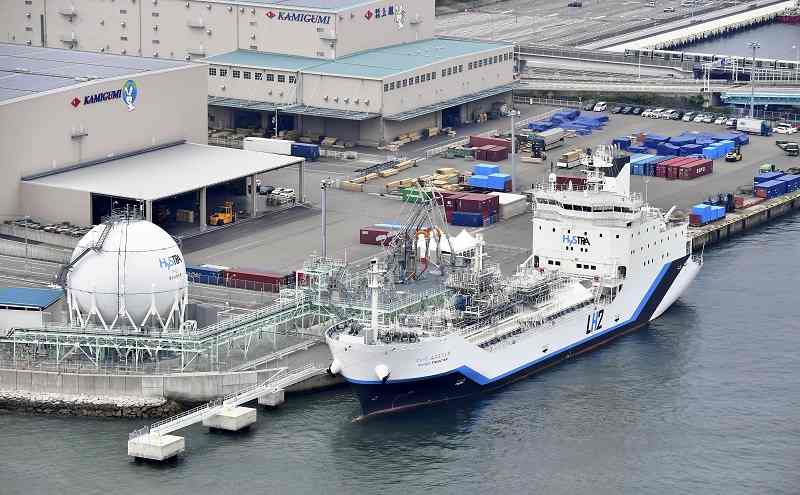
The Suiso Frontier, the world’s first liquefied hydrogen carrier, is seen docked at Kobe Port in May last year.
1:00 JST, August 31, 2022
The government is planning to build ports capable of accepting hydrogen tankers.
As the world strives toward decarbonization, demand for hydrogen is expected to increase in such fields as power generation and transportation. To ensure a stable supply of hydrogen, the government plans to include a policy to build a maritime transport network in the Basic Plan on Ocean Policy to be revised around May next year.
Founded on the Basic Act on Ocean Policy established in 2007, the Basic Plan on Ocean Policy lays out a comprehensive set of maritime measures for implementation. In principle, the plan is revised every five years or so — the current plan was adopted in May 2018.
Japan aims to cut greenhouse gas emissions by 46% by fiscal 2030 based on 2013 levels and achieve carbon neutrality by effectively reducing emissions to zero by 2050. The government, which expects hydrogen to become a next-generation fuel because it does not produce greenhouse gases when burned, aims to increase annual hydrogen consumption to 20 million tons by 2050 from its current figure of 2 million tons.
Cost-cutting remains a challenge, however. The Natural Resources and Energy Agency estimates that it currently costs about ¥170 to procure a cubic meter of hydrogen, but the government wants to slash this number some 80% to ¥30 by 2030. To that end, it is necessary to develop a supply chain to enable stable procurement of hydrogen on a large scale.
As a possible model, the government is looking at a demonstration experiment conducted by CO2-free Hydrogen Energy Supply-chain Technology Research Association (HySTRA), comprising Kawasaki Heavy Industries Ltd., Iwatani Corp. and other companies. In February, HySTRA transported liquefied hydrogen produced in Australia to Kobe Port using a hydrogen carrier with a tank capacity of 1,250 cubic meters. The experiment marked the first-ever large-scale conveyance of liquefied hydrogen by sea in the world.
According to the Land, Infrastructure, Transport and Tourism Ministry, Kobe Port is the only port in Japan presently capable of handling hydrogen tankers. The government is thus asking port-managing municipalities across the country to estimate their future hydrogen demands and will base its future development plans on the municipalities’ reports, local conditions and other factors.





Most Read
Popular articles in the past 24 hours
-

3,000 Accounts Posting, Spreading Content Critical of Japan on X;...
-

My Spendthrift Mother Constantly Asks Me for Money
-

Japanese Students Use Traditional Pickle to Create Novel Wagashi ...
-

‘Dry Bonsai’ Gives New Life to Withered Trees, Allows Free Artist...
-

A Packed Bus Plunges off a Nepal Highway, Killing 19 and Injuring...
-

Dozens of Jewelry, Other Items Stolen After Glass Door, Showcases...
-

1.2 Mil. Rapeseed Flowers Attract Cute Birds, People in Aichi Pre...
-

Kofu Records 25.3 C; Ome in Western Tokyo Sees 25.1 C
Popular articles in the past week
-

Japan PM Takaichi’s Cabinet Resigns en Masse
-

Man Infected with Measles Reportedly Dined at Restaurant in Tokyo...
-

Sanae Takaichi Elected Prime Minister of Japan; Keeps All Cabinet...
-

Japan's Govt to Submit Road Map for Growth Strategy in March, PM ...
-

Bus Carrying 40 Passengers Catches Fire on Chuo Expressway; All E...
-
U.S. Firm to Build Training Hub in Fukushima N-plant for Debris R...
-

Japan, U.S. Name 3 Inaugural Investment Projects; Reached Agreeme...
-

Riku-Ryu Pair Wins Gold Medal: Their Strong Bond Leads to Major C...
Popular articles in the past month
-
Japan PM Takaichi’s Cabinet Resigns en Masse
-

Japan Institute to Use Domestic Commercial Optical Lattice Clock ...
-

Israeli Ambassador to Japan Speaks about Japan’s Role in the Reco...
-
Man Infected with Measles Reportedly Dined at Restaurant in Tokyo...
-

Videos Plagiarized, Reposted with False Subtitles Claiming ‘Ryuky...
-

Man Infected with Measles May Have Come in Contact with Many Peop...
-

Prudential Life Insurance Plans to Fully Compensate for Damages C...
-

Woman with Measles Visited Hospital in Tokyo Multiple Times Befor...
Top Articles in Science & Nature
-
Japan Institute to Use Domestic Commercial Optical Lattice Clock to Set Japan Standard Time
-

iPS Treatments Pass Key Milestone, but Broader Applications Far from Guaranteed
-
Record 700 Startups to Gather at SusHi Tech Tokyo in April; Event Will Center on Themes Like Artificial Intelligence and Robotics
-
iPS Cell Products for Parkinson’s, Heart Disease OK’d for Commercialization by Japan Health Ministry Panel
-

Japan to Ban Use of Power Banks on Airplanes
JN ACCESS RANKING
-
Japan PM Takaichi’s Cabinet Resigns en Masse
-
Japan Institute to Use Domestic Commercial Optical Lattice Clock to Set Japan Standard Time
-
Israeli Ambassador to Japan Speaks about Japan’s Role in the Reconstruction of Gaza
-
Man Infected with Measles Reportedly Dined at Restaurant in Tokyo Station
-
Videos Plagiarized, Reposted with False Subtitles Claiming ‘Ryukyu Belongs to China’; Anti-China False Information Also Posted in Japan