
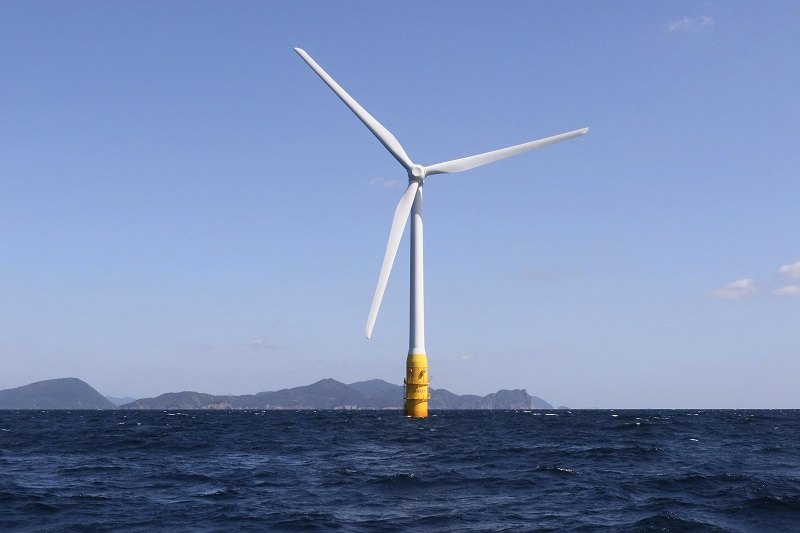
An offshore windmill is seen off the coast of Nagasaki Prefecture.
13:44 JST, April 7, 2022
Mitsubishi Corp. will enter the green hydrogen business in collaboration with companies such as British resource giant Shell.
In green hydrogen, hydrogen is produced without emitting carbon dioxide through the electrolysis of water using electricity generated by renewable energy sources.
Large-scale offshore wind farms are being constructed in Europe with the aim of producing 400,000 tons of green hydrogen annually in 2030. This will help gradually replace hydrogen being produced using natural gas and other fossil fuels, thus promoting decarbonization.
Eneco, a Mitsubishi subsidiary based in the Netherlands engaged in renewable energy projects in Europe, has decided to take a 10% stake in a joint venture formed by Shell, Norwegian energy giant Equinor ASA, and other companies.
The joint venture will construct by 2030 offshore wind farms generating about 4 gigawatts of electricity, equivalent to four nuclear power plants, in European waters, mainly off the coast of the Netherlands. The project will use the power to produce green hydrogen.
Total investment in the project is expected to exceed ¥300 billion, of which Mitsubishi will shoulder dozens of billions of yen.
Hydrogen is used for many purposes, including as a fuel for factory boilers and home heating systems, as well as for synthesizing ammonia, an ingredient in fertilizers. Currently, most hydrogen is produced using natural gas and other fossil fuels. Hydrogen produced in this manner is called gray hydrogen. If the carbon dioxide emitted during production is captured and stored, it is called blue hydrogen.
Since Russia’s invasion of Ukraine, there has been an increased interest in hydrogen as a way to reduce dependence on natural gas. If this project comes to fruition, it would reduce by the equivalent of 1% of the amount of natural gas the European Union imported from Russia in 2021.
Mitsubishi plans to invest about ¥1 trillion in renewable energy by fiscal 2030 ending in March 2031. In Japan, the company is moving forward with plans to build offshore wind farms in three areas off the coast of Akita and Chiba prefectures.





Most Read
Popular articles in the past 24 hours
-

3,000 Accounts Posting, Spreading Content Critical of Japan on X;...
-

My Spendthrift Mother Constantly Asks Me for Money
-

Japanese Students Use Traditional Pickle to Create Novel Wagashi ...
-

‘Dry Bonsai’ Gives New Life to Withered Trees, Allows Free Artist...
-

A Packed Bus Plunges off a Nepal Highway, Killing 19 and Injuring...
-

Dozens of Jewelry, Other Items Stolen After Glass Door, Showcases...
-

1.2 Mil. Rapeseed Flowers Attract Cute Birds, People in Aichi Pre...
-
Kofu Records 25.3 C; Ome in Western Tokyo Sees 25.1 C
Popular articles in the past week
-

Japan PM Takaichi’s Cabinet Resigns en Masse
-

Man Infected with Measles Reportedly Dined at Restaurant in Tokyo...
-

Sanae Takaichi Elected Prime Minister of Japan; Keeps All Cabinet...
-
Japan's Govt to Submit Road Map for Growth Strategy in March, PM ...
-

Bus Carrying 40 Passengers Catches Fire on Chuo Expressway; All E...
-

U.S. Firm to Build Training Hub in Fukushima N-plant for Debris R...
-

Japan, U.S. Name 3 Inaugural Investment Projects; Reached Agreeme...
-

Riku-Ryu Pair Wins Gold Medal: Their Strong Bond Leads to Major C...
Popular articles in the past month
-
Japan PM Takaichi’s Cabinet Resigns en Masse
-

Japan Institute to Use Domestic Commercial Optical Lattice Clock ...
-

Israeli Ambassador to Japan Speaks about Japan’s Role in the Reco...
-
Man Infected with Measles Reportedly Dined at Restaurant in Tokyo...
-

Videos Plagiarized, Reposted with False Subtitles Claiming ‘Ryuky...
-

Man Infected with Measles May Have Come in Contact with Many Peop...
-

Prudential Life Insurance Plans to Fully Compensate for Damages C...
-
Woman with Measles Visited Hospital in Tokyo Multiple Times Befor...
Top Articles in Science & Nature
-
Japan Institute to Use Domestic Commercial Optical Lattice Clock to Set Japan Standard Time
-

iPS Treatments Pass Key Milestone, but Broader Applications Far from Guaranteed
-
Record 700 Startups to Gather at SusHi Tech Tokyo in April; Event Will Center on Themes Like Artificial Intelligence and Robotics
-
iPS Cell Products for Parkinson’s, Heart Disease OK’d for Commercialization by Japan Health Ministry Panel
-
Japan to Ban Use of Power Banks on Airplanes
JN ACCESS RANKING
-
Japan PM Takaichi’s Cabinet Resigns en Masse
-
Japan Institute to Use Domestic Commercial Optical Lattice Clock to Set Japan Standard Time
-
Israeli Ambassador to Japan Speaks about Japan’s Role in the Reconstruction of Gaza
-
Man Infected with Measles Reportedly Dined at Restaurant in Tokyo Station
-
Videos Plagiarized, Reposted with False Subtitles Claiming ‘Ryukyu Belongs to China’; Anti-China False Information Also Posted in Japan