
12:41 JST, March 2, 2026
On the flight back to Japan from the United States, Mieko Hattori, then 44, realized she was the only one awake in the dim light. Suddenly, she felt that she heard a voice say, “Stop crying and do something instead.” For Mieko, it sounded like the voice of her son Yoshihiro, who died at the age of 16.
On Oct. 17, 1992, just two months after arriving in Louisiana to study, Yoshihiro visited a house that he thought was the location of a Halloween party. A resident of the house thought Yoshihiro was an intruder. Armed with a gun, the man warned Yoshihiro to “freeze” before fatally shooting the teenager.
The voice made Mieko think she should do something so that her son’s death would not mean nothing. While on the flight carrying his body in the cargo compartment, Mieko took out a pen and notebook and began writing a plea for gun control to the U.S. president. Mieko, now 78, said her hatred for the man who shot her son vanished while writing.
Plea to U.S. president
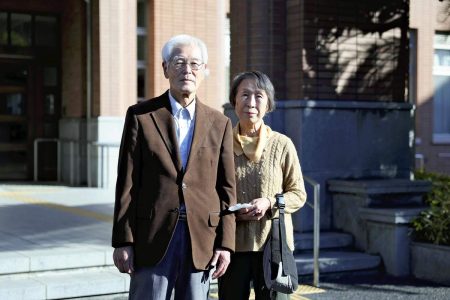
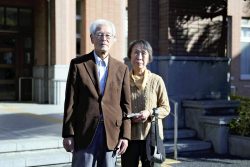
Masaichi, left, and Mieko Hattori are seen at Aichi Prefectural Asahigaoka Senior High School in Nagoya on Dec. 16, where Yoshihiro studied.
Mieko Hattori, does not clearly remember where it was. She only remembers that it was in a large space, and that her son, Yoshihiro, lay on his back with a peaceful expression. When she touched his body, she felt the body cold and hard, like a sculpture. She said to herself: “It’s all my fault. I told him, just 16 years old, to go study in the United States.” She clung to his body and cried out, “Forgive me!”
Hattori ran a small English-language school in her home in Nagoya. In 1975, she had her first son, Yoshihiro, with her husband, Masaichi, now 78, who was an engineer at an auto parts company.
Yoshihiro grew as a playful middle child between an older sister and younger brother.
Mieko suggested that Yoshihiro study in the United States, expecting that “the experience in the country of liberty would make him a person free of a sense of discrimination or prejudice.”
In August 1992, with a smile, she saw her son off as he departed Japan, thrilled with the hope of “making the United States my second home.”
The tragic incident occurred on the night of Oct. 17 that year. That day, Yoshihiro had been invited to a Halloween party at the home of another exchange student’s host family in Baton Rouge, La., along with Webb Haymaker, the 16-year-old eldest son of Yoshihiro’s host family. The two boys rang the doorbell of a house that they thought was their intended destination, but it was the wrong house.
“Freeze!” A male resident inside warned through the opened door. Perhaps unable to understand the warning, Yoshihiro continued moving toward him. The next instant, the man fired a bullet, which pierced Yoshihiro’s left chest.
Disbelieved with the shocking news, Mieko and Masaichi Hattori flew to the United States. They saw and identified their son’s body, and then attended an emergency press conference followed by a memorial service at the church. After the stormy five-day period of these events, they received Yoshihiro’s body and took it back to Japan with them by plane.
A whirlwind of thoughts raced through Mieko’s mind: If only my boy had understood the meaning of “Freeze”; if only he had seen the gun clearly. Those “if onlys” came and went in her mind.
Son’s voice triggers petition
Mieko also thought: If only guns did not exist in the first place, my son would not have died. She realized that how abnormal, frightening could be to live in a society where ordinary citizens are allowed to own guns. She also felt that the shooter might also be a victim of this society that is permissive of guns. A society where a 16-year-old child can be killed by a gun is absolutely wrong.
At that moment, Mieko distinctly heard her son’s voice saying, “Do something.” It felt like a mission “sent from heaven.”
“I must let Yoshihiro [in heaven] do something meaningful as proof that he lived in this world,” she thought. Blaming the shooter would not solve anything. She thought: I want to appeal to change a society permissive of guns, which is abnormal from a Japanese viewpoint. To her own surprise, she was very calm and focused on what to do at that moment.
On the flight home, Mieko drafted a petition to remove guns from American homes. At her son’s wake the day after she returned to Japan, she distributed copies of the finished petition to mourners and began collecting signatures. What an audacious thing for an ordinary person like me to do, she thought. She also felt, “Yoshihiro is encouraging me.”
1.8 million signatures
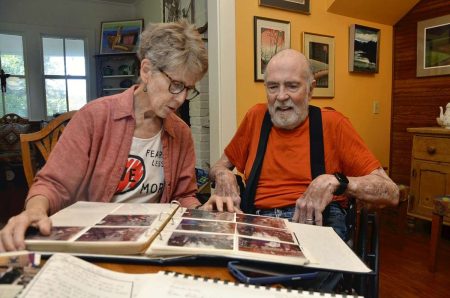
Holley Haymaker, left, and her husband Richard look at an album in Baton Rouge, La., on Nov. 6.
There were others who joined the petition drive: the Haymakers, Yoshihiro’s host family.
Holley Haymaker, now 81, recalled that right after the incident she was crushed by guilt about Yoshihiro’s death. Her remorse was so deep that she was afraid of looking into the eyes of Yoshihiro’s parents, who had rushed over from Japan. Yet, the first things Mieko and Masaichi said were asking if Webb was OK, and expressing gratitude for taking care of their son. It was heart wrenching.
Holley’s husband, Richard, now 86, was the first to take action. At the time, Yoshi’s story had only been covered in the United States briefly by a local paper.
They wrote an op-ed for The New York Times titled “Another Magnum, Another Victim” and began collecting signatures. Richard also reached out to gun control groups across the country, uniting their previously scattered efforts into one powerful wave.
The two families that live so far apart saw their hopes come to fruition in November 1993 in the form of a meeting with then U.S. President Bill Clinton.
The Hattoris and the Haymakers were invited to the White House, where they handed Clinton a petition with some of about 1.8 million signatures from Japan and the United States. Clinton said emphatically that gun violence must be eliminated. Shortly thereafter, the U.S. Congress passed into law new gun control legislation that included provisions for stricter background checks on gun buyers.
That same year, the Hattoris used the payout from Yoshihiro’s life insurance to help establish the Yoshi Hattori Memorial Scholarship, supporting U.S. students who wish to visit Japan. The fund’s aim is for Americans to learn that “it is possible to live safely without guns.”
The couple frequently traveled to the United States to participate in gun control rallies and gave numerous lectures in Japan. The grief, anguish and regret over losing their son never faded, but Mieko managed to maintain her emotional balance by throwing herself into activism.
Meanwhile, a subtle rift formed within the family.
While Mieko devoted herself entirely to activism, Masaichi remained as busy as ever with his work. She began to resent him. “Why isn’t he fulfilling his duties as a parent?” she thought. Minor disagreements led to more frequent arguments. She even began to resent her daughter and son, wondering, “How can they live such normal lives with such calm faces?”
It wasn’t that the family was indifferent. Her second son, Akira, now 48, was in his third year of junior high school at the time of the incident. He was conflicted, feeling both dissatisfied with himself for “not doing anything” and a desire to “live his own life” as an entrance exam was coming up.
Anonymous calls came to the Hattoris’ home, criticizing Mieko as “interfering in U.S. domestic affairs” and reproaching Mieko for not crying. A sense of loneliness grew behind her activism.
“Always with you” — during this time, the Haymakers were her lifeline. They exchanged faxes about their lives and regularly shared news from the United States about the many people mourning the tragedy and demanding gun control.
There was another source of relief. While the man who shot Yoshihiro was acquitted in criminal court, he lost the civil lawsuit when the court rejected his claim of self-defense.
Young Americans who came to Japan on the memorial scholarship have grown up.
Matthew Prutz, 35, came from Baton Rouge in 2007 to study.
After experiencing Japanese society without guns he said it gave him a lot of insights, adding, “[In the U.S.] people get guns because they feel dangerous and [to] save themselves, but it makes people more dangerous. It’s like a paradox.”
Changing opinions
As time passed, Mieko, who had been desperately immersed in her activism, began to find some peace of mind.
Resolved to “do what a parent should do,” Masaichi sometimes took time off work to join his wife at lectures and gatherings. Yoshihiro’s classmates tirelessly collected signatures. Mieko had felt lonely, but looking back, she had many allies.
In the autumn of 2022, 30 years after the incident, Mieko and Masaichi brought their campaign to a close. Both past 70, the couple thought to themselves, “Maybe it’s time to retire.” They thought they heard Yoshihiro whisper to them, “You did good.”
The Hattoris handed over leadership of the group to Masaki Hirata, an associate professor at Nagoya City University who studies American history, and shifted to supporting the next generation.
To date, 34 students have come to Japan through the memorial scholarship. At Aichi Prefectural Asahigaoka Senior High School, where Yoshihiro studied, students from Japan and overseas have discussed gun control on 15 occasions.
“It’s not about imposing your views, but conveying your own opinions while respecting the perspectives of the others,” Hirata said. “Given the concerns about today’s polarized society, there is much to learn from the Hattoris’ approach to dialogue.”
In November 2025, Mieko and Masaichi met the Haymakers online for the first time in four years. Their conversation ranged over lighthearted topics: Mieko’s painting and gardening hobbies, and the growth of Holley and Richard’s grandchildren.
Tragedy, however, struck the Haymakers about four years ago. Webb, who witnessed Yoshihiro being shot, took his own life at 46. Though he had worked as a psychotherapist, Webb suffered from post-traumatic stress disorder after the incident.
Both families lost a son to a single bullet, and had campaigned for a “world without guns.”
Mass shootings occur almost every year in America, with gun-related deaths in 2023, including suicides, exceeding 46,000.
“I understand that the mindset of owning guns for self-defense is deeply ingrained and won’t change easily,” Mieko said.
She feels the United States, where her son hoped to find a second home, is heading in the wrong direction.
Yet Mieko believes one thing firmly. Speaking via video call to the Haymakers, who lamented the current state of America, she said that her son taught her that even if their voices are small, if they keep speaking out, they can make difference. Mieko then said the Haymakers that was what she wanted to tell.





Most Read
Popular articles in the past 24 hours
-

Improvement of Japanese Language Schools Lags Rise in Foreigners
-

Japan's Test-Takers in Sapporo Offered Special Accommodation Arra...
-

Rental Lab Space in Tokyo Area More Than Doubles Since 2010, Offe...
-

South Korea's Lee to Take Steps for Better Ties with Japan
-

Architourism: Rediscover the Value, Appeal of Famous Structures
-

At Least 6 Killed as Shiites Storm U.S. Consulate in Pakistan ove...
-

Bank of Japan Deputy Governor Says Rate Hikes Likely to Continue
-

Japanese Government Bonds Rally, Yields Tumble as Iran Strikes Sp...
Popular articles in the past week
-

Nepal Bus Crash Kills 19 People, Injures 25 Including One Japanes...
-
Milano Cortina 2026: Japanese Gold Medalist Figure Skater Miura S...
-
Tokyo Spends Big on Children, Wins Over Parents
-

McDonald's Japan Raises Prices; Big Mac to Cost ¥500, Double Chee...
-

‘Dry Bonsai’ Gives New Life to Withered Trees, Allows Free Artist...
-
Japan’s Miura, Kihara Announce Withdrawal from Figure Skating Wor...
-

Exhibition Featuring Yoshiharu Tsuge’s Manga World Underway in Ch...
-

Yokohama to Test Out Renewable-Powered Offshore Floating Data Cen...
Popular articles in the past month
-

Producer Behind Pop Group XG Arrested for Cocaine Possession
-

Japan PM Takaichi’s Cabinet Resigns en Masse
-

Man Infected with Measles Reportedly Dined at Restaurant in Tokyo...
-

Israeli Ambassador to Japan Speaks about Japan’s Role in the Reco...
-

Videos Plagiarized, Reposted with False Subtitles Claiming ‘Ryuky...
-

Man Infected with Measles May Have Come in Contact with Many Peop...
-

Prudential Life Insurance Plans to Fully Compensate for Damages C...
-

Woman with Measles Visited Hospital in Tokyo Multiple Times Befor...
Top Articles in JN Specialities
-
Exhibition Shows Keene’s Interactions with Showa-Era Writers in Tokyo, Features Newspaper Columns, Related Materials
-

The Japan News / Weekly Edition (2/20-2/26)
-

Step Back in Time at Historical Estate Renovated into a Commercial Complex in Tokyo
-
Senior Japanese Citizens Return to University to Gain Knowledge, Find New Career, Make Friends
-
“The Tale of Genji” Back-Translation Project Led to Touching Encounter with Keene; Poet Sisters Recount Memories of Scholar at Packed Talk Event in Tokyo
JN ACCESS RANKING
-
Producer Behind Pop Group XG Arrested for Cocaine Possession
-
Japan PM Takaichi’s Cabinet Resigns en Masse
-
Man Infected with Measles Reportedly Dined at Restaurant in Tokyo Station
-
Israeli Ambassador to Japan Speaks about Japan’s Role in the Reconstruction of Gaza
-
Videos Plagiarized, Reposted with False Subtitles Claiming ‘Ryukyu Belongs to China’; Anti-China False Information Also Posted in Japan