
Tokyo’s Biggest Exhibit on Donald Keene Set to Open Saturday at Setagaya Literary Museum; Many Pieces to Be Displayed for 1st Time
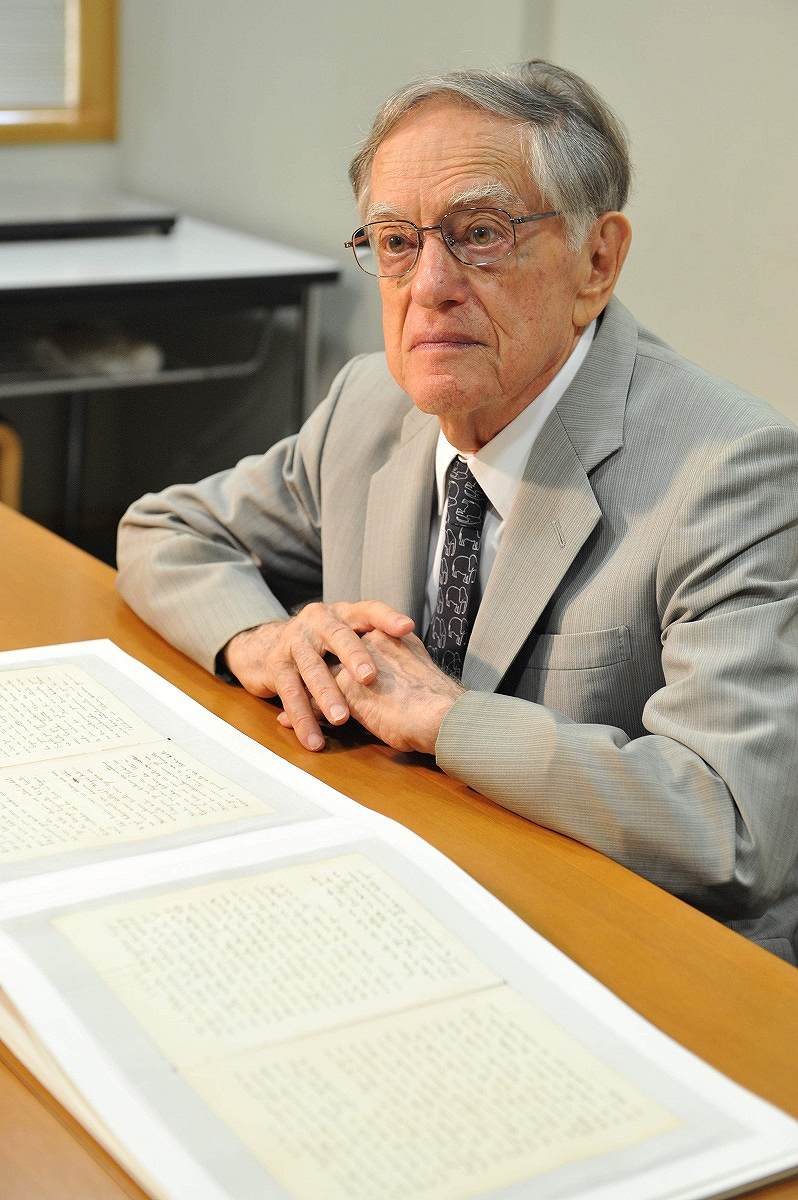
Donald Keene views a reproduction of Takuboku Ishikawa’s “Romazi Nikki” at the Hakodate City Central Library on July 23, 2012.
13:25 JST, November 12, 2025
An exhibition introducing the achievements and character of Japanese literature scholar Donald Keene, and reexamining the appeal of Japanese literature, will begin on Saturday at the Setagaya Literary Museum in Setagaya Ward, Tokyo. Celebrating the museum’s 30th anniversary, “Seeds in the Heart: Donald Keene Exhibition” will run for about four months in two phases, displaying over 300 items in total, including many that will be shown for the first time.
After World War II, Keene spent his life spreading Japanese literature and culture worldwide. He died in February 2019 at the age of 96.
“This is the first time such a large Keene exhibition will be held in Tokyo,” said Seiki Keene, 75, the adopted son of Donald Keene, speaking at the museum on Nov. 5 as preparations for the exhibit were underway. “While there was a large-scale exhibit at the Kanagawa Museum of Modern Literature in Yokohama in 2022 — the centenary of his birth — three years have passed since then, and the examination of my father’s personal belongings has progressed considerably. This exhibit features numerous items from among [his possessions] that are being shown for the first time, including calligraphy works, paintings, antiques and books.”
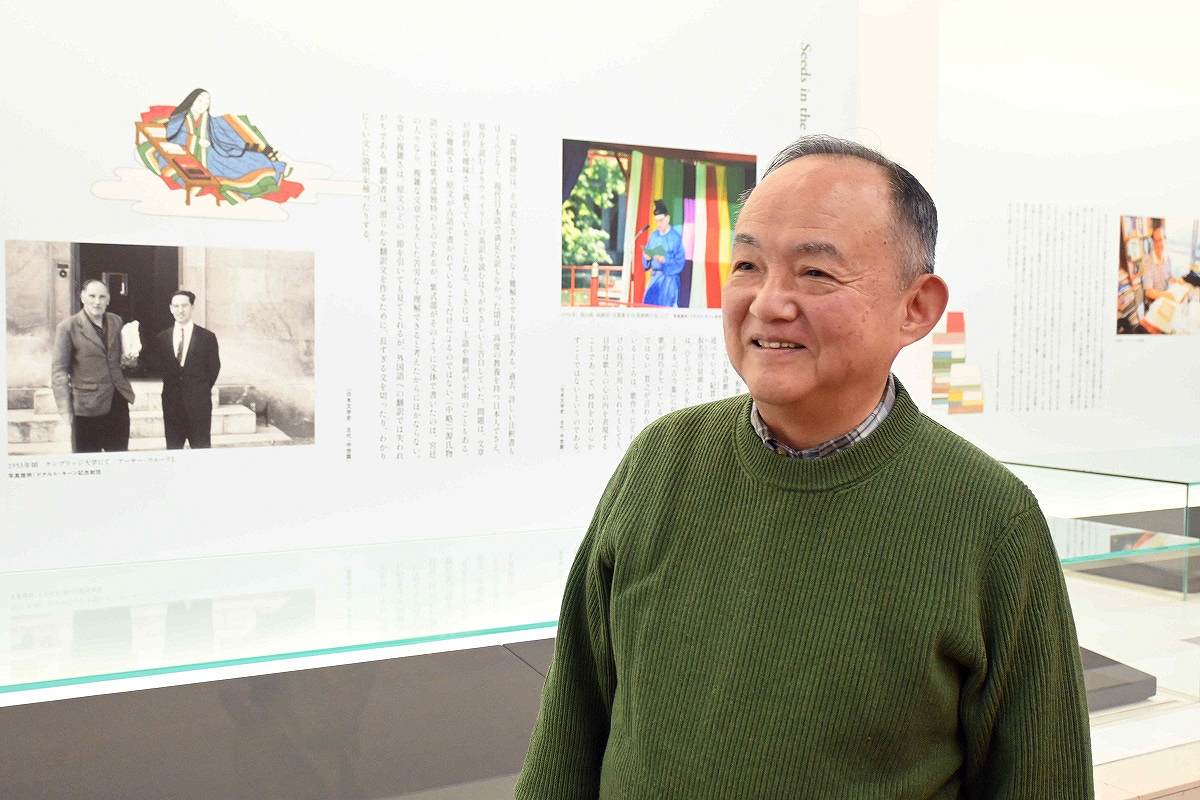
Seiki Keene speaks about the upcoming Donald Keene exhibit, at the Setagaya Literary Museum on Nov. 5.
Among the highlights are a uniquely shaped Buddhist altar crafted for Keene after his death and a reproduction of the manuscript for “Romazi Nikki” (Diary in Romanized Japanese) by Takuboku Ishikawa (1886–1912).
The Buddhist altar, bearing a hexagonal roof, was crafted over roughly three years by Kazumi Murose, a Living National Treasure in lacquer art, and Mikihisa Kinoshita, a master carpenter specializing in sukiya-style architecture. The two received no pay for making it, except for material costs, and they presented it to Seiki in March last year. This is the first time it is on public display.
Murose, who had been close friends with Keene during his lifetime, asked his longtime acquaintance Kinoshita to “create a Buddhist altar that embodies Keene’s spirit, something original.” Kinoshita was inspired to create an altar using the techniques of sukiya-style architecture, and crafted it entirely from high-grade Chinese quince. Murose then finished it with lacquer. The altar embodies the shared wish of both men for Keene — who opened the door of Japanese literature to the world and naturalized as a Japanese citizen in his later years — to have a “Japanese home.”
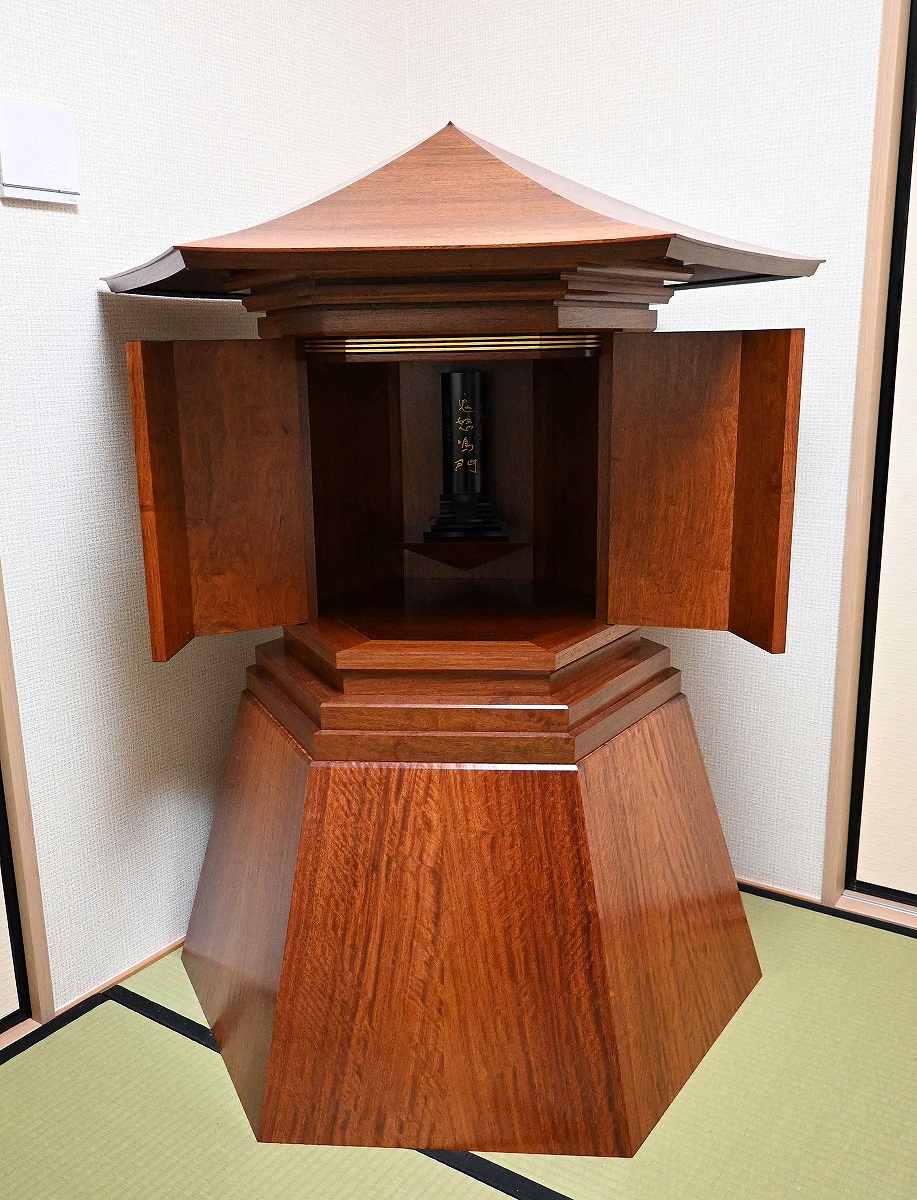
The unique Buddhist altar presented to Seiki after Keene’s death
As for the “Romazi Nikki,” a diary Takuboku wrote in Romanized characters about his poverty, debts, family and other private matters, Keene praised it as “one of the greatest masterpieces of post-Meiji era literature,” according to Seiki. Keene translated parts of it into English, and included it in the 1956 American publication “Modern Japanese Literature: An Anthology.”
Seiki traveled to Hokkaido to visit the Hakodate Takuboku Kai, a group that keeps materials related to Takuboku, and was able to borrow a reproduction of the manuscript for the exhibition. “The original is never taken outside the group. Even this reproduction has never been exhibited outside Hakodate before,” Seiki explained.
Shoichi Saeki, the first director of the Setagaya Literary Museum, who died in 2016, was a friend of Keene’s. In 2000, Keene gave a commemorative lecture for the museum’s fifth anniversary that focused on Emperor Meiji. The upcoming exhibit was made possible due to the ongoing exchange between current director Ikuo Kameyama and Seiki.
During the exhibit, six related events are scheduled, including a gallery talk by Murose and Kinoshita on Jan. 25 and a lecture on March 1 by Yukio Kakuchi, who had long-standing exchanges with Keene and translated many of his books. All events will be on a first-come, first-served basis. Additionally, the Music Division of the Setagaya Arts Foundation will hold two events with entry fees: an opera event on Dec. 16 and a modern Noh performance on Jan. 18, both reflecting on Keene’s legacy through conversation and live music.
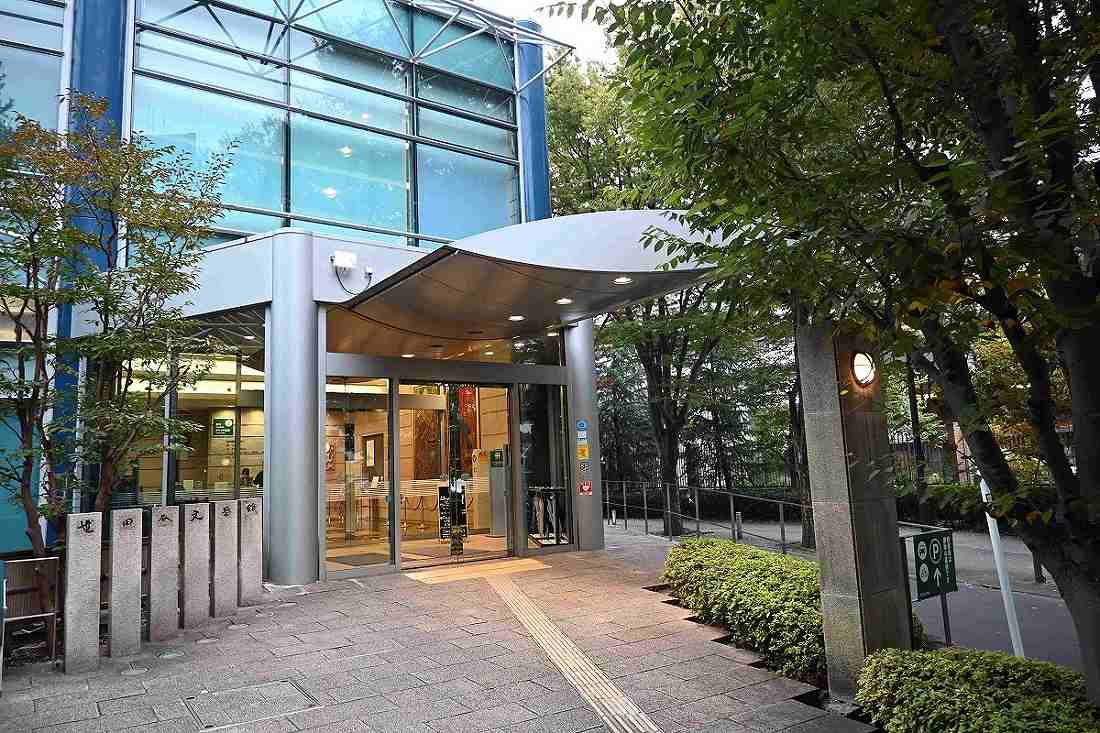
The Setagaya Literary Museum in Setagaya Ward, Tokyo, where the Donald Keene Exhibition will be held
The first phase of the exhibit runs through Jan. 12 next year. The second runs from Jan. 14 through March 8. Tickets are ¥1,000 for general admission. For details, visit the Setagaya Literary Museum website (https://www.setabun.or.jp/ ).



Most Read
Popular articles in the past 24 hours
-
Japanese Shipping Giants Halt Strait of Hormuz Transit as Iran Co...
-

U.S. Launches Attacks on Iran: Avoid Escalation of Conflict by An...
-

Improvement of Japanese Language Schools Lags Rise in Foreigners
-
Rental Lab Space in Tokyo Area More Than Doubles Since 2010, Offe...
-
Sawtooth Roof Factory Stands as Monument to Ashikaga Textile Hist...
-
Parents of Japanese Teen Shot in U.S. Strive for Gun Control
-
Disinformation Spreads About Team Mirai, Ballot Readers; Online P...
-
Bank of Japan Deputy Governor Says Rate Hikes Likely to Continue
Popular articles in the past week
-

Nepal Bus Crash Kills 19 People, Injures 25 Including One Japanes...
-
Milano Cortina 2026: Japanese Gold Medalist Figure Skater Miura S...
-
Tokyo Spends Big on Children, Wins Over Parents
-

McDonald's Japan Raises Prices; Big Mac to Cost ¥500, Double Chee...
-
‘Dry Bonsai’ Gives New Life to Withered Trees, Allows Free Artist...
-
Japan’s Miura, Kihara Announce Withdrawal from Figure Skating Wor...
-
Exhibition Featuring Yoshiharu Tsuge’s Manga World Underway in Ch...
-

Yokohama to Test Out Renewable-Powered Offshore Floating Data Cen...
Popular articles in the past month
-

Producer Behind Pop Group XG Arrested for Cocaine Possession
-

Japan PM Takaichi’s Cabinet Resigns en Masse
-

Man Infected with Measles Reportedly Dined at Restaurant in Tokyo...
-

Israeli Ambassador to Japan Speaks about Japan’s Role in the Reco...
-

Videos Plagiarized, Reposted with False Subtitles Claiming ‘Ryuky...
-

Man Infected with Measles May Have Come in Contact with Many Peop...
-

Prudential Life Insurance Plans to Fully Compensate for Damages C...
-

Woman with Measles Visited Hospital in Tokyo Multiple Times Befor...
Top Articles in JN Specialities
-
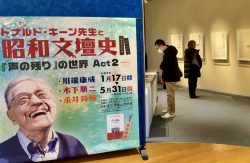
Exhibition Shows Keene’s Interactions with Showa-Era Writers in Tokyo, Features Newspaper Columns, Related Materials
-

The Japan News / Weekly Edition (2/20-2/26)
-

Step Back in Time at Historical Estate Renovated into a Commercial Complex in Tokyo
-
Senior Japanese Citizens Return to University to Gain Knowledge, Find New Career, Make Friends
-
“The Tale of Genji” Back-Translation Project Led to Touching Encounter with Keene; Poet Sisters Recount Memories of Scholar at Packed Talk Event in Tokyo
JN ACCESS RANKING
-
Producer Behind Pop Group XG Arrested for Cocaine Possession
-
Japan PM Takaichi’s Cabinet Resigns en Masse
-
Man Infected with Measles Reportedly Dined at Restaurant in Tokyo Station
-
Israeli Ambassador to Japan Speaks about Japan’s Role in the Reconstruction of Gaza
-
Videos Plagiarized, Reposted with False Subtitles Claiming ‘Ryukyu Belongs to China’; Anti-China False Information Also Posted in Japan