
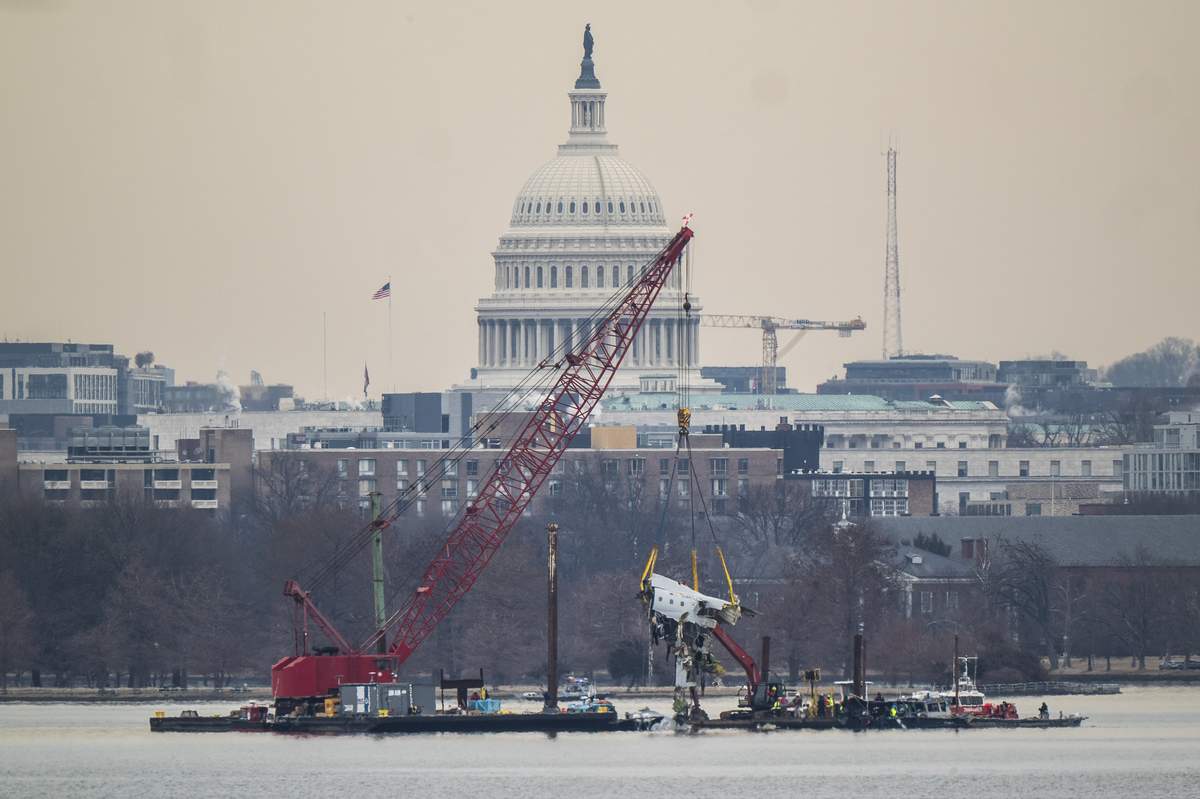
A crane removes wreckage of American Airlines Flight 5342 and an Army Black Hawk helicopter from the Potomac River near Reagan National Airport on Feb. 3.
15:10 JST, December 11, 2025
Family members of those killed in the January midair collision between a U.S. Army Black Hawk helicopter and an American Airlines regional jet are raising alarms about a provision in the defense funding bill that they say would allow the military to potentially restore flying procedures that may have been factors in the crash.
The nighttime collision that killed 67 people occurred over the Potomac River, just as the jet was in its final stages of landing at Reagan National Airport in Arlington, Virginia.
In the months since, the victims’ families and lawmakers have homed in on the Army helicopter’s lack of a critical positioning and communications system called ADSB-out. That technology, widely used in commercial aviation, emits a real-time track of an aircraft’s location and could have provided the control tower and other nearby airplanes critical information to prevent the accident.
The Army’s 12th Aviation Battalion was operating the Black Hawk around National Airport on the night of the collision and was conducting a proficiency training flight, or check ride, that included flying parts of the unit’s “continuity of government” mission – the potential evacuation from Washington, D.C., of key members of government to secure locations in case of an attack.
In those flights, the pilots had a waiver that allowed them not to transmit ADSB-out location data to protect operational security.
In October, Sens. Ted Cruz (R-Texas) and Maria Cantwell (D-Washington) advanced legislation that would require all aircraft operating in congested airspace to have equipment that would broadcast their positions to other aircraft. The lawmakers had hoped it would be included as part of the Pentagon funding measure.
Instead, on Wednesday, the House passed the final version of the 2026 National Defense Authorization Act, which included allowing the military to resume flying in D.C. airspace – and in similarly congested airspace around the country – without using the transmitters when carrying out national security mission or training flights. The annual finding bill is expected to be taken up by the Senate next week.
Sen. Tim Kaine (D-Virginia), who represents many of the families who lost loved ones in the crash, said in a statement that a provision he supported to require stricter location broadcasting from aircraft was ultimately watered down “to accommodate [Defense Department] concerns.”
Shortly after the vote, Cantwell, in a speech on the Senate floor, expressed disappointment that the House allowed a provision that would compromise the safety of the airspace around National Airport to remain in the bill. How the provision made it into the funding measure, she said, is a mystery.
“Who is not listening?” Cantwell continued. “Who’s not listening to the ranking members of committees? Who’s not listening to the NTSB? Who’s not listening to the families of the victims? Who is jamming this into a bill just because they think the DOD still deserves to fly in a crowded airspace without people knowing that they are there?”
Earlier in the day, at a news conference at National Transportation Safety Board headquarters, NTSB Chair Jennifer Homendy called the NDAA language “shameful.”
“We should be working together in partnership to prevent the next accident, not inviting history to repeat itself by re-creating the same conditions that were in place on January 29th,” said a visibly outraged Homendy.
Homendy noted that it is unusual for the NTSB to weigh in on pending legislation but said that the independent safety agency could not remain silent. She also telegraphed her concerns in a letter sent to leaders of the House and Senate Armed Services committees, saying the bill as written gives military aircraft “unfettered access” to D.C. airspace.
That NDAA language was an effort to allow the Army to keep training for its national security mission, while recognizing the dangers of operations in the congested Washington, D.C., airspace, said a person familiar with the legislation who spoke on the condition of anonymity to provide additional context.
On Wednesday in a joint statement, Cruz and Cantwell – along with Sens. Jerry Moran (R-Kansas) and Tammy Duckworth (D-Illinois) – said the NDAA language “fails to make the skies safer. As drafted, the NDAA protects the status quo, allowing military aircraft to keep flying in DC airspace under different rules and with outdated transmission requirements.”
Family members of the crash victims called the exceptions “deeply concerning.”
The NDAA language would put future flights at risk by continuing to “allow for the setting aside of requirements,” said Tim and Sheri Lilley, whose son, Sam Lilley, was the first officer on the American Airlines regional jet. “Safety that depends on exemptions cannot be the foundation of a secure airspace system.”
In a statement, families of some of the crash victims urged Congress to strengthen the bill’s language before final passage and require “real, enforceable visibility standards for all military aircraft operating near civilian traffic,” including legislation requiring ADSB-out “to ensure that a tragedy like Flight 5342 never happens again.”
The NTSB hearing on the crash this summer revealed multiple points of failure, including repeat warnings by pilots to the Federal Aviation Administration that went unheeded about the complex airspace around National Airport and the lack of margin of error between helicopter and commercial air routes. The hearing revealed that the Black Hawk’s barometric altimeter also had known problems that resulted in the crews not receiving accurate altitude data.
In the months since the crash, Route 4 – a low-level helicopter route alongside the Potomac River that directly intersects one of National Airport’s landing paths – has been closed to further use. The Army also secured funding to upgrade ADSB systems throughout its helicopter fleet earlier this year and is in the process of installing those systems.
The Army also ceased flying missions from the Pentagon’s helipad after an incident in May in which radar at the Pentagon lost visibility of an approaching Black Hawk. At the time, two approaching commercial airliners at National Airport were forced to abort landings to avoid the military traffic.
Since the crash, the 12th Aviation Battalion has continued training for portions of the continuity of government mission but has suspended other parts due to the now-closed route and helipad access.
The Army has not responded to requests from The Washington Post to outline what steps it has taken since the crash to change how it operates in D.C. airspace, or how it is maintaining its ability to perform a continuity of government mission under the new flight restrictions.
The NTSB’s final report on the causes of the crash is expected next month, and the Army investigation’s findings shortly after that.






Most Read
Popular articles in the past 24 hours
-

3,000 Accounts Posting, Spreading Content Critical of Japan on X;...
-

Milano Cortina 2026: Sakamoto Serves as Flag Bearer; Japan Earns ...
-

My Spendthrift Mother Constantly Asks Me for Money
-

Japanese Students Use Traditional Pickle to Create Novel Wagashi ...
-

‘Dry Bonsai’ Gives New Life to Withered Trees, Allows Free Artist...
-

A Packed Bus Plunges off a Nepal Highway, Killing 19 and Injuring...
-

Dozens of Jewelry, Other Items Stolen After Glass Door, Showcases...
-

1.2 Mil. Rapeseed Flowers Attract Cute Birds, People in Aichi Pre...
Popular articles in the past week
-

Japan PM Takaichi’s Cabinet Resigns en Masse
-

Man Infected with Measles Reportedly Dined at Restaurant in Tokyo...
-

Sanae Takaichi Elected Prime Minister of Japan; Keeps All Cabinet...
-

Japan's Govt to Submit Road Map for Growth Strategy in March, PM ...
-

Bus Carrying 40 Passengers Catches Fire on Chuo Expressway; All E...
-

U.S. Firm to Build Training Hub in Fukushima N-plant for Debris R...
-

Japan, U.S. Name 3 Inaugural Investment Projects; Reached Agreeme...
-

Riku-Ryu Pair Wins Gold Medal: Their Strong Bond Leads to Major C...
Popular articles in the past month
-
Japan PM Takaichi’s Cabinet Resigns en Masse
-

Japan Institute to Use Domestic Commercial Optical Lattice Clock ...
-

Israeli Ambassador to Japan Speaks about Japan’s Role in the Reco...
-
Man Infected with Measles Reportedly Dined at Restaurant in Tokyo...
-

Videos Plagiarized, Reposted with False Subtitles Claiming ‘Ryuky...
-

Man Infected with Measles May Have Come in Contact with Many Peop...
-

Prudential Life Insurance Plans to Fully Compensate for Damages C...
-

Woman with Measles Visited Hospital in Tokyo Multiple Times Befor...
Top Articles in News Services
-

Survey Shows False Election Info Perceived as True
-

Prudential Life Expected to Face Inspection over Fraud
-

Hong Kong Ex-Publisher Jimmy Lai’s Sentence Raises International Outcry as China Defends It
-

Japan’s Nikkei Stock Average Touches 58,000 as Yen, Jgbs Rally on Election Fallout (UPDATE 1)
-
Japan’s Nikkei Stock Average Falls as US-Iran Tensions Unsettle Investors (UPDATE 1)
JN ACCESS RANKING
-
Japan PM Takaichi’s Cabinet Resigns en Masse
-
Japan Institute to Use Domestic Commercial Optical Lattice Clock to Set Japan Standard Time
-
Israeli Ambassador to Japan Speaks about Japan’s Role in the Reconstruction of Gaza
-
Man Infected with Measles Reportedly Dined at Restaurant in Tokyo Station
-
Videos Plagiarized, Reposted with False Subtitles Claiming ‘Ryukyu Belongs to China’; Anti-China False Information Also Posted in Japan