
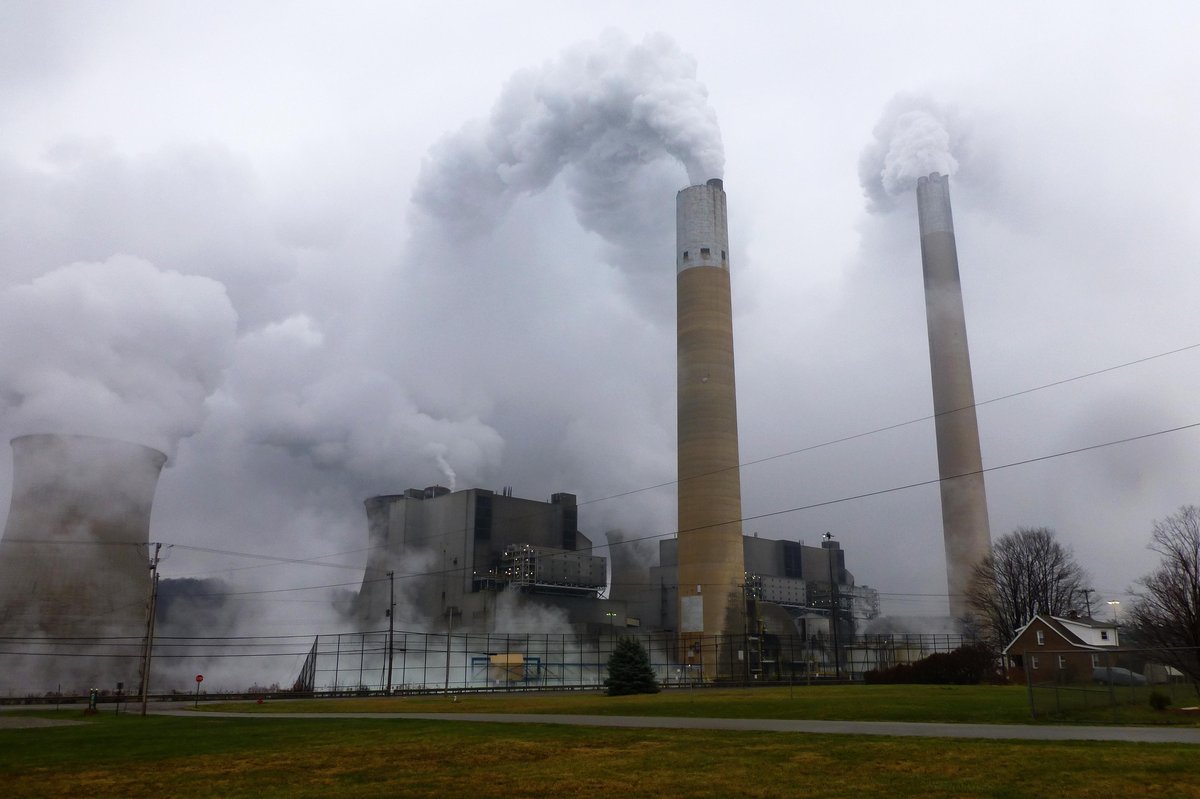
Smoke and steam billow from cooling towers and smokestacks at the now-closed Bruce Mansfield Power Plant in Shippingport, Pennsylvania.
17:13 JST, November 26, 2025
The Environmental Protection Agency is abandoning a rule that would strengthen limits on fine-particle pollution, a move scientists and experts say could lead to dirtier air and more U.S. deaths.
On Monday night, the agency moved to vacate defense of the rule, which the Biden administration finalized last year, arguing that the previous administration did not have the authority to tighten it. That regulation imposed stricter standards on fine particulate matter measuring less than 2.5 micrometers in diameter, including soot, which ranks as the nation’s deadliest air pollutant.
The agency argued in the U.S. Court of Appeals for the District of Columbia Circuit that the Biden-era rule was done “without the rigorous, stepwise process that Congress required,” according to the court filing. “EPA now confesses error and urges this Court to vacate the Rule before the area designation deadline” of Feb. 7.
EPA press secretary Carolyn Holran said the Biden administration rule would cost “hundreds of millions, if not billions of dollars to American citizens if allowed to be implemented.”
President Joe Biden’s EPA estimated that compliance could cost the industry up to $590 million each year.
The stricter standards finalized under the Biden administration sought to address the pollution burden for disadvantaged communities. Under the first Trump administration, the EPA kept the level of PM2.5 at 12.0 micrograms per cubic meter of air; the Biden administration lowered the level to 9.0 micrograms. At the time, the Biden administration’s EPA estimated that the shift would prevent 4,500 premature deaths and 290,000 lost workdays by 2032, when the rule was slated to be fully implemented.
PM2.5, which is roughly one-thirtieth the width of a human hair, can travel through a person’s lungs and easily infiltrate the bloodstream. Exposure can trigger short-term respiratory problems such as coughing, wheezing, difficulty breathing and asthma exacerbation, according to the EPA. In severe cases, fine particulates have been linked to heart attack and stroke, as well as lung cancer.
Industry trade associations and attorneys general from conservative states filed a lawsuit against Biden’s EPA, stating that compliance with the tighter standard would have steep costs and burden manufacturers. Some of the major sources of the air pollutant include refineries, power plants, and cars and trucks.
“I am pleased to see the Trump administration roll back this and other devastating Biden-era policies that would have done considerable harm to West Virginia manufacturers, utilities and families,” said West Virginia Gov. Patrick Morrisey (R), who led a multistate effort to block the rule.
During a hearing before the House Energy and Commerce subcommittee on environment in June, industry lobbyist Paul Noe testified that the EPA’s model would make it difficult for businesses to construct manufacturing plants and obtain federal permits for them.
Noe, who is the vice president of public policy at the American Forest and Paper Association, said that by “setting the standard so close to background levels” of fine particulate matter, there would not be “sufficient ‘permit headroom.’” He added that industry was no longer the primary contributor of PM2.5 in the United States, with wildfires and dust accounting for a greater share of the problem.
The administration’s withdrawal from the case drew instant backlash from environmental groups and advocates who say the move ignores science and dismantles pollution safeguards.
“The administration wants to take away Americans’ right to breathe clean, safe air, free from deadly soot pollution,” said John Walke, senior attorney with the Natural Resources Defense Council, an advocacy group. “The Trump EPA is siding with big polluters, challenging safer standards and asking a court to do its dirty work.”
Seth Johnson, a senior attorney at Earthjustice who has been helping the EPA defend the rule in court, said the EPA had never before abandoned its legal defense for this type of rule. The shift, Johnson said, does not negate or address the scientific evidence.
“They are running away from the standard without disputing the science,” Johnson said. “They are asking the court to make the standard go away.”
In its filing, the EPA proposed reverting to the rule finalized in 2020, during President Donald Trump’s first term. The agency is required to do a thorough review of the fine-particle pollution standards every five years.



Most Read
Popular articles in the past 24 hours
-

3,000 Accounts Posting, Spreading Content Critical of Japan on X;...
-

My Spendthrift Mother Constantly Asks Me for Money
-

Japanese Students Use Traditional Pickle to Create Novel Wagashi ...
-

‘Dry Bonsai’ Gives New Life to Withered Trees, Allows Free Artist...
-

A Packed Bus Plunges off a Nepal Highway, Killing 19 and Injuring...
-

Dozens of Jewelry, Other Items Stolen After Glass Door, Showcases...
-

1.2 Mil. Rapeseed Flowers Attract Cute Birds, People in Aichi Pre...
-
Kofu Records 25.3 C; Ome in Western Tokyo Sees 25.1 C
Popular articles in the past week
-

Japan PM Takaichi’s Cabinet Resigns en Masse
-

Man Infected with Measles Reportedly Dined at Restaurant in Tokyo...
-

Sanae Takaichi Elected Prime Minister of Japan; Keeps All Cabinet...
-

Japan's Govt to Submit Road Map for Growth Strategy in March, PM ...
-

Bus Carrying 40 Passengers Catches Fire on Chuo Expressway; All E...
-
U.S. Firm to Build Training Hub in Fukushima N-plant for Debris R...
-

Japan, U.S. Name 3 Inaugural Investment Projects; Reached Agreeme...
-

Riku-Ryu Pair Wins Gold Medal: Their Strong Bond Leads to Major C...
Popular articles in the past month
-
Japan PM Takaichi’s Cabinet Resigns en Masse
-

Japan Institute to Use Domestic Commercial Optical Lattice Clock ...
-

Israeli Ambassador to Japan Speaks about Japan’s Role in the Reco...
-
Man Infected with Measles Reportedly Dined at Restaurant in Tokyo...
-

Videos Plagiarized, Reposted with False Subtitles Claiming ‘Ryuky...
-

Man Infected with Measles May Have Come in Contact with Many Peop...
-

Prudential Life Insurance Plans to Fully Compensate for Damages C...
-

Woman with Measles Visited Hospital in Tokyo Multiple Times Befor...
Top Articles in News Services
-
Survey Shows False Election Info Perceived as True
-
Prudential Life Expected to Face Inspection over Fraud
-
Hong Kong Ex-Publisher Jimmy Lai’s Sentence Raises International Outcry as China Defends It
-

Japan’s Nikkei Stock Average Touches 58,000 as Yen, Jgbs Rally on Election Fallout (UPDATE 1)
-
Japan’s Nikkei Stock Average Falls as US-Iran Tensions Unsettle Investors (UPDATE 1)
JN ACCESS RANKING
-
Japan PM Takaichi’s Cabinet Resigns en Masse
-
Japan Institute to Use Domestic Commercial Optical Lattice Clock to Set Japan Standard Time
-
Israeli Ambassador to Japan Speaks about Japan’s Role in the Reconstruction of Gaza
-
Man Infected with Measles Reportedly Dined at Restaurant in Tokyo Station
-
Videos Plagiarized, Reposted with False Subtitles Claiming ‘Ryukyu Belongs to China’; Anti-China False Information Also Posted in Japan