
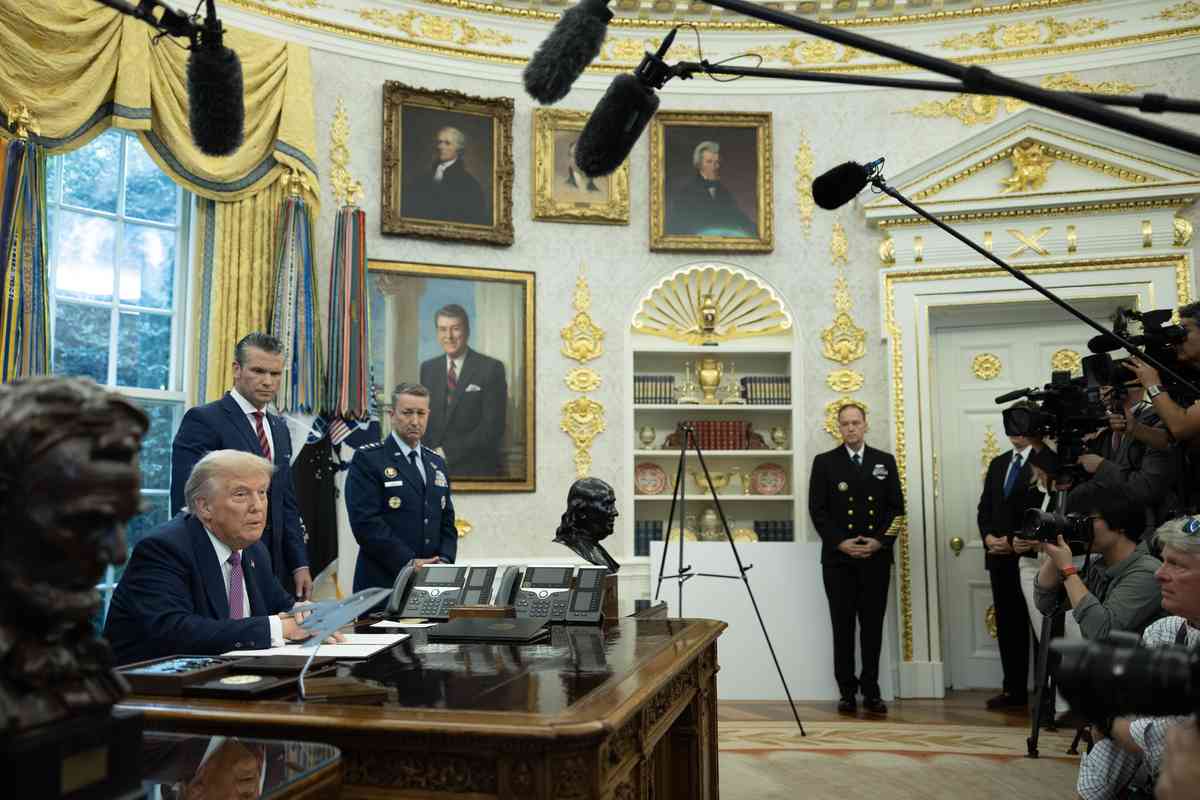
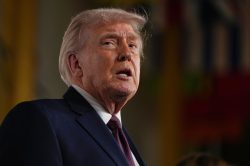
President Donald Trump is joined in the Oval Office by Defense Secretary Pete Hegseth and Joint Chiefs Chairman Gen. Dan Caine.
12:34 JST, November 16, 2025
Defense Secretary Pete Hegseth and Joint Chiefs Chairman Gen. Dan Caine returned to the White House on Friday for a second consecutive day of deliberations centered on potential military action in Venezuela, as U.S. forces in the region prepared for possible attack orders, according to people familiar with the matter.
It remains unclear if President Donald Trump has decided to pursue such an escalation, though high-level discussions over whether to strike Venezuela – and how – have been underway for days, these people said, speaking on the condition of anonymity because the matter is highly sensitive. Also joining the White House meeting were Vice President JD Vance, Secretary of State Marco Rubio and Deputy Chief of Staff Stephen Miller, these people said.
A White House spokesperson declined to comment. The Pentagon press office did not respond to a request for comment.
An administration official said “a host of options” has been presented to the president. Trump is “very good at maintaining strategic ambiguity, and something he does very well is he does not dictate or broadcast to our adversaries what he wants to do next,” the official said.
Any strike on Venezuelan territory would upend the president’s frequent promises of avoiding new conflicts and betray promises made to Congress in recent weeks that no active preparations were underway for such an attack. It also would further complicate U.S. cooperation with other Latin American countries, and deepen suspicions – there and in Washington – over whether Trump’s endgame is the forced removal of Venezuela’s president, Nicolás Maduro, whom Trump has accused of sending drugs and violent criminals to the United States.
Maduro, a socialist strongman, came to power in Caracas in 2013 and increasingly has become a fixation for Trump. In August, U.S. officials increased the reward for information leading to his arrest and conviction from $25 million to $50 million, citing alleged ties to drug cartels and U.S. beliefs dating back to the Biden administration that he lost Venezuela’s 2024 presidential election and refused to step down.
“The United States is very plugged into what’s going on in Venezuela, the chatter among Maduro’s people and the highest levels of his regime,” the administration official said. “Maduro is very scared, and he should be scared. The president has options on the table that are very bad for Maduro and his illegitimate regime. … We view this regime as illegitimate, and it’s not serving the Western Hemisphere well.”
The United States maintains a massive military advantage over Venezuela, but a significant expansion of its activities also risks exposing American troops to grave danger. Fighter pilots aboard the USS Gerald R. Ford, an aircraft carrier that’s been dispatched to the region, have been studying Venezuelan air defenses, though they did not yet know whether they’ll be ordered to attack, a person familiar with the matter said. The Venezuelan Defense Ministry has announced a massive mobilization of nearly 200,000 air, ground and navy personnel to prepare to defend the country.
U.S. planning has raised the possibility, too, of involving the military’s elite Delta Force, according to two people familiar with the matter. The highly trained Special Operations unit prepares for an array of capture-and-kill missions, and it saw frequent usage in two decades of U.S. wars in the Middle East.
In recent weeks, Trump and his top advisers have sent mixed signals about the administration’s aims. He has repeatedly voiced a desire to expand “to the land” a campaign – now called Operation Southern Spear – that has killed 80 people aboard small speedboats alleged to be smuggling drugs through the Caribbean Sea and eastern Pacific Ocean. Yet as Congress debated legislation to prevent Trump from starting a war in Venezuela, Hegseth and Rubio privately told select lawmakers that the administration was not currently planning to do so – an assurance that helped persuade enough Republicans to reject the measure.
During a late-October briefing on Capitol Hill, members of the House Armed Services Committee asked military officials whether the Pentagon was planning any operations inside Venezuela, a Democratic lawmaker said. They were assured then as well that the answer was no, the lawmaker said.
“I’m starting to have a major trust deficit with the department,” this person said of the Pentagon, speaking on the condition of anonymity because the briefing they received was classified. “And I’m starting to believe that their motives are not pure and that they’re not being truthful and candid with Congress.”
The Trump administration’s binding legal defense of its military operations around Latin America does not seek to justify an attack on Venezuela itself, according to several people who have reviewed the document. Two lawmakers said that the Trump administration’s argument instead seeks to blend the laws that govern criminal drug trafficking with the laws of armed conflict.
The document compares narcotics to “chemical weapons,” these people said. It also attempts to justify the lethal boat strikes by claiming the U.S. is acting in “collective self-defense” with allies such as Colombia and Mexico against drug cartels funding campaigns of violence in their countries through the narcotics trade.
But some lawmakers, and many legal experts, call the comparison misguided. Drug trafficking is a civilian offense perpetrated by suspected criminals, not an armed attack by enemy combatants who pose an imminent threat to American citizens.
“Harboring drug runners has never been considered a use of force under international law or an attack under international law,” Dan Maurer, a former Army judge advocate general who now teaches at Ohio Northern University, said on a call with reporters this week.
The New York Times and Wall Street Journal previously reported elements of the administration’s argument.
The Trump administration’s sprawling military mission in Latin America has roiled some of Washington’s closest partners in the region. Colombia, a longtime collaborator on counternarcotics operations, this week said it was suspending its intelligence sharing with the United States over what the country’s president, Gustavo Petro, said was a “human rights” imperative.
Mexico’s president, Claudia Sheinbaum, said this week that representatives from her government met with U.S. officials after a recent U.S. strike about 400 miles from Acapulco to reaffirm existing maritime agreements and “prevent the use of bombing against vessels” so close to Mexico’s territory. Sheinbaum said previously that “we do not agree with these attacks.”
The representatives from the two countries reached an understanding that if U.S. officials have information about suspected drug trafficking vessels near Mexico, the Mexican navy would be tasked with intercepting those boats, Sheinbaum said. The meeting took place after the Mexican navy was asked to help with a search-and-rescue mission after the U.S. boat strike near Mexico late last month, according to two Mexican government officials who spoke on the condition of anonymity to discuss the private conversation.
“President Trump is working with many regional partners on counternarcotics, but will continue to take every possible measure to stop the flow of deadly drugs into our homeland,” a senior Trump administration official said in response to questions about the Mexico discussions. The official spoke on the condition of anonymity under ground rules set by the White House.
The U.S. Embassy in Mexico declined to comment.
With the arrival of the Gerald R. Ford, there are about 15,000 U.S. troops in the region, including personnel spread across roughly a dozen warships and reinforcements sent in recent weeks to U.S. facilities in Puerto Rico. Collectively, it marks a stunning presence in a region that historically has seen only one or two U.S. Navy vessels at a time, along with the U.S. Coast Guard conducting routine drug-interdiction operations that typically resulted in the detention of alleged smugglers and confiscation of any contraband.
As of Friday, there were seven U.S. warships in the Caribbean: the guided missile cruisers USS Gettysburg and USS Lake Erie; the destroyers USS Gravely and USS Stockdale; and the amphibious ships USS Iwo Jima, USS Fort Lauderdale and USS San Antonio. The Ford was nearby in the Atlantic with the destroyers USS Mahan, USS Bainbridge and USS Winston S. Churchill.
National security experts have said they can foresee Trump taking action soon.
On Thursday, retired Gen. Laura Richardson, who led U.S. Southern Command from 2021 to 2024, said during a panel discussion at the Atlantic Council that Venezuela’s military has older weapons and, broadly, lacks operational readiness. She added that Venezuela has an older air-defense system that is probably arrayed to protect the capital city of Caracas and the Maduro regime. Venezuela, she added, has long provided safe haven to Colombian drug cartels that move across the two countries’ shared border.
Alexander Gray, who served in national security roles during the first Trump administration, said during the same panel discussion that the Maduro government is “almost inseparable from the narcotraffickers.”
“To the extent that we can have regime change that occurs from an internal source, that’s ideal,” Gray argued, alluding to an overthrow of Maduro from within Venezuela rather than a forced removal led by the U.S. military. “But I think where we’re headed is that this regime, as currently constituted, poses a direct threat to U.S. national interests, and that is why the president has taken the action that he has.”
Many Democrats, and some Republicans, resoundingly disagree. Sen. Todd Young (R-Indiana), who last week declined to endorse legislation that sought to constrain Trump on Venezuela, said after the vote that he was “troubled” nonetheless by “many aspects and assumptions” Trump and the administration’s defenders have made in seeking to justify its actions in Latin America. Young added, “It is at odds with the majority of Americans who want the U.S. military less entangled in international conflicts.”





Most Read
Popular articles in the past 24 hours
-

My Spendthrift Mother Constantly Asks Me for Money
-

Japanese Students Use Traditional Pickle to Create Novel Wagashi ...
-

‘Dry Bonsai’ Gives New Life to Withered Trees, Allows Free Artist...
-

A Packed Bus Plunges off a Nepal Highway, Killing 19 and Injuring...
-

McDonald's Japan Raises Prices; Big Mac to Cost ¥500, Double Chee...
-

Astellas Collaborates with Vir to Develop Its Experimental Prosta...
-

Nepal Bus Crash Kills 19 People, Injures 25 Including One Japanes...
-

Japan’s Nikkei Stock Average Rises as AI-Related Stocks Shine; Co...
Popular articles in the past week
-

Producer Behind Pop Group XG Arrested for Cocaine Possession
-

Japan PM Takaichi’s Cabinet Resigns en Masse
-

Sanae Takaichi Elected Prime Minister of Japan; Keeps All Cabinet...
-

Japan's Govt to Submit Road Map for Growth Strategy in March, PM ...
-

Bus Carrying 40 Passengers Catches Fire on Chuo Expressway; All E...
-
U.S. Firm to Build Training Hub in Fukushima N-plant for Debris R...
-
Japan, U.S. Name 3 Inaugural Investment Projects; Reached Agreeme...
-

Riku-Ryu Pair Wins Gold Medal: Their Strong Bond Leads to Major C...
Popular articles in the past month
-
Producer Behind Pop Group XG Arrested for Cocaine Possession
-
Japan PM Takaichi’s Cabinet Resigns en Masse
-

Japan Institute to Use Domestic Commercial Optical Lattice Clock ...
-

Man Infected with Measles Reportedly Dined at Restaurant in Tokyo...
-

Israeli Ambassador to Japan Speaks about Japan’s Role in the Reco...
-

Videos Plagiarized, Reposted with False Subtitles Claiming ‘Ryuky...
-

Man Infected with Measles May Have Come in Contact with Many Peop...
-

Prudential Life Insurance Plans to Fully Compensate for Damages C...
Top Articles in News Services
-
Survey Shows False Election Info Perceived as True
-
Hong Kong Ex-Publisher Jimmy Lai’s Sentence Raises International Outcry as China Defends It
-
Japan’s Nikkei Stock Average Touches 58,000 as Yen, Jgbs Rally on Election Fallout (UPDATE 1)
-
Japan’s Nikkei Stock Average Falls as US-Iran Tensions Unsettle Investors (UPDATE 1)
-
Trump Names Former Federal Reserve Governor Warsh as the Next Fed Chair, Replacing Powell
JN ACCESS RANKING
-
Producer Behind Pop Group XG Arrested for Cocaine Possession
-
Japan PM Takaichi’s Cabinet Resigns en Masse
-
Japan Institute to Use Domestic Commercial Optical Lattice Clock to Set Japan Standard Time
-
Man Infected with Measles Reportedly Dined at Restaurant in Tokyo Station
-
Israeli Ambassador to Japan Speaks about Japan’s Role in the Reconstruction of Gaza