
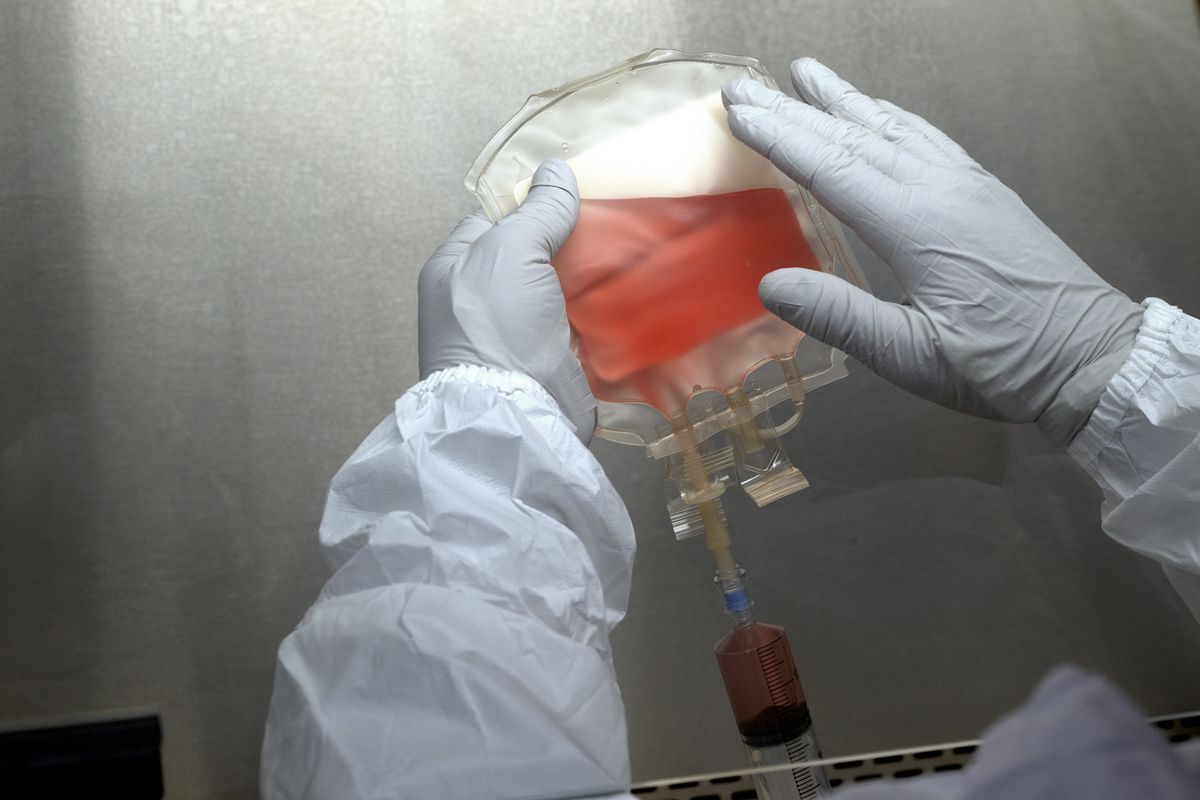
A clinical trial at Children’s National Hospital is one of three testing therapies for pediatric solid tumors. All are part of a $470 million project called Cancer Grand Challenges.
12:31 JST, November 3, 2025
Years of caring for children with solid tumors and looking into the eyes of parents starved for hope have led Catherine Bollard to what she calls the most important moment of her career.
Children’s National Hospital, where Bollard is senior vice president and chief research officer, is poised to start recruiting children with pediatric sarcomas and other solid tumors that have resisted chemotherapy and radiation for a clinical trial that will use an inventive new technique to combat one of the most persistent problems in cancer care.
For 30 years, as medicine advanced in the treatment of breast cancer and chronic myeloid leukemia, progress on children’s solid tumors has remained “dismal,” Bollard said. “There just hasn’t been the same amount of effort and financial support around really understanding the biology of pediatric cancers” that there has been for adult cancers, she said. “We have not gone fast enough as a field.”
But this time, Bollard and her team will attack the cancer with a two-pronged approach never tried before. The 12 children in the trial will receive a treatment using their own T cells, one specially engineered to counter cancer’s skill in escaping medications aimed at a single target.
The treatment the children receive will attack two targets on their tumors simultaneously: one called PRAME, a protein that promotes tumor growth, and the other B7-H3, a protein that helps cancer evade the immune system.
“Cancers are really clever,” Bollard explained. “And one of the ways they get clever is they get rid of one of their targets.” If the cancer cells detect that a treatment like T cells is focusing on one target, she said, “then the cancer cell can just go, ‘Okay, I’m going to get rid of that target.’ But because our product is targeting two, it’s much harder for the tumor cell to catch up and delete them both.”
The idea for the design of the new treatment came to Bollard one day in August or September 2024 as she was driving to the hospital. She told her research team they would need to add a few last-minute experiments to prove the new product’s potency before they could submit their clinical trial application to the Food and Drug Administration.
Preparing each child’s T cells will take about two to three weeks, plus another week for testing to ensure no pathogens are present.
The clinical trial at Children’s National is one of three testing therapies for pediatric solid tumors; the others are taking place at University College London and Boston Children’s Hospital. All are part of a massive $470 million project called Cancer Grand Challenges, launched in 2020 by the National Cancer Institute and Cancer Research UK, a London-based charity that supports cancer research.
David Scott, who directs the Cancer Grand Challenges, said the program aims to build on successes in cancer research but targets “the tough problems where we need innovation to move forward.”
In addition to tackling children’s solid tumors, Cancer Grand Challenges include projects aimed at understanding and reducing inequities in cancer; learning why the incidence of early-onset cancers is rising around the world; and understanding and reversing cachexia, a syndrome affecting many cancer patients characterized by significant weight loss, including the loss of skeletal muscle and fatty tissue.
The United States records about 3,700 new cases of pediatric solid tumors each year. The relative rarity of these cancers has been one of the barriers to progress. It’s much harder to interest drug companies when the market for anything they discover will be relatively small.
“There have been some wonderful breakthroughs over the years. We do have some new agents, but the pace that these things have come on board has been extremely slow for children,” said Cindy Schwartz, a professor of pediatrics at the Medical College of Wisconsin and a doctor at Children’s Wisconsin hospital. Schwartz has treated children with solid tumors for 35 years.
“One of the tumors I specialized in over the years is osteosarcoma,” she said, “and we’ve not changed our therapies significantly for decades.”
About 1,000 cases of osteosarcoma, a rare bone tumor, are diagnosed in the U.S. each year, about half in children.
Schwartz said the one agent that showed an 8 percent improvement in osteosarcoma survival in 2008 has been approved in Europe and other countries, but not yet in the U.S., “so it’s very frustrating.”
Another problem: Some of the treatments that have worked for adults have not worked for children.
“A really good example of that is checkpoint inhibitors,” Bollard said. “You see all these ads for Opdivo. These checkpoint inhibitors aren’t working for pediatric solid tumors, and we think that’s because the microenvironment in pediatric cancers is very different than in adult cancers.”
A tumor’s microenvironment, the ecosystem that surrounds it, includes immune cells and the endothelial cells that line blood vessels. But in pediatric cancers, unlike those afflicting adults, the microenvironment has not had decades of experience encountering viruses and learning to fight them.
Abbe Pannucci, a lab manager at the University of Pittsburgh Medical Center who will be serving as a patient advocate for the clinical trial at Children’s National, has a personal stake in the fight against children’s solid tumors.
To this day, Pannucci, 25, has no idea why she was one of the lucky children to survive such a tumor. Her rhabdomyosarcoma was Stage 4, meaning it had already spread. She was 10 years old, and her five-year outlook was 30 percent or less.
“I think about that a lot, honestly,” said Pannucci. “I’m dedicating my survivorship to making a difference in all of the advocacy and research. I’m kind of creating my why.”
Pannucci endured 54 rounds of chemotherapy, seven different kinds, the maximum doses of each. She survived, though the treatments made her infertile and put her at risk for secondary cancers.
“I’ve kind of adopted the role of a scientific explainer,” she said of her role as patient advocate in the clinical trial. “I’m working a lot on developing patient information sheets and video explainers that are super accessible to kids.”
Another patient advocate is Gavin Lindberg, who co-founded the Maryland-based nonprofit EVAN Foundation with his wife, Wendy, in honor of their son and only child.
Evan Lindberg “was pure joy,” his father said, a smart, funny boy who loved dinosaurs, monster trucks and driveway hockey. Evan died at the age of 7 after a four-year bout with neuroblastoma, a rare cancer that develops in nerve tissue.
“He took on his treatment with such courage and strength and resiliency that it was hard to believe that he was a young boy,” Gavin Lindberg said.
Evan’s parents donated his cells for research, and his father said he sometimes thinks of scientists using them in their work.
Over the past three years, the team at Children’s National lay the groundwork for the clinical trial: testing the treatment on children’s cancer cells in a lab dish, writing the step-by-step protocol, and applying for and receiving various approvals.
“The work that we really needed to do was to show that it was just as safe” as similar treatments that attack just a single target on the tumor, Bollard said.
“If it works once or twice, that’s not enough,” she said. “If it works three times, that’s not enough. If it works 10 times, that’s a signal that maybe this will be important.”







Most Read
Popular articles in the past 24 hours
-

Voters Using AI to Choose Candidates in Japan's Upcoming General ...
-

Japan's Snow-Clad Beauty: Camellia Flowers Seen in Winter Bloom a...
-

Monkey Strikes Junior High School Girl from Behind in Japan's Yam...
-

Genichiro Inokuma's Mural in Ueno Station That Gave Hope in Postw...
-

Senior Japanese Citizens Return to University to Gain Knowledge, ...
-

Heavy Snow Linked to 30 Deaths across Japan since Late Jan.; JMA ...
-

Tokyo Police Arrest Head of Resignation Assistance Firm
-

Foreign and Security Policy: Political Parties Must Discuss How T...
Popular articles in the past week
-

Japan Institute to Use Domestic Commercial Optical Lattice Clock ...
-

Australian Woman Dies After Mishap on Ski Lift in Nagano Prefectu...
-

Foreign Snowboarder in Serious Condition After Hanging in Midair ...
-

Chinese Embassy in Japan Reiterates Call for Chinese People to Re...
-

Narita Airport, Startup in Japan Demonstrate Machine to Compress ...
-

Toyota Motor Group Firm to Sell Clean Energy Greenhouses for Stra...
-
Sakie Yokota, Last Surviving Parent of a North Korea Abductee, Ur...
-

Beer Yeast Helps Save Labor, Water Use in Growing Rice; Govt Hope...
Popular articles in the past month
-
Univ. in Japan, Tokyo-Based Startup to Develop Satellite for Disa...
-
JAL, ANA Cancel Flights During 3-day Holiday Weekend due to Blizz...
-
China Confirmed to Be Operating Drilling Vessel Near Japan-China ...
-

China Eyes Rare Earth Foothold in Malaysia to Maintain Dominance,...
-
M6.2 Earthquake Hits Japan's Tottori, Shimane Prefectures; No Tsu...
-
Japan Institute to Use Domestic Commercial Optical Lattice Clock ...
-

Japan, Qatar Ministers Agree on Need for Stable Energy Supplies; ...
-

Japan, Italy to Boost LNG Cooperation; Aimed at Diversifying Japa...
Top Articles in News Services
-

Arctic Sees Unprecedented Heat as Climate Impacts Cascade
-

Prudential Life Expected to Face Inspection over Fraud
-

South Korea Prosecutor Seeks Death Penalty for Ex-President Yoon over Martial Law (Update)
-

Trump Names Former Federal Reserve Governor Warsh as the Next Fed Chair, Replacing Powell
-

Japan’s Nagasaki, Okinawa Make N.Y. Times’ 52 Places to Go in 2026
JN ACCESS RANKING
-
Univ. in Japan, Tokyo-Based Startup to Develop Satellite for Disaster Prevention Measures, Bears
-
JAL, ANA Cancel Flights During 3-day Holiday Weekend due to Blizzard
-
China Confirmed to Be Operating Drilling Vessel Near Japan-China Median Line
-
China Eyes Rare Earth Foothold in Malaysia to Maintain Dominance, Counter Japan, U.S.
-
Japan Institute to Use Domestic Commercial Optical Lattice Clock to Set Japan Standard Time