
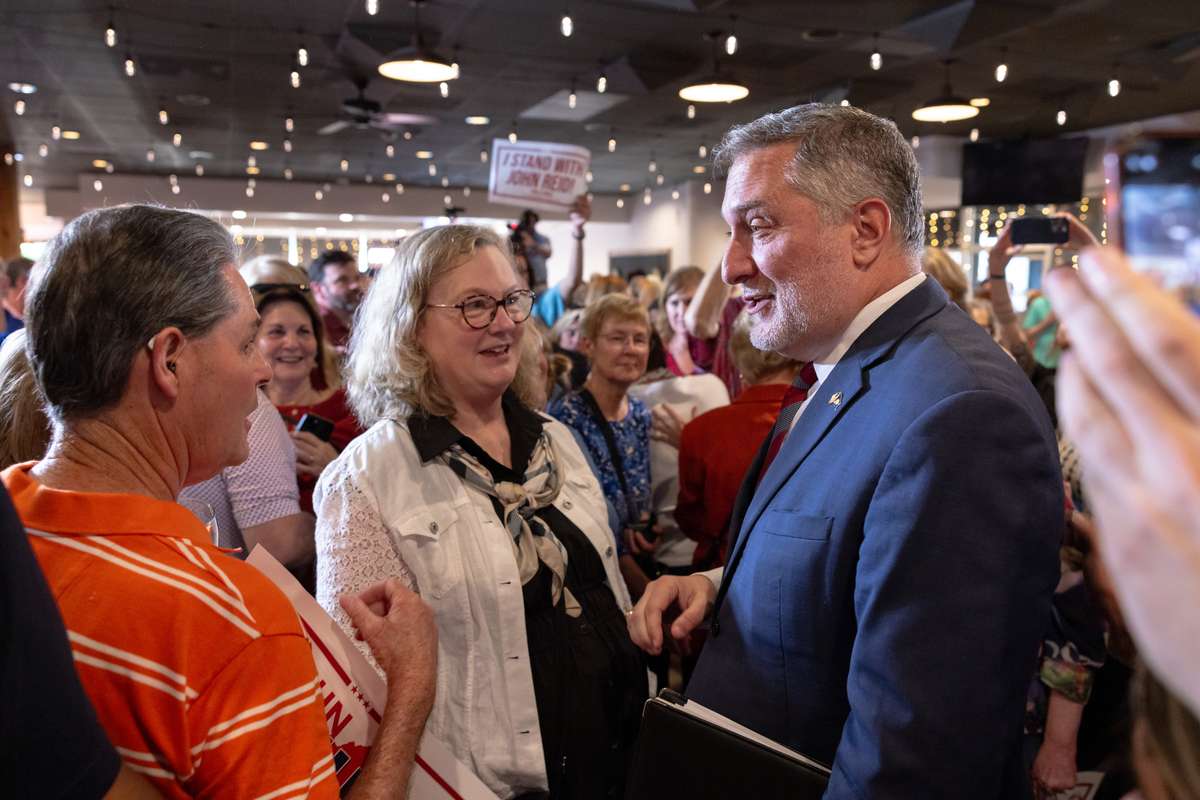
John Reid greets supporters during a campaign event in April in Henrico County, outside Richmond.
12:42 JST, October 31, 2025
John Reid had already been making it public for decades, but standing before a diner full of retirees earlier this month, the GOP nominee for Virginia lieutenant governor said it again.
He’s gay – and not hiding it.
“I don’t want anybody to walk out of this room and think, ‘That guy was being deceptive,’” Reid, 54, told the crowd picking at their eggs and tater tots in Fairfax County last month. “I don’t think this is the number one thing about my candidacy, but everybody likes to talk behind my back.”
A former conservative talk-radio host and Capitol Hill aide, Reid says he would much rather focus on his long career in GOP politics or his hard-right stances on issues such as labor policy and trans girls on sports teams.
Yet as he barnstorms across Virginia ahead of Tuesday’s election, Reid – who would be the first openly gay Republican elected statewide here or anywhere in the country – also has been confronting a complicated reality: His sexuality has made parts of his own party openly hostile.
He’s betting that voters, though, won’t care.
His approach on the campaign trail represents “a particular dance that gay conservatives do around this question about identity,” said Neil J. Young, the author of “Coming Out Republican: A History of the Gay Right.”
“They don’t want to play the ‘identity card’ because conservatives aren’t supposed to do identity politics,” Young said. “But they can’t help doing it because it’s important and noteworthy. They want to signal that it means something about the Republican Party these days.”
Reid especially has had a tough time avoiding identity politics, Young said.
Reid became the GOP nominee without a primary after the only other candidate bowed out. Soon after, Gov. Glenn Youngkin (R) asked Reid to drop out over allegations that he had reposted dozens of photos of nude and seminude men on a social media account. Reid denied the account was his and refused to quit the race.
It took two months for the party’s two other statewide candidates to make an appearance with Reid. In Virginia, statewide candidates are not running mates – each office is elected separately – and GOP gubernatorial nominee Winsome Earle-Sears has expressed her opposition to same-sex marriage as a self-identified “Christian first, Republican second.”
Reid has mostly charted his own course on the campaign trail, vastly out-raised by his Democratic opponent, state Sen. Ghazala F. Hashmi, but not far behind in polling.
Phil Kazmierczak, a gay Republican who quit Youngkin’s LGBTQ+ Advisory Board over the governor’s response to Reid, said Reid’s candidacy is helping to prove that the GOP has become more tolerant.
“We have made great strides,” he said, and it is now “far easier being a Republican who happens to be gay than a gay guy who happens to be a Republican.”
While the party has aggressively leaned into anti-trans policies, it softened its opposition to many gay rights issues in its 2024 platform. Gay Republicans who see sexual orientation and transgender identity as separate matters have begun to occupy a more visible, if still precarious, niche in the party.
President Donald Trump appointed a handful of out-and-proud gay Republicans to high-profile posts, including Treasury Secretary Scott Bessent and acting Kennedy Center president Richard Grenell.
But Reid, who is among the first from that niche to stump before voters, also has used the social media flap – and the grievance politics of the Trump era – to turn his “identity card” as a gay man into a kind of sleight-of-hand, Young said.
“He’s perfectly positioned for this moment, given broader developments within the Republican Party itself,” Young said. “It’s useful for him to say, ‘They’re coming after me because I’m gay,’ because it’s similar to how [the political establishment] came after Trump.”
Tom Rich, a retired federal employee listening to Reid at the Fairfax diner, said he didn’t know Reid was gay until he brought it up.
The allegations that Reid posted racy photos to the social media site Tumblr were “troubling,” he said, but attacks from Democrats over the incident made Rich, 66, even more interested in supporting Reid. “It makes me kind of sympathetic to him,” Rich said.
The rise of the gay Republican
In the half-century since the Democratic Party officially embraced gay rights, openly LGBTQ Democrats have exploded into elected office. Today, the party’s ranks include three governors, 13 members of Congress, a viable presidential candidate and hundreds more lower-level officials, including nearly two dozen in Virginia alone.
The other side of the aisle has been much slower to follow. In the same time period, just three Republicans were elected or reelected to Congress after coming out.
Just five years ago, a sitting GOP congressman from Virginia lost his seat after he officiated a wedding between two men. The following year, a heterosexual Republican primary candidate for Virginia lieutenant governor was called a “gay Democrat” by a rival campaign for supporting same-sex marriage.
That hostility appears to have started to ease – at least a little bit – with Trump.
Last year, Trump pushed to soften the GOP’s opposition to same-sex marriage in its party platform. He appointed high-profile figures like Bessent and Grenell. And he filled out the ranks of his government with enough out-and-proud gay appointees that they have formed a loose affinity group in Washington.
Most of them are White, most of them are men and most of them reject any notion that their sexual orientation must define their politics. In other words, they are a lot like Reid.
The evolution has yet to extend to elected office.
The Victory Institute, which tracks openly LGBTQ elected officials, has tallied up 30 such Republicans nationwide – the most prominent among them perhaps being the mayor of Menominee, Michigan, population 8,200.
The lieutenant governor job in Virginia is largely ceremonial and has just two duties: breaking ties in the state Senate and taking over the Executive Mansion if the governor dies. But it also frequently serves as a stepping-stone to higher office – Earle-Sears, the Republican gubernatorial nominee, is the state’s current lieutenant governor.
So if Reid were to be elected, he would almost instantly become the most high-profile gay Republican in the country, said Ed Williams, director of the Log Cabin Republicans.
From Richmond to D.C. and back
The son of a school principal turned Republican state delegate from the Richmond suburbs, Reid grew up enmeshed in Virginia politics but always aimed himself at a career working with politicians – rather than becoming one.
He interned for Ronald Reagan during his post-presidency in California, then got a job as a TV news reporter in Texas and came back to Virginia to anchor the news at Richmond’s Channel 8 in 1994. A few years into the job, on National Coming Out Day, he took to the airwaves and said he was gay.
But Reid craved more freedom and a change and in 2004 took a job as communications director for U.S. Sen. George Allen (R-Virginia) and moved to D.C. – just in time for a tense political debate on Capitol Hill over same-sex marriage.
Those years forced him to face the tensions between his politics and his sexual orientation, he recalled, as gay friends would head to fundraisers for liberal LGBTQ groups and one blogger threatened to publicize his sexuality – all while he tried to advocate for gay rights inside GOP spaces.
It was part of “navigating this very awkward but real dynamic of people on both sides of the political spectrum,” he said in an interview, “who find some component of what I believe to be incorrect.”
Reid encountered that animosity quickly after jumping into the lieutenant governor’s race.
One evangelical pastor in Lynchburg wrote in a blog post that Reid’s “candidacy represents a bridge too far” because many Christian voters would avoid the polls on Election Day rather than vote for a gay man.
In a debate this month, Earle-Sears reiterated her opposition to same-sex marriage and appeared to say that firing people over their sexual orientation is “not discrimination.” (Reid, who said he spoke to Earle-Sears afterward, claims she was misinterpreted due to crosstalk.)
Democrats quickly seized on that sound bite, with Hashmi’s campaign putting out a statement saying she would “always fight for John Reid’s right to marriage equality – even if he won’t.”
Support for gay rights, but focus elsewhere
Reid, who lives with his partner of eight years, Alonzo Mable, said he supports same-sex marriage but opposes a Democratic effort to codify it in the state constitution because it is written in such a way that it could force wedding-related businesses to violate their owners’ religious beliefs.
He also supports protections from workplace discrimination for gay people and their right to serve openly in the military, he said, but notes that both matters have long been settled at the federal level.
Reid’s platform is instead focused on a host of red meat issues. Although the lieutenant governor has no real role in policymaking, Reid has emphasized his desire to preserve “right-to-work” laws, eliminate the state’s car tax and fight Democratic efforts to raise the hourly minimum wage to $20.
He has also said being gay makes him especially well-suited to speak out against the “extreme trans agenda.”
During his speech at the Fairfax diner – which, coincidentally, was on National Coming Out Day – he repeatedly brought up a registered sex offender who had been accused of flashing people at nearby school and rec-center changing facilities as a reason to restrict which bathrooms can be used by transgender people.
Virginia Republican National Committeewoman Patti Lyman, who got up and spoke in support of Reid, said in an interview that while she does not agree with his stance on same-sex marriage, she is otherwise aligned with the man she dubbed “the most conservative candidate on the ticket in many years.”
“We can’t be electing someone based on that issue when they’re not going to have any influence on that issue,” she said.
As Reid went on to explain to the room why his sexual orientation was a nonissue – “I’m running for lieutenant governor, not associate pastor” – someone from the crowd cut in.
“Is that why Youngkin tried to get you out of the race?” the man asked.
“We’ll talk about it,” Reid answered, though they never really did.






Most Read
Popular articles in the past 24 hours
-

Voters Using AI to Choose Candidates in Japan's Upcoming General ...
-

Japan's Snow-Clad Beauty: Camellia Flowers Seen in Winter Bloom a...
-

Monkey Strikes Junior High School Girl from Behind in Japan's Yam...
-

Genichiro Inokuma's Mural in Ueno Station That Gave Hope in Postw...
-

Senior Japanese Citizens Return to University to Gain Knowledge, ...
-

Heavy Snow Linked to 30 Deaths across Japan since Late Jan.; JMA ...
-

Tokyo Police Arrest Head of Resignation Assistance Firm
-

Foreign and Security Policy: Political Parties Must Discuss How T...
Popular articles in the past week
-

Japan Institute to Use Domestic Commercial Optical Lattice Clock ...
-

Australian Woman Dies After Mishap on Ski Lift in Nagano Prefectu...
-

Foreign Snowboarder in Serious Condition After Hanging in Midair ...
-

Chinese Embassy in Japan Reiterates Call for Chinese People to Re...
-

Narita Airport, Startup in Japan Demonstrate Machine to Compress ...
-

Toyota Motor Group Firm to Sell Clean Energy Greenhouses for Stra...
-

Sakie Yokota, Last Surviving Parent of a North Korea Abductee, Ur...
-

Beer Yeast Helps Save Labor, Water Use in Growing Rice; Govt Hope...
Popular articles in the past month
-

Univ. in Japan, Tokyo-Based Startup to Develop Satellite for Disa...
-

JAL, ANA Cancel Flights During 3-day Holiday Weekend due to Blizz...
-
China Confirmed to Be Operating Drilling Vessel Near Japan-China ...
-

China Eyes Rare Earth Foothold in Malaysia to Maintain Dominance,...
-
M6.2 Earthquake Hits Japan's Tottori, Shimane Prefectures; No Tsu...
-
Japan Institute to Use Domestic Commercial Optical Lattice Clock ...
-

Japan, Qatar Ministers Agree on Need for Stable Energy Supplies; ...
-
Japan, Italy to Boost LNG Cooperation; Aimed at Diversifying Japa...
Top Articles in News Services
-

Arctic Sees Unprecedented Heat as Climate Impacts Cascade
-

Prudential Life Expected to Face Inspection over Fraud
-

South Korea Prosecutor Seeks Death Penalty for Ex-President Yoon over Martial Law (Update)
-

Trump Names Former Federal Reserve Governor Warsh as the Next Fed Chair, Replacing Powell
-

Japan’s Nagasaki, Okinawa Make N.Y. Times’ 52 Places to Go in 2026
JN ACCESS RANKING
-
Univ. in Japan, Tokyo-Based Startup to Develop Satellite for Disaster Prevention Measures, Bears
-
JAL, ANA Cancel Flights During 3-day Holiday Weekend due to Blizzard
-
China Confirmed to Be Operating Drilling Vessel Near Japan-China Median Line
-
China Eyes Rare Earth Foothold in Malaysia to Maintain Dominance, Counter Japan, U.S.
-
Japan Institute to Use Domestic Commercial Optical Lattice Clock to Set Japan Standard Time