
12:37 JST, April 28, 2025
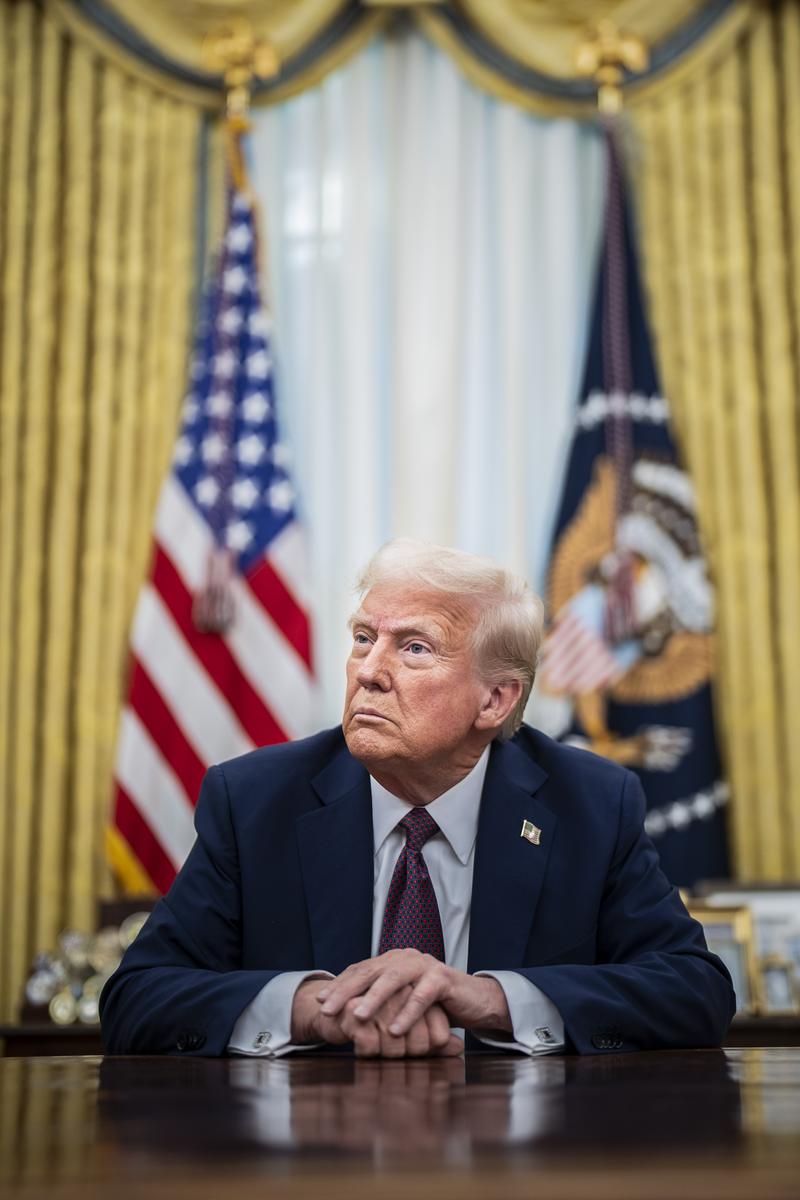
When President Donald Trump stood in the Capitol Rotunda to deliver his second inauguration address, he made a series of proclamations and predications as he declared: “A tide of change is sweeping the country.”
Nearly 100 days after he took the oath, that much has proved unmistakably true.
He has ushered in a dramatic shift far beyond the typical changes that take place every four or eight years, even bigger than Trump himself did in 2017 when he took office the first time. He has altered in fundamental ways how the U.S. economy works, how global diplomacy is conducted, and how immigration is enforced. He is working to tear down and remake the federal bureaucracy, pushing the limits of presidential power, and waging war against the court system.
As he marks his 100th day in office on Wednesday, Trump has a historically low approval rating with signs of erosion on two of his top issues, the economy and immigration. He has overseen a drop in the stock market with few recent precedents, with economists and consumers fearing a rise in inflation and a possible recession.
But inside the White House, there is broad agreement that Trump has laid the foundation for vast and far-reaching changes that will alter the federal government and American society. Senior administration officials are pleased on the verge of giddy – “every morning I wake up and it’s like living in a dreamscape,” said one top official – and suggest that his staff and Cabinet are far more united than when he first took office eight years ago, and are able to oversee more sweeping and more rapid changes as a result.
They also have far more planned, including more executive actions and a renewed push for congressional legislation, in what the official described as “lots of torpedoes under the water you’re not seeing right now but soon you will.” They have ambitions to deport more immigrants this year than any point in American history, with a larger crackdown coming that includes plans to pay undocumented immigrants to leave the country and providing them flights to do so.
And there are few signs they will back down on challenges with the courts, arguing that they are fighting a philosophical battle about the power of the presidency.
“The obvious comparison point is FDR’s first 100 days,” the senior administration official said, speaking on the condition of anonymity to discuss the matter more candidly, during a briefing with a group of reporters. “But I think you’re seeing something much bigger than that. What you’re seeing in a philosophical sense is rejecting all the failures of the global construct that was created really at the end of the Cold War that has governed U.S. economic and foreign policy since that time.”
“If you think about what the president campaigned on, they’ve all been implemented with astonishing speed,” the official added. “These are not tinkering around the edges. These are effectuating 180-degree change.”
They are unraveling a trade and tariff system in place for decades, one that Trump officials say has led to “the self-mutilation of our economy” and “the great screwing of the American middle class.” And they believe they are dismantling a federal bureaucracy that has made moving quickly difficult, and has worked against the executive branch that Trump is elected to represent.
While some of his plans have led to changes, many have yet to be realized and a Washington Post tracker of 31 key campaign promises finding that eight haven’t happened and five are facing roadblocks. His tariff policy has morphed several times, causing confusion among foreign economic ministers and Wall Street investors. He has yet to solve the war in Ukraine, something he once said he could do within 24 hours of taking office.
The S&P 500 is down about 8 percent, putting Trump off to the worst stock market start to a presidency in recent memory.
Trump has functioned at a dizzying pace. He has signed 139 executive orders – already approaching what Joe Biden did over four years – but has had only one piece of legislation worthy of a signing ceremony. He has hosted 14 foreign leaders, delivered the longest address to Congress in recent memory, and has spoken to reporters almost every day.
He has sought to find a foil – mentioning Biden more than 430 times, an average of more than four times every day of his presidency – but Democrats have struggled to find a consistent message or a prominent leader. Republicans have largely marched in lockstep, and a number of law firms and universities have acquiesced to his demands.
Joan Hoff, professor of history at Montana State University and former president of the Center for the Study of the Presidency, said that no president since Franklin D. Roosevelt in 1933 has displayed the rapid pace that Trump has maintained.
“Nobody since then has tried to flood the country with these controversial projects in the first 100 days,” she said. “It’s been effective. What he’s doing, I think, is confusing the public – and confusing Democrats in particular – in how to react to him … It’s kept the Democrats running around trying to figure out what to do.”
Trump has differed, she said, in that Roosevelt was relatively consistent in his approach, while Trump has moved in fits and starts as he has proposed tariffs and then delayed and altered them, or as he proposed taking over the Gaza Strip but not doing much to follow through. And while Roosevelt pressed 15 major pieces of legislation through Congress in his first 100 days, Trump has almost exclusively relied on executive orders.
“That’s an easy, quick way to flood the market and flood national TV coverage,” Hoff said. “He didn’t do that in 2017. It has to do with a better-organized, radical, like-minded group of advisers round him now that he didn’t have in 2017.”
During the first 100 days, presidents often have a honeymoon phase where the public is more willing to go along with their priorities and see them in a favorable light, and before they overreach the mandate they perceive themselves to have. Biden had a 57 percent approval rating at this point in his presidency, while Barack Obama was at 65 percent and George W. Bush at 62 percent. Trump during his first term was at 41 percent, the only president in modern history with a higher disapproval rating.
In a Washington Post-ABC-Ipsos poll released Sunday, 39 percent of Americans approve of how he is handling the presidency, a decline of six percentage points from February.
The poll also finds broad disagreement with many of his policies, including 64 percent disapproving of how he is handling tariffs, 57 percent disapproving of how he is managing the federal government, and 58 percent saying they are concerned that Trump will do too much to reduce the size and role of the federal government.
Trump administration officials give little indication of many changes to come, despite the slide in polling and concerns across the political spectrum about economic turbulence, saying that the pace of executive actions is expected to continue.
One major priority, they say, is to continue with broad actions on immigration. They are going to increase financial penalties on illegal immigration, expand enforcement with ICE partnering with local law enforcement, and emphasize self-deportation. They have plans to offer immigrants here illegally free flights home and cash incentives paired with increased penalties.
“We think we’ll see people choosing to leave on their own,” one official said. It is unclear how much the payments would be, or how the funding would be allocated.
The Post reported earlier this month that Trump officials have been aiming for 1 million deportations this year, a goal that analysts and immigration officials have been skeptical of but one that the White House still seems to be after.
“We will have this year, I’m confident, the largest number of deportations honestly calculated in American history,” a senior administration official said.
The next 100 days, a second official said, will be focused on “trade deals, and peace deals.”
While Trump has put off some of his tariff plans and said he is open to negotiating with various countries, his advisers insist he is committed to seeing them through.
“I don’t think there is anything the president is more resolute about than trade deals and implementing these tariffs,” one senior administration official said.
Trump, who several times a week signs a series of executive orders in the Oval Office, is expected to continue pursuing executive actions. But he also wants to hold more signing ceremonies at the White House, and officials say the coming months are going to be marked by him pressing for more congressional action.
“All of this has been done through sheer executive power and authority,” one of the senior administration officials said. “But moving forward we expect Congress to get their work done.”
Trump’s burst of activity in his first three months has also been marked by an expansion of presidential power, and a willingness to openly chastise a judicial system that has sought to limit some of his decisions. Administration officials have suggested, for example, that they are not bound by court orders to return Maryland resident Kilmar Abrego García, who the government has admitted was mistakenly sent to a prison in El Salvador.
The courts have also ruled against some of the efforts to slash government spending and eliminate federal jobs through the U.S. DOGE Service overseen by Elon Musk. Trump’s open criticism of federal judges has triggered concern among legal scholars who say the country could be approaching a constitutional crisis.
White House officials argue that Trump is doing what voters elected him to do, and show little sign of easing up on the battle with the judiciary.
“Right now there is a cabal of judges, a small subset of that group, that believe it’s their mission to run out the clock and make it … impossible to implement his agenda,” said one of the senior administration officials.
The disruptive nature of Trump’s term exceeds what he did in his first term, partly because he came into office more prepared, after four years out of office, and with several senior advisers having a more specific plan to implement. But he has also been largely unmoved by outside counsel, and has surrounded himself with loyalists in ways that have eliminated many of the guardrails of the first term and created fewer internal opposition.
“There truly is a sea change in attitude among senior staff in the West Wing; there’s trust in one another,” said one of the senior administration officials. “And a battle rhythm that we hit on day one … You’ve seen the Cabinet. It’s a completely different bunch from the team he chose in the first term.”








Most Read
Popular articles in the past 24 hours
-

Toronto Blue Jays’ Kazuma Okamoto Blasts 1st HR of Spring
-

20 Trapped in Tokyo Skytree Lift, Rescued 5½ Hours Later
-
Japan Seeks to Counter China's Expanding Influence in Pacific by ...
-
Japan's Diet Begins Debate on Takaichi's Budget Plans, ‘Proactive...
-

Japan Asks U.S. Not to Worsen Tariffs; Chief Cabinet Secretary Ki...
-

Exhibition Featuring Yoshiharu Tsuge’s Manga World Underway in Ch...
-
CARTOON OF THE DAY (February 24)
-

Nikkei Rises Over 700 Points to Hit New Intraday High
Popular articles in the past week
-

Producer Behind Pop Group XG Arrested for Cocaine Possession
-

Japan, U.S. Name 3 Inaugural Investment Projects; Reached Agreeme...
-

iPS Treatments Pass Key Milestone, but Broader Applications Far f...
-

Tokyo Skytree's Elevator Stops, Trapping 20 People; All Rescued (...
-

Director Naomi Kawase's New Film Explores Heart Transplants in Ja...
-

Japan’s Major Real Estate Firms Expanding Overseas Businesses to ...
-
Survey Shows False Election Info Perceived as True
-

Milano Cortina 2026: Japan’s Mari Fukada Wins Gold in Women’s Sno...
Popular articles in the past month
-
Producer Behind Pop Group XG Arrested for Cocaine Possession
-

Japan PM Takaichi’s Cabinet Resigns en Masse
-

Japan Institute to Use Domestic Commercial Optical Lattice Clock ...
-

Man Infected with Measles Reportedly Dined at Restaurant in Tokyo...
-

Israeli Ambassador to Japan Speaks about Japan’s Role in the Reco...
-

Videos Plagiarized, Reposted with False Subtitles Claiming ‘Ryuky...
-

Man Infected with Measles May Have Come in Contact with Many Peop...
-

Prudential Life Insurance Plans to Fully Compensate for Damages C...
Top Articles in News Services
-
Survey Shows False Election Info Perceived as True
-

Hong Kong Ex-Publisher Jimmy Lai’s Sentence Raises International Outcry as China Defends It
-

Japan’s Nikkei Stock Average Touches 58,000 as Yen, Jgbs Rally on Election Fallout (UPDATE 1)
-
Japan’s Nikkei Stock Average Falls as US-Iran Tensions Unsettle Investors (UPDATE 1)
-
Trump Names Former Federal Reserve Governor Warsh as the Next Fed Chair, Replacing Powell
JN ACCESS RANKING
-
Producer Behind Pop Group XG Arrested for Cocaine Possession
-
Japan PM Takaichi’s Cabinet Resigns en Masse
-
Man Infected with Measles Reportedly Dined at Restaurant in Tokyo Station
-
Israeli Ambassador to Japan Speaks about Japan’s Role in the Reconstruction of Gaza
-
Videos Plagiarized, Reposted with False Subtitles Claiming ‘Ryukyu Belongs to China’; Anti-China False Information Also Posted in Japan