To use this site, please disable the ad blocking feature and reload the page.
This website uses cookies to collect information about your visit for purposes such as showing you personalized ads and content, and analyzing our website traffic. By clicking “Accept all,” you will allow the use of these cookies.
Users accessing this site from EEA countries and UK are unable to view this site without your consent. We apologize for any inconvenience caused.
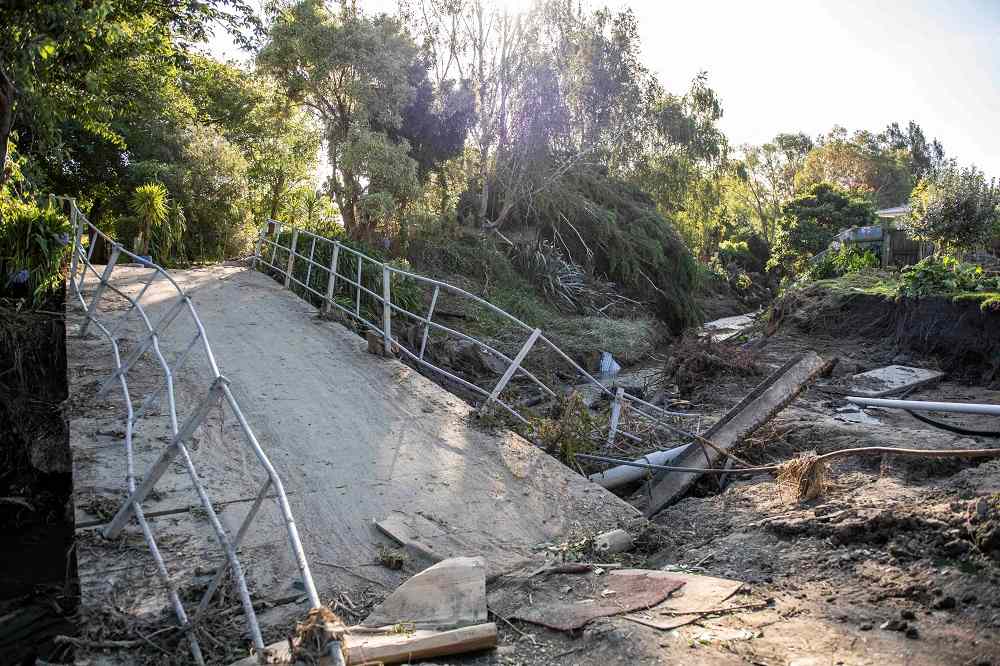
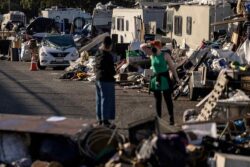
New Zealand Defence Force / Handout via Reuters A general view of a damaged bridge after a small creek bursts its bank causing houses to flood in Havelock North, New Zealand on Saturday.
Reuters
15:02 JST, February 20, 2023
WELLINGTON (Reuters) — New Zealand warned on Monday the final cost of the devastating Cyclone Gabrielle, which has left at least 11 people dead, could rise above $8 billion as authorities announced emergency funding to help in the recovery efforts.
The cyclone hit the North Island’s northernmost region on Feb. 12 and tracked down the east coast, inflicting widespread destruction. Prime Minister Chris Hipkins has called Gabrielle New Zealand’s biggest natural disaster this century.
“The required investment to reconnect our communities and future-proof our nation’s infrastructure is going to be significant and it will require hard decisions,” said Hipkins at a news conference announcing an emergency NZ$300 million ($187.08 million) cyclone relief package.
Earlier on Monday Finance Minister Grant Robertson said the total cost to government could be similar to the NZ$13.5 billion (8.42 billion) it spent rebuilding Christchurch after the devastating 2011 earthquake.
Robertson has been appointed Cyclone Recovery Minister, in addition to his existing portfolio.
The interim package provides NZ$250 million to fix critical roads across disaster hit regions, and a further NZ$50 million in emergency support was set aside for businesses and primary producers. More relief and re-building funding from the government is expected.
Hipkins also extended the national state of emergency, which was declared last week for only the third time in its history, a further seven days to help the recovery and relief efforts.
Police have confirmed 11 deaths in circumstances related to the cyclone, most of those have been in Hawke’s Bay in the North Island. Roughly 2,200 people are still unaccounted for.
New Zealand police commissioner Andrew Coster told the AM Show on Monday the number of deaths would likely rise, adding that difficulty with communications is hampering efforts to make contact with affected people.
New Zealand has deployed 60 Starlink satellites, built by Elon Musk-owned SpaceX, with another 30 on the way, to plug gaps in the telecommunications network as roughly 15,000 people across the North Island remain without power.
Recovery efforts are continuing with search and rescue teams still working in cyclone damaged areas, while power and telecommunications remain down for some homes. Roads are closed and people are reporting issues getting cash.