To use this site, please disable the ad blocking feature and reload the page.
This website uses cookies to collect information about your visit for purposes such as showing you personalized ads and content, and analyzing our website traffic. By clicking “Accept all,” you will allow the use of these cookies.
Users accessing this site from EEA countries and UK are unable to view this site without your consent. We apologize for any inconvenience caused.
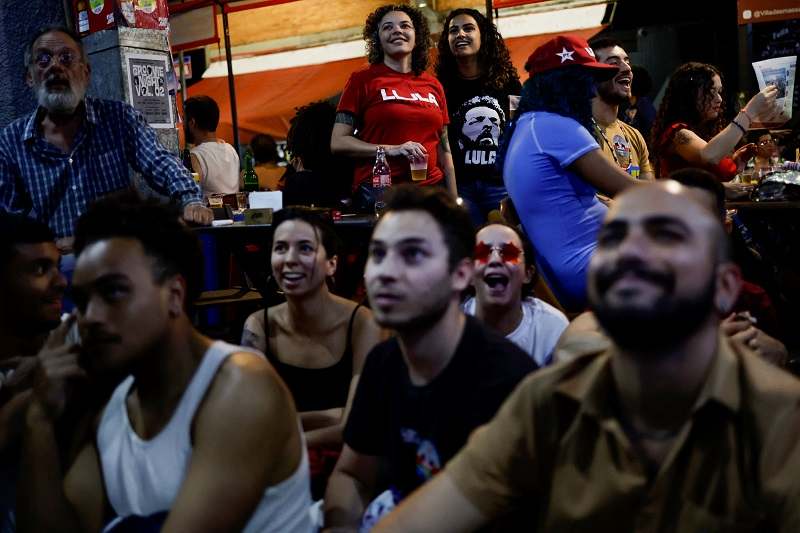
Reuters People observe a debate ahead of the runoff election between Brazil’s President and candidate for re-election Jair Bolsonaro and former President and current candidate Luiz Inacio Lula da Silva, at a bar in Brasilia on Friday.
Reuters
15:31 JST, October 29, 2022
RIO DE JANEIRO (Reuters) — Brazil’s right-wing President Jair Bolsonaro and his leftist election rival, Luiz Inacio Lula da Silva, traded barbs late on Friday in their final televised debate ahead of Sunday’s tense runoff vote.
Polls suggest Lula is the slight favorite to come back for a third term, capping a remarkable political renaissance after his jailing on graft convictions that were overturned. But Bolsonaro outperformed opinion polls in the first-round vote this month, and many analysts say the election could go either way.
During Friday’s free-wheeling debate, the deeply polarizing figures attacked each other’s character and record, accused each other of lying and refused repeatedly to answer each other’s questions.
Bolsonaro opened the debate by denying reports that he might unpeg the minimum wage from inflation, announcing instead he would raise it to 1,400 reais ($260) a month if re-elected, a move that is not in his government’s 2023 budget.
Still, most analysts and focus groups with undecided voters suggested the president had done little to shake up a race that polls show broadly stable since Lula led the first round of voting on Oct. 2 by 5 percentage points.
That result was better for Bolsonaro than most polls had shown, giving him a boost of momentum to start the month, but the past two weeks of the campaign have presented headwinds.
On Sunday, one of Bolsonaro’s allies opened fire on Federal Police officers coming to arrest him. A week earlier Bolsonaro had to defend himself from attack ads after he told an anecdote about meeting Venezuelan migrant girls in suggestive terms.
In their first head-to-head debate this month, Lula blasted Bolsonaro’s handling of a pandemic in which nearly 700,000 Brazilians have died, while Bolsonaro focused on the graft scandals that tarnished the reputation of Lula’s Workers Party.
On Friday night, both candidates returned repeatedly to Lula’s two terms as president from 2003 to 2010, when high commodity prices helped to boost the economy and combat poverty. Lula vowed to revive those boom times, while Bolsonaro suggested current social programs are more effective.