
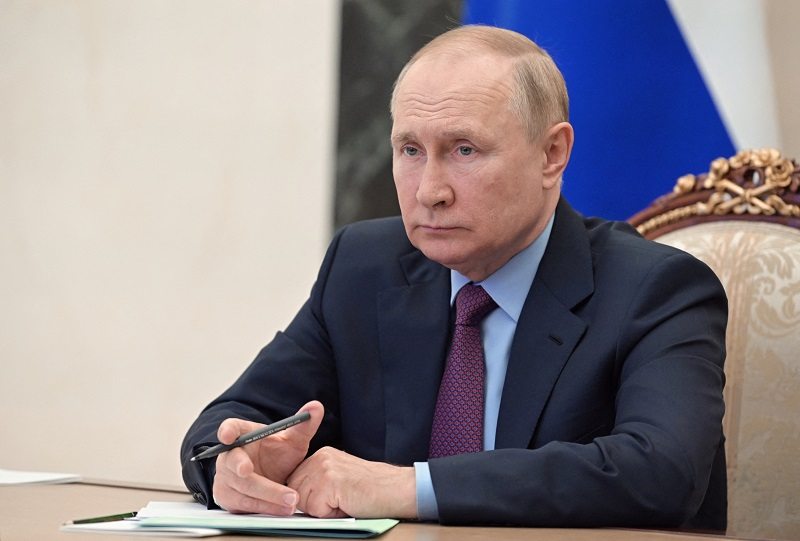
Russian President Vladimir Putin chairs a meeting on the development of the country’s metallurgical sector, via a video link at the Kremlin in Moscow, Russia August 1, 2022.
11:55 JST, August 6, 2022
MOSCOW (Reuters) – Russia has banned investors from so-called unfriendly countries from selling shares in key energy projects and banks until the end of the year, stepping up pressure in the sanctions stand-off with the West.
Western countries and allies, including Japan, have piled financial restrictions on Russia since it sent troops into Ukraine in late February. Moscow retaliated with obstacles for Western businesses and their allies leaving Russia, and in some cases seized their assets.
The decree, signed by President Vladimir Putin and published on Friday, immediately bans investors from countries which supported sanctions on Russia from selling their assets in production sharing agreements (PSA), banks, strategic entities, companies producing energy equipment, as well as in other projects, from oil and gas production to coal and nickel.
Putin could issue a special waiver in certain cases for the deals to go ahead, the decree said, and the government and the central bank should prepare a list of banks for the Kremlin’s approval. The decree mentioned no investors by name.
TAKING THE HIT
The ban covers almost all big financial and energy projects where foreign investors still have stakes, including the Sakhalin-1 oil and gas project.
On Thursday, Russian state oil champion Rosneft ROSN.MM blamed Exxon Mobil XOM.N for falling output at the Sakhalin-1 group of fields, after the U.S. energy major said it was in the process of transferring its 30% stake “to another party.” Read full story
Separately, a government decree signed on Aug. 2 gave foreign investors at the Sakhalin-2 liquefied natural gas (LNG) project – Royal Dutch Shell RDSa.L and Japanese trading houses Mitsui & Co 8031.T and Mitsubishi Corp 8058.T – a month to claim their stakes in a new entity which will replace the existing project.
The new decree does not cover the Sakhalin-2 project, it said.
Exxon declined to comment. On Thursday, before the ban, Exxon said it has made significant progress exiting the Sakhalin-1 venture and that the pull out is a complex process. As a former operator, Exxon has “an obligation to ensure the safety of people, protection of the environment and integrity of operations,” spokesperson Casey Norton said on Thursday.
Shell was looking for options to withdraw from the project while Japan’s government reiterated its wish for the Japanese companies to maintain their stakes there.
Italy’s UniCredit CRDI.MI and Intesa ISP.MI, U.S. group Citi C.N and Austria’s Raiffeisen RBIV.VI continue to search for options to exit Russia, while others such as Societe Generale SOGN.PA, ROSB.MM and HSBC HSBA.L have found a way out. Read full story
Citigroup declined to comment on Friday, but on Thursday, the bank said in a filing it will continue to reduce its operations and exposures to Russia.
Citigroup has ceased soliciting any new business or new clients in Russia, it said.
Citigroup disclosed $8.4 billion in Russia exposure as of June 30, compared with $7.9 billion at the end of the first quarter. The exposure rose due to a rise in the value of the rouble.





Most Read
Popular articles in the past 24 hours
-

My Spendthrift Mother Constantly Asks Me for Money
-

Japanese Students Use Traditional Pickle to Create Novel Wagashi ...
-

‘Dry Bonsai’ Gives New Life to Withered Trees, Allows Free Artist...
-

A Packed Bus Plunges off a Nepal Highway, Killing 19 and Injuring...
-

McDonald's Japan Raises Prices; Big Mac to Cost ¥500, Double Chee...
-

Nepal Bus Crash Kills 19 People, Injures 25 Including One Japanes...
-
Astellas Collaborates with Vir to Develop Its Experimental Prosta...
-
Japan’s Nikkei Stock Average Rises as AI-Related Stocks Shine; Co...
Popular articles in the past week
-

Producer Behind Pop Group XG Arrested for Cocaine Possession
-

Japan PM Takaichi’s Cabinet Resigns en Masse
-

Sanae Takaichi Elected Prime Minister of Japan; Keeps All Cabinet...
-
Japan's Govt to Submit Road Map for Growth Strategy in March, PM ...
-

Bus Carrying 40 Passengers Catches Fire on Chuo Expressway; All E...
-
U.S. Firm to Build Training Hub in Fukushima N-plant for Debris R...
-
Japan, U.S. Name 3 Inaugural Investment Projects; Reached Agreeme...
-

Riku-Ryu Pair Wins Gold Medal: Their Strong Bond Leads to Major C...
Popular articles in the past month
-
Producer Behind Pop Group XG Arrested for Cocaine Possession
-
Japan PM Takaichi’s Cabinet Resigns en Masse
-

Japan Institute to Use Domestic Commercial Optical Lattice Clock ...
-

Man Infected with Measles Reportedly Dined at Restaurant in Tokyo...
-

Israeli Ambassador to Japan Speaks about Japan’s Role in the Reco...
-

Videos Plagiarized, Reposted with False Subtitles Claiming ‘Ryuky...
-

Man Infected with Measles May Have Come in Contact with Many Peop...
-

Prudential Life Insurance Plans to Fully Compensate for Damages C...
Top Articles in News Services
-
Survey Shows False Election Info Perceived as True
-
Hong Kong Ex-Publisher Jimmy Lai’s Sentence Raises International Outcry as China Defends It
-
Japan’s Nikkei Stock Average Touches 58,000 as Yen, Jgbs Rally on Election Fallout (UPDATE 1)
-
Japan’s Nikkei Stock Average Falls as US-Iran Tensions Unsettle Investors (UPDATE 1)
-
Trump Names Former Federal Reserve Governor Warsh as the Next Fed Chair, Replacing Powell
JN ACCESS RANKING
-
Producer Behind Pop Group XG Arrested for Cocaine Possession
-
Japan PM Takaichi’s Cabinet Resigns en Masse
-
Japan Institute to Use Domestic Commercial Optical Lattice Clock to Set Japan Standard Time
-
Man Infected with Measles Reportedly Dined at Restaurant in Tokyo Station
-
Israeli Ambassador to Japan Speaks about Japan’s Role in the Reconstruction of Gaza