To use this site, please disable the ad blocking feature and reload the page.
This website uses cookies to collect information about your visit for purposes such as showing you personalized ads and content, and analyzing our website traffic. By clicking “Accept all,” you will allow the use of these cookies.
Users accessing this site from EEA countries and UK are unable to view this site without your consent. We apologize for any inconvenience caused.
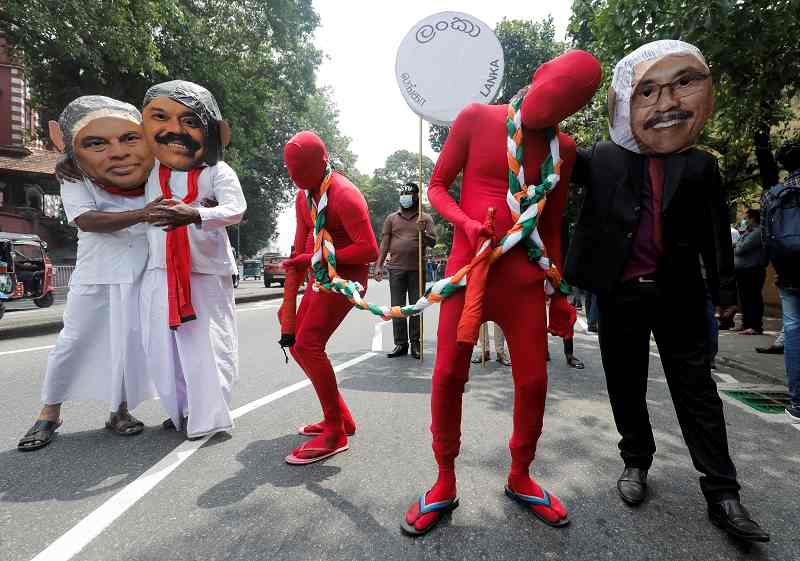
Reuters Members of Socialist Youth Union wear masks of Sri Lankan President Gotabaya Rajapaksa, Prime Minister Mahinda Rajapaksa and Finance Minister Basil Rajapaksa and two men dressed in symbol of Ceylon Petroleum Corporation with a rope in Indian national flag colours stand during a protest against the worsening economic crisis in Colombo on March 18.
Reuters
14:45 JST, April 4, 2022
COLOMBO (Reuters) – The son of Sri Lanka’s prime minister resigned from the cabinet on Monday and several other members have offered to do so, a minister said, just days after President Gotabaya Rajapaksa declared a state of emergency following protests over an economic crisis.
The debt-laden country is struggling to pay for imports of fuel and other essentials due to a severe shortage of foreign currency, leading to hours-long power cuts and widespread demonstrations that continued despite a weekend curfew.
Traffic was back on the streets of the country’s main city Colombo on Monday, but there were reports of sporadic and peaceful protests from across the country.
Youth and Sports Minister Namal Rajapaksa, nephew of Gotabaya and the son of Prime Minister Mahinda Rajapaksa, said on Twitter on Monday he had told the president’s secretary about his resignation with immediate effect.
Namal said he quit in the hope it would help the president and prime minister’s “decision to establish stability” for Sri Lankans and the government.
Education Minister Dinesh Gunawardena told local media late on Sunday that “we handed our letters of resignation to the prime minister”.
“The president and the prime minister will discuss and take relevant decisions,” he said, without clarifying how many ministers had offered to quit.
Udaya Gammanpila, the chief of one of the 11 political parties that form the ruling coalition, said he had met the president and prime minister on Sunday with a plan to form a new cabinet.
“Our initial proposal was to set up an interim government representing all political parties of the government,” Gammanpila of the Pivithuru Hela Urumaya party told Reuters.
The island nation of 22 million, off India’s southern tip, is also grappling with soaring inflation after the government steeply devalued its currency last month ahead of talks with the International Monetary Fund for a loan programme.
The country’s expenditure has exceeded its income under successive governments while its production of tradable goods and services has been inadequate. The twin deficits were badly exposed by the COVID-19 pandemic that crippled its economic mainstay, the tourism industry.