
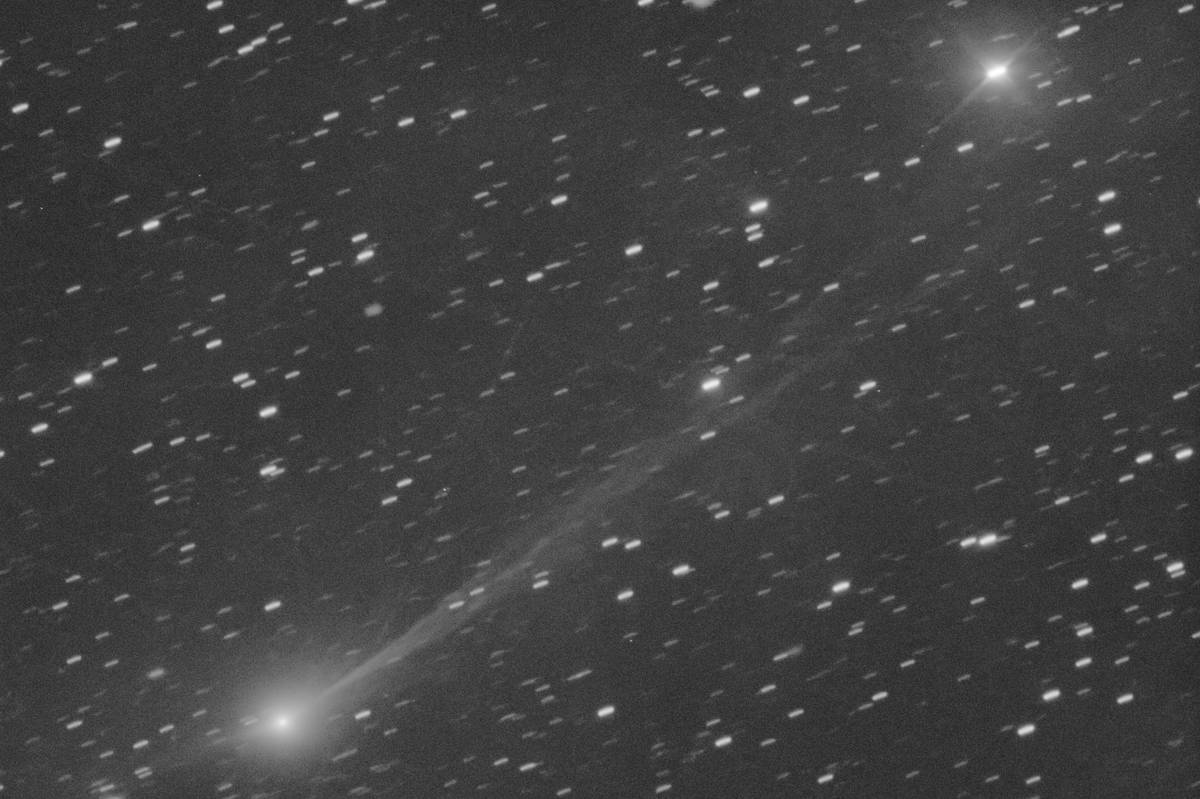
This photo provided by Gianluca Masi shows the interstellar comet 3I/Atlas as it streaks through space, 190 million miles from Earth, on Wednesday, Nov. 19, 2025. The image was taken from Manciano, Italy.
10:50 JST, November 20, 2025
CAPE CANAVERAL, Fla. (AP) — NASA unveiled close-up pictures on Wednesday of the interstellar comet that’s making a quick one-and-done tour of the solar system.
Discovered over the summer, the comet known as 3I/Atlas is only the third confirmed object to visit our corner of the cosmos from another star. It zipped harmlessly past Mars last month.
Three NASA spacecraft on and near the red planet zoomed in on the comet as it passed just 18 million miles (29 million kilometers) away, revealing a fuzzy white blob. The European Space Agency’s two satellites around Mars also made observations.
Other NASA spacecraft will remain on the lookout in the weeks ahead, including the Webb Space Telescope. At the same time, astronomers are aiming their ground telescopes at the approaching comet, which is about 190 million miles (307 million kilometers) from Earth. The Virtual Telescope Project’s Gianluca Masi zoomed in Wednesday from Italy.
The comet is visible from Earth in the predawn sky by using binoculars or a telescope.
“Everyone that is in control of a telescope wants to look at it because it’s a fascinating and rare opportunity,” said NASA’s acting astrophysics director, Shawn Domagal-Goldman.
The closest the comet will come to Earth is 167 million miles (269 million kilometers) in mid-December. Then it will hightail it back into interstellar space, never to return.
ESA’s Juice spacecraft, bound for Jupiter, has been training its cameras and scientific instruments on the comet all month, particularly after it made its closest pass to the sun. But scientists won’t get any of these observations back until February because Juice’s main antenna is serving as a heat shield while it’s near the sun, limiting the flow of data.
Named for the telescope in Chile that first spotted it, the comet is believed to be anywhere from 1,444 feet (440 meters) across to 3.5 miles (5.6 kilometers) across. Observations indicate that the exceptionally fast-moving comet may have originated in a star system older than our own — “which gives me goose bumps to think about,” said NASA scientist Tom Statler.
“That means that 3I/Atlas is not just a window into another solar system, it’s a window into the deep past and so deep in the past that it predates even the formation of our Earth and our sun,” Statler told reporters.
NASA officials were quick to dispel rumors that this friendly solar system visitor, as they called it, might be an alien ship of some sort. They said that because of the federal government shutdown, they weren’t able to respond to all the theories cropping up in recent weeks.
The space agency is always on the hunt for life beyond Earth, “but 3I/Atlas is a comet,” said NASA’s associate administrator, Amit Kshatriya.








Most Read
Popular articles in the past 24 hours
-

Japan Figure Skating Legend Yuzuru Hanyu Is Proud Disaster Surviv...
-

Massive Sewer Pipe Found Jutting Out of Highway in Osaka
-

Japan-U.S. Summit Likely to Focus on Middle East; Takaichi to Fac...
-

15 Years since Great East Japan Earthquake: How Can Affected Area...
-

Japan Holds Memorial Events to Mark 15th Anniversary of 2011 Eart...
-

Japan’s Nikkei Stock Average Rise Lifted by AI Stocks, Easing Con...
-

Parents in Japan to Get Instagram Notifications When Teens Repeat...
-

Japan’s Mitsui O.S.K. Lines Container Ship Anchored in Persian Gu...
Popular articles in the past week
-

Ibaraki Pref.'s 1st Foreign Bus Driver Hired in Tsukuba
-

Nippon Life Insurance's U.S. Arm Sues OpenAI Over Legal Assistanc...
-
Japan Figure Skating Legend Yuzuru Hanyu Is Proud Disaster Surviv...
-

Govt to Utilize ODA for Ensuring Economic Security; Securing Ener...
-

Amid Strait of Hormuz Blockade, Shipping Companies Scramble to Ge...
-
Massive Sewer Pipe Found Jutting Out of Highway in Osaka
-

Japan Govt Survey Finds Just 10% of Workers Want Working Hours to...
-

Beckoning Cats Get Makeover to Fit Modern Lifestyles with Sleek D...
Popular articles in the past month
-

Producer Behind Pop Group XG Arrested for Cocaine Possession
-

Japan PM Takaichi’s Cabinet Resigns en Masse
-

Man Infected with Measles Reportedly Dined at Restaurant in Tokyo...
-

Videos Plagiarized, Reposted with False Subtitles Claiming ‘Ryuky...
-

iPS Treatments Pass Key Milestone, but Broader Applications Far f...
-

Sanae Takaichi Elected Prime Minister of Japan; Keeps All Cabinet...
-

Nepal Bus Crash Kills 19 People, Injures 25 Including One Japanes...
-

South Korea Tightens Rules on Foreigners Buying Homes in Seoul Me...
Top Articles in News Services
-

Survey Shows False Election Info Perceived as True
-
Japan’s Nikkei Stock Average Falls as US-Iran Tensions Unsettle Investors (UPDATE 1)
-
Japan’s Nikkei Stock Average Rises on Tech Rally and Takaichi’s Spending Hopes (UPDATE 1)
-

Japan to Ban Use of Power Banks on Airplanes
-

North Korea Unveils Image of Kim Jong Un’s Teenage Daughter Firing Rifle
JN ACCESS RANKING
-
Producer Behind Pop Group XG Arrested for Cocaine Possession
-
Japan PM Takaichi’s Cabinet Resigns en Masse
-
Man Infected with Measles Reportedly Dined at Restaurant in Tokyo Station
-
Videos Plagiarized, Reposted with False Subtitles Claiming ‘Ryukyu Belongs to China’; Anti-China False Information Also Posted in Japan
-
iPS Treatments Pass Key Milestone, but Broader Applications Far from Guaranteed