
- Manga & Anime
- MY HEROES
Isao Sasaki, Japanese Anison Singer, Celebrates 65th Anniversary of Career, Recovery from Illness with Concert
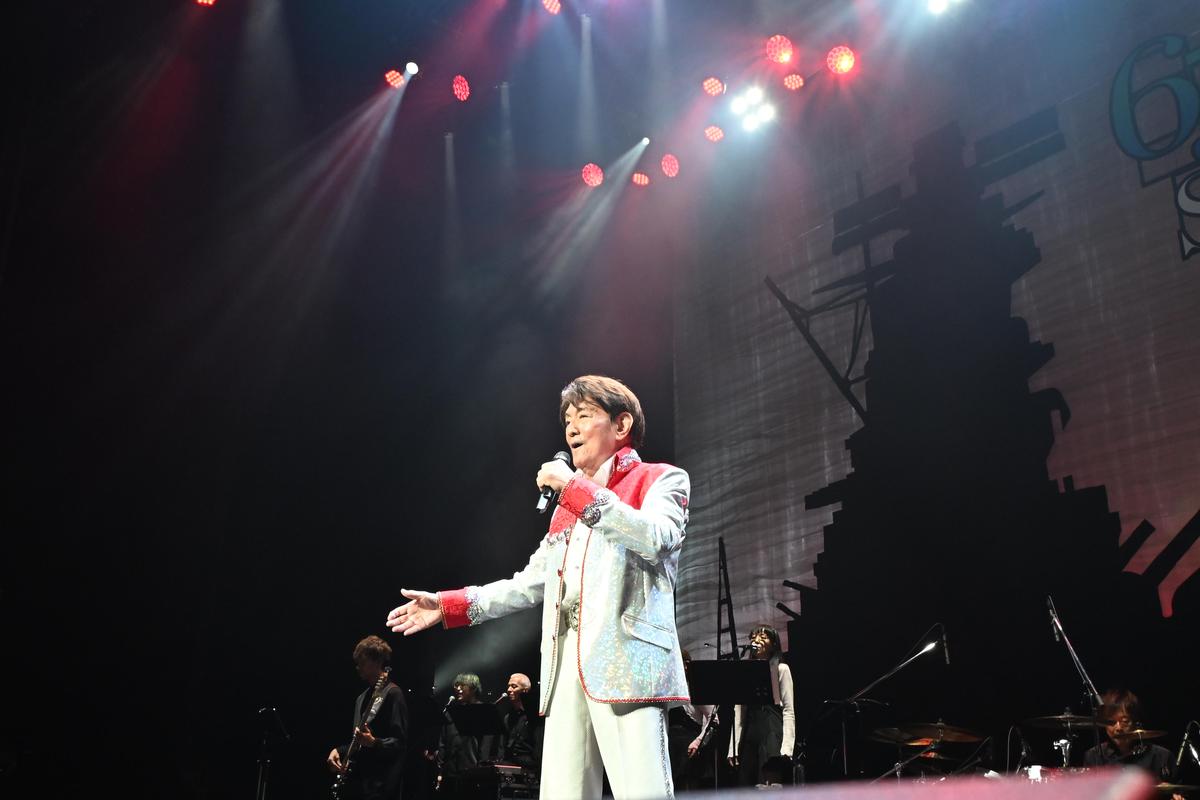
Isao Sasaki sings on stage in Tokyo on July 20.
10:30 JST, August 8, 2025
Singer Isao Sasaki, famous for singing the theme of anime series “Uchu Senkan Yamato” (“Space Battleship Yamato”) among many other songs, celebrated the 65th anniversary of his debut on July 20. I had the honor of serving as emcee for the talk session in the first part of “Sasaki Isao 65 Shunen Kinen: Nakama to Iwau Fukkatsusai” (Isao Sasaki 65th anniversary commemoration: A celebration of his return with friends and company).
Singing professionally for 65 years is itself a great achievement, but what’s more is Sasaki having just made a miraculous comeback from an illness. In January, he was diagnosed with acute exacerbation of interstitial pneumonia, and had to be hospitalized until the end of February. After recuperating at home, he made the first step of his comeback at an anison (anime song) concert in late April. While in the hospital, he was told that he would die in two or three days if the steroids did not work.
With this context, the audience of about 2,000 at the July concert grew even more excited to see Sasaki come on stage with a big smile, to the opening of the Yamato theme song. Their roars and applause rumbled the auditorium, and the band members on stage were almost moved to tears.
“I feel that I was kept alive by all of you,” Sasaki told the audience. “I’d like to thank you and sing for you.”
And he passionately sang his signature songs, including “Makkana Scarf” (The red scarf), “Yamato!! Aratanaru Tabidachi” (Yamato!! The new departure) and “Galaxy Express 999.” He then went on to sing the “Space Pirate Captain Harlock” theme, originally sung by Ichiro Mizuki, who died in 2022 and was a friend of Sasaki, to mourn his loss.
The talk portion in the first part of the concert also featured by fellow alumni from the popular TV anime series “Kagaku Ninjatai Gatchaman” (“Gatchaman”). Sasaki provided the voice for the widely loved character Joe and sang the theme songs from the series. The three participants in the session were voice actor Katsuji Mori, who played the protagonist, Ken, for the whole series; voice actor Miyuki Ueda, Sasaki’s real-life wife, who played a key character in “Gatchaman II,” and singer Mitsuko Horie, who duetted the ending title song for “Gatchaman II” with Sasaki.
“We recorded the song simultaneously, singing in booths separated by an acrylic board,” Horie said of the recording of the song, “Ashita Yumemite” (Dreaming of tomorrow). Recalling the old days, Sasaki and Horie then sang the duet on stage.
Mori and Ueda happened to know each other from their childhood days. While working for “Gatchaman II,” Mori watched Ueda and Sasaki becoming drawn to each other in real time.
“I told her to stop going out with him, forever, but that made her into him even more,” Mori said, laughing out loud, revealing that he practically played Cupid for the couple.
Then Sasaki and Mori duetted “Issho ni Aruko Kono Michi o” (Let’s walk this way together), a song from the series with music and lyrics by Sasaki. The crowd loved the duet, which included a spoken part by Mori.
The concert also featured Sasaki’s singer colleagues Hironobu Kageyama, Masaaki Endo and Kentaro Hayami.
Toward the end, Sasaki sang “Kimi no Seishun wa Kagayaite iruka” (Are your youthful days shining?), the theme song from tokusatsu live-action superhero drama “Chojinki Metalder.” The lyrics, written by the late James Miki, have a line that goes, “Maketa to omou made ningen wa makenai” (People can’t lose until they think they have lost), which had never sounded so touching before that day. The lyrics are so in line with Sasaki, who has never given up despite his serious illness, managing to sing at this anniversary concert, which lasted about three hours. The next song, “My Way,” seemed as if it was about his own life. I listened to it from the wings and could not help being overwhelmed with emotion.
I was blessed to have spent many hours with him during the concert’s meetings and rehearsals. Despite it being not long after his recovery, Sasaki was uncompromising, reworking the program and talk session topics several times. When rehearsing the Yamato theme song, which he must have sung tens of thousands of times, he sang it in full.
I felt the way he worked hard to prepare for the concert taught me a lot. His dedication to singing must be why audiences have been drawn to and enamored by him for so many years. I sincerely hope he will continue to let us listen to his fantastic singing.




Most Read
Popular articles in the past 24 hours
-

Improvement of Japanese Language Schools Lags Rise in Foreigners
-
Japan's Test-Takers in Sapporo Offered Special Accommodation Arra...
-

Japanese Shipping Giants Halt Strait of Hormuz Transit as Iran Co...
-

Rental Lab Space in Tokyo Area More Than Doubles Since 2010, Offe...
-

U.S. Launches Attacks on Iran: Avoid Escalation of Conflict by An...
-
Parents of Japanese Teen Shot in U.S. Strive for Gun Control
-
Sawtooth Roof Factory Stands as Monument to Ashikaga Textile Hist...
-

Disinformation Spreads About Team Mirai, Ballot Readers; Online P...
Popular articles in the past week
-

Nepal Bus Crash Kills 19 People, Injures 25 Including One Japanes...
-
Milano Cortina 2026: Japanese Gold Medalist Figure Skater Miura S...
-
Tokyo Spends Big on Children, Wins Over Parents
-

McDonald's Japan Raises Prices; Big Mac to Cost ¥500, Double Chee...
-

‘Dry Bonsai’ Gives New Life to Withered Trees, Allows Free Artist...
-
Japan’s Miura, Kihara Announce Withdrawal from Figure Skating Wor...
-

Exhibition Featuring Yoshiharu Tsuge’s Manga World Underway in Ch...
-

Yokohama to Test Out Renewable-Powered Offshore Floating Data Cen...
Popular articles in the past month
-

Producer Behind Pop Group XG Arrested for Cocaine Possession
-

Japan PM Takaichi’s Cabinet Resigns en Masse
-

Man Infected with Measles Reportedly Dined at Restaurant in Tokyo...
-

Israeli Ambassador to Japan Speaks about Japan’s Role in the Reco...
-

Videos Plagiarized, Reposted with False Subtitles Claiming ‘Ryuky...
-

Man Infected with Measles May Have Come in Contact with Many Peop...
-

Prudential Life Insurance Plans to Fully Compensate for Damages C...
-

Woman with Measles Visited Hospital in Tokyo Multiple Times Befor...
Top Articles in Culture
-
BTS to Hold Comeback Concert in Seoul on March 21; Popular Boy Band Releases New Album to Signal Return
-

Director Naomi Kawase’s New Film Explores Heart Transplants in Japan, Production Involved Real Patients, Families
-

Tokyo Exhibition Offers Inside Look at Impressionism; 70 of 100 Works on ‘Interiors’ by Monet, Others on Loan from Paris
-
Traditional Japanese Silk Hakama Tradition Preserved by Sole Weaver in Sendai
-
Exhibition Featuring Yoshiharu Tsuge’s Manga World Underway in Chofu, Tokyo; Unique, Surreal Works Draw Steady Crowds
JN ACCESS RANKING
-
Producer Behind Pop Group XG Arrested for Cocaine Possession
-
Japan PM Takaichi’s Cabinet Resigns en Masse
-
Man Infected with Measles Reportedly Dined at Restaurant in Tokyo Station
-
Israeli Ambassador to Japan Speaks about Japan’s Role in the Reconstruction of Gaza
-
Videos Plagiarized, Reposted with False Subtitles Claiming ‘Ryukyu Belongs to China’; Anti-China False Information Also Posted in Japan