
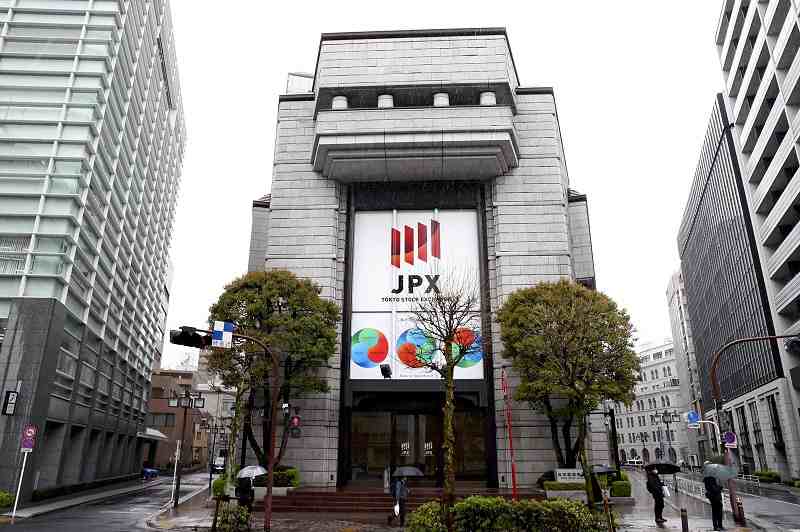
The Tokyo Stock Exchange
16:33 JST, December 5, 2020
To correct the extreme concentration of domestic stock trading in the Tokyo Stock Exchange, the government will set up a panel of experts to begin discussions in earnest as early as this year.
The panel will review the regulations stipulated in the Financial Instruments and Exchange Law and consider ways to encourage the use of alternative markets, such as the proprietary trading system (PTS). The aim is to create a system that will allow investors to continue trading even in the event of a major system failure at the TSE.
The Financial Services Agency announced the plan at a meeting on Dec. 1. The panel intends to compile a report by next spring.
In the United States, the New York Stock Exchange and the NASDAQ each have about 20% market share, and the PTS has a noticeable presence. In contrast, the TSE accounts for about 80% of stock trading in Japan, and the PTS only has about 5% market share due to the small number of stocks that can be traded.
On Oct. 1, a major system failure at the TSE resulted in a halt to trading for a whole day. The PTS was unable to make up for the volume of trades normally made on the TSE, bringing the problem of its dominance back into focus.
Many brokerage firms choose the market they will trade on based on the speed of trading and the number of stocks listed, which means orders tend to concentrate on the larger TSE. The FSA wants to review the “best execution policy” stipulated in the Financial Instruments and Exchange Law in order to mitigate this.
The best execution policy is a rule that requires brokerages to establish the best conditions for investors to buy and sell stocks. The FSA will consider including items such as “comparing multiple markets to determine where to place orders” and “using the market that offers the most favorable price.”
A senior FSA official said, “If the policy of ‘price first’ is presented as part of the best execution policy, the use of the PTS may be promoted.”
However, there has actually been an ongoing effort to promote inter-market competition since 1998, when the ban on the PTS was lifted. In the end, it has resulted in the TSE’s dominance. A source in the securities industry said: “Many investors believe it is more convenient to have many trades in one market. Diversification of the market is not easy.”
In addition, if the best execution policy is reviewed, there may be disadvantages such as an increased burden on securities firms due to system changes and trades taking a longer time to be executed.





Most Read
Popular articles in the past 24 hours
-
Massive Sewer Pipe Found Jutting Out of Highway in Osaka
-

Japan-U.S. Summit Likely to Focus on Middle East; Takaichi to Fac...
-

15 Years since Great East Japan Earthquake: How Can Affected Area...
-

Japan Holds Memorial Events to Mark 15th Anniversary of 2011 Eart...
-

Japan’s Nikkei Stock Average Rise Lifted by AI Stocks, Easing Con...
-

Parents in Japan to Get Instagram Notifications When Teens Repeat...
-

2 Mt. Fuji Hikers Identified as Police Warn People Not to Climb i...
-

CARTOON OF THE DAY (March 11)
Popular articles in the past week
-

Ibaraki Pref.'s 1st Foreign Bus Driver Hired in Tsukuba
-

Nippon Life Insurance's U.S. Arm Sues OpenAI Over Legal Assistanc...
-
Govt to Utilize ODA for Ensuring Economic Security; Securing Ener...
-

Amid Strait of Hormuz Blockade, Shipping Companies Scramble to Ge...
-
Massive Sewer Pipe Found Jutting Out of Highway in Osaka
-
Japan Govt Survey Finds Just 10% of Workers Want Working Hours to...
-

Beckoning Cats Get Makeover to Fit Modern Lifestyles with Sleek D...
-

Japan's 2nd Round of U.S. Investments May Be Worth Over $100 Bill...
Popular articles in the past month
-

Producer Behind Pop Group XG Arrested for Cocaine Possession
-

Japan PM Takaichi’s Cabinet Resigns en Masse
-

Man Infected with Measles Reportedly Dined at Restaurant in Tokyo...
-

Videos Plagiarized, Reposted with False Subtitles Claiming ‘Ryuky...
-

iPS Treatments Pass Key Milestone, but Broader Applications Far f...
-

Sanae Takaichi Elected Prime Minister of Japan; Keeps All Cabinet...
-

Nepal Bus Crash Kills 19 People, Injures 25 Including One Japanes...
-

South Korea Tightens Rules on Foreigners Buying Homes in Seoul Me...
Top Articles in Business
-

Japan, U.S. Name 3 Inaugural Investment Projects; Reached Agreement After Considerable Difficulty
-
Nippon Life Insurance’s U.S. Arm Sues OpenAI Over Legal Assistance Provided by ChatGPT
-

Japan’s Major Real Estate Firms Expanding Overseas Businesses to Secure Future Growth, Focusing on Europe, U.S., Asia
-

Transport Companies See Opportunity in Narita Expansion; Airlines, Railways Prepare to Meet Expected Growth in Demand
-
Amid Strait of Hormuz Blockade, Shipping Companies Scramble to Get Japan-Linked Vessels out of Persian Gulf
JN ACCESS RANKING
-
Producer Behind Pop Group XG Arrested for Cocaine Possession
-
Japan PM Takaichi’s Cabinet Resigns en Masse
-
Man Infected with Measles Reportedly Dined at Restaurant in Tokyo Station
-
Videos Plagiarized, Reposted with False Subtitles Claiming ‘Ryukyu Belongs to China’; Anti-China False Information Also Posted in Japan
-
iPS Treatments Pass Key Milestone, but Broader Applications Far from Guaranteed