
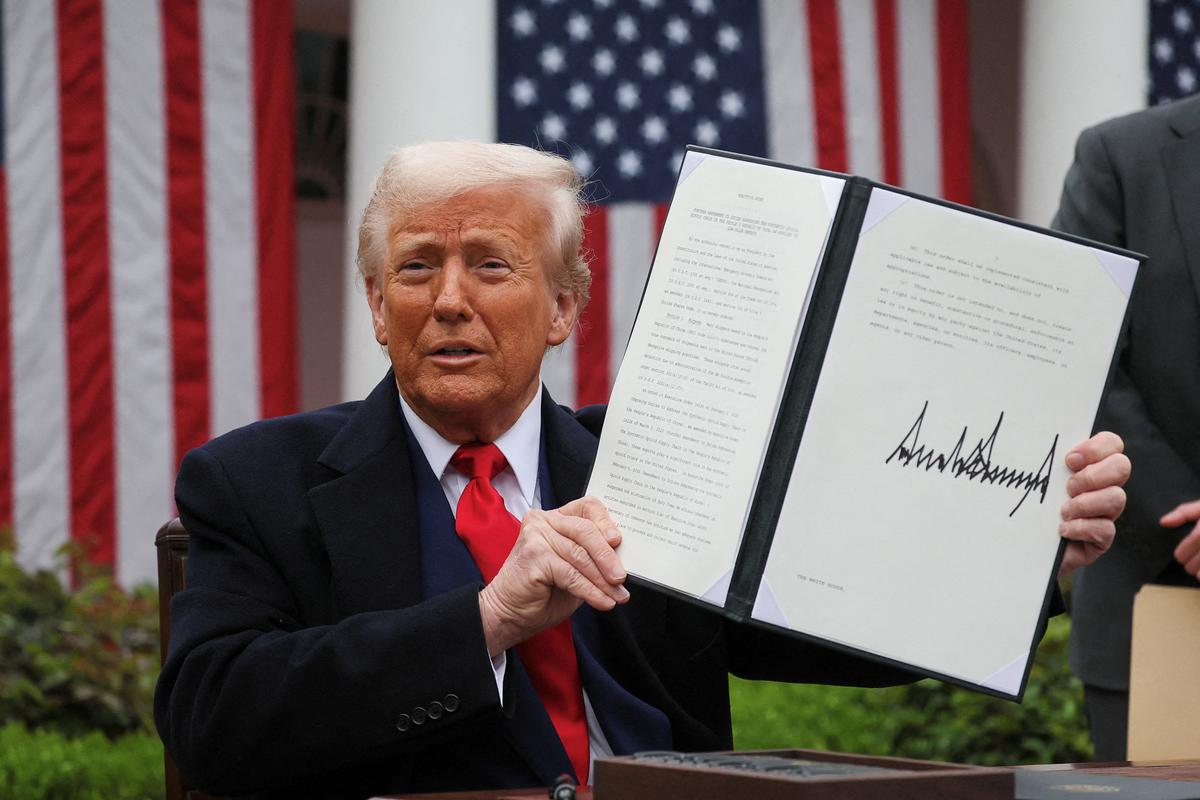
U.S. President Donald Trump holds a signed executive order on tariffs, in the Rose Garden at the White House in Washington, D.C., U.S., April 2, 2025.
10:50 JST, April 3, 2025
WASHINGTON, April 2 (Reuters) – Rising tariffs in the U.S. could feed into more prolonged inflation than might be expected, Fed Governor Adriana Kugler said on Wednesday, pushing back on views that prices would only rise on imported goods.
“There may be reasons why tariffs have more prolonged effects” than simply causing a one-time jump in the price of imported goods, Kugler said.
New tariffs already imposed by President Donald Trump, for example, target intermediate goods like aluminum and steel.
“This will affect all sectors through supply chain networks…It may take longer for that to filter through the economy,” Kugler said at an event at Princeton University.
The risk of retaliation by other countries and the possible shift in U.S. inflation expectations could add to the impact, she said, as could the risk that tariffs distort prices so much it shifts capital towards the production of goods “in which maybe we don’t have a comparative advantage.”
“That will mean we’re paying higher prices for things that could have been produced more cheaply somewhere else,” Kugler said.
Kugler spoke as Trump was rolling out a sweeping set of new levies across much of the world, with new taxes as high as 46% on some countries, historic allies like the European Union hit with 20% levies, and 25% tariffs now slated to go into effect on Mexico and Canada.
Trump’s actions have raised concern among some Fed officials that coming months could see growth slow even as prices rise, a difficult dilemma for a central bank charged with keeping prices stable and employment high.
“We are already seeing some upside risks to inflation…We may be seeing down the road a little bit of a slowdown as well,” Kugler said.
Right now she said she felt higher-than-anticipated inflation was the bigger risk, particularly given that consumers seemed to be frontrunning tariffs with auto purchases, for example, that may add to growth in the near term.
She said in remarks prepared for the event that she supported keeping the Fed’s current interest rate steady “for as long as these upside risks to inflation continue,” given ongoing economic growth and stable employment.
The Fed held interest rates steady at its March 18-19 meeting, and central bank officials have said they want more clarity on the impact of President Donald Trump’s policies. Fed policymakers’ projections for the year, however, showed they expect higher inflation and slower growth than they did in December before the sweep of Trump’s tariff plans became clearer.


Related Tags






Most Read
Popular articles in the past 24 hours
-

Japan Train Company to Increase Fares, Including in Tokyo Metropo...
-
Japan Govt to Tighten Requirements to Receive Permanent Residency...
-

Tail of ANA Plane Struck Runway During Landing in Houston; No Inj...
-

Samurai Japan Holds First Practice in Miami; Team Will Play again...
-

Medical Care at Home and Disasters: Ensure Systems to Provide Con...
-

Iran Targets Busiest International Airport as Top UN Body Demands...
-

Japan to Face Venezuela in World Baseball Classic Quarterfinals
-

North Korean Leader Kim and His Daughter Try out New Pistols at S...
Popular articles in the past week
-

Japan Figure Skating Legend Yuzuru Hanyu Is Proud Disaster Surviv...
-

Nippon Life Insurance's U.S. Arm Sues OpenAI Over Legal Assistanc...
-

Ibaraki Pref.'s 1st Foreign Bus Driver Hired in Tsukuba
-
Govt to Utilize ODA for Ensuring Economic Security; Securing Ener...
-

Massive Sewer Pipe Found Jutting Out of Highway in Osaka
-

Beckoning Cats Get Makeover to Fit Modern Lifestyles with Sleek D...
-
Japan Govt Survey Finds Just 10% of Workers Want Working Hours to...
-
Japan's 2nd Round of U.S. Investments May Be Worth Over $100 Bill...
Popular articles in the past month
-

Producer Behind Pop Group XG Arrested for Cocaine Possession
-

Japan PM Takaichi’s Cabinet Resigns en Masse
-

Man Infected with Measles Reportedly Dined at Restaurant in Tokyo...
-

Videos Plagiarized, Reposted with False Subtitles Claiming ‘Ryuky...
-

iPS Treatments Pass Key Milestone, but Broader Applications Far f...
-
Japan Figure Skating Legend Yuzuru Hanyu Is Proud Disaster Surviv...
-

Sanae Takaichi Elected Prime Minister of Japan; Keeps All Cabinet...
-

Nepal Bus Crash Kills 19 People, Injures 25 Including One Japanes...
Top Articles in Business
-
Nippon Life Insurance’s U.S. Arm Sues OpenAI Over Legal Assistance Provided by ChatGPT
-

Japan, U.S. Name 3 Inaugural Investment Projects; Reached Agreement After Considerable Difficulty
-

Japan’s Major Real Estate Firms Expanding Overseas Businesses to Secure Future Growth, Focusing on Europe, U.S., Asia
-

Transport Companies See Opportunity in Narita Expansion; Airlines, Railways Prepare to Meet Expected Growth in Demand
-

Amid Strait of Hormuz Blockade, Shipping Companies Scramble to Get Japan-Linked Vessels out of Persian Gulf
JN ACCESS RANKING
-
Producer Behind Pop Group XG Arrested for Cocaine Possession
-
Japan PM Takaichi’s Cabinet Resigns en Masse
-
Man Infected with Measles Reportedly Dined at Restaurant in Tokyo Station
-
Videos Plagiarized, Reposted with False Subtitles Claiming ‘Ryukyu Belongs to China’; Anti-China False Information Also Posted in Japan
-
iPS Treatments Pass Key Milestone, but Broader Applications Far from Guaranteed