
10:18 JST, January 5, 2022
The government plans to draw up guidelines by the end of this fiscal year to regulate business operators who pose as individual sellers and put up defective products on online shopping sites, according to sources.
Demand for online shopping has grown as people stay at home more amid the novel coronavirus pandemic, leading to increased problems involving dubious sales. The government is therefore seeking to heighten the protection of consumers.
These will be the first guidelines specifically targeting such unscrupulous business operators online.
The guidelines are likely to cover online shopping sites such as Amazon and Rakuten, as well as Mercari and other flea market sites. If sellers who pretend to be private individuals on their account conduct multiple transactions to make a profit on these sites, the guidelines will allow the sites’ operators to regard them as business operators.
Specifically, the guidelines are likely to stipulate that a seller will be identified as a business operator if a self-proclaimed individual seller “sells a significant number of items, such as brand-name products, health foods and tickets,” or “continually receives evaluations and reviews over a certain period of time.”
Until now, shopping site operators have devised their own measures to handle such dubious trading practices. There have been no clear national standards to distinguish between individual sellers and business operators.
In many cases involving problems such as the delivery of counterfeit brand items, sellers posing as individuals disappeared and consumers were unable to contact them. Such cases sparked calls to create guidelines.
A new law to protect consumers from online shopping-related problems is likely to be enacted by May, enabling the Consumer Affairs Agency to ask site operators to stop offering certain products if business operators sell defective and other problematic items on their sites. The government believes that the envisaged guidelines will help site operators bar unscrupulous vendors.
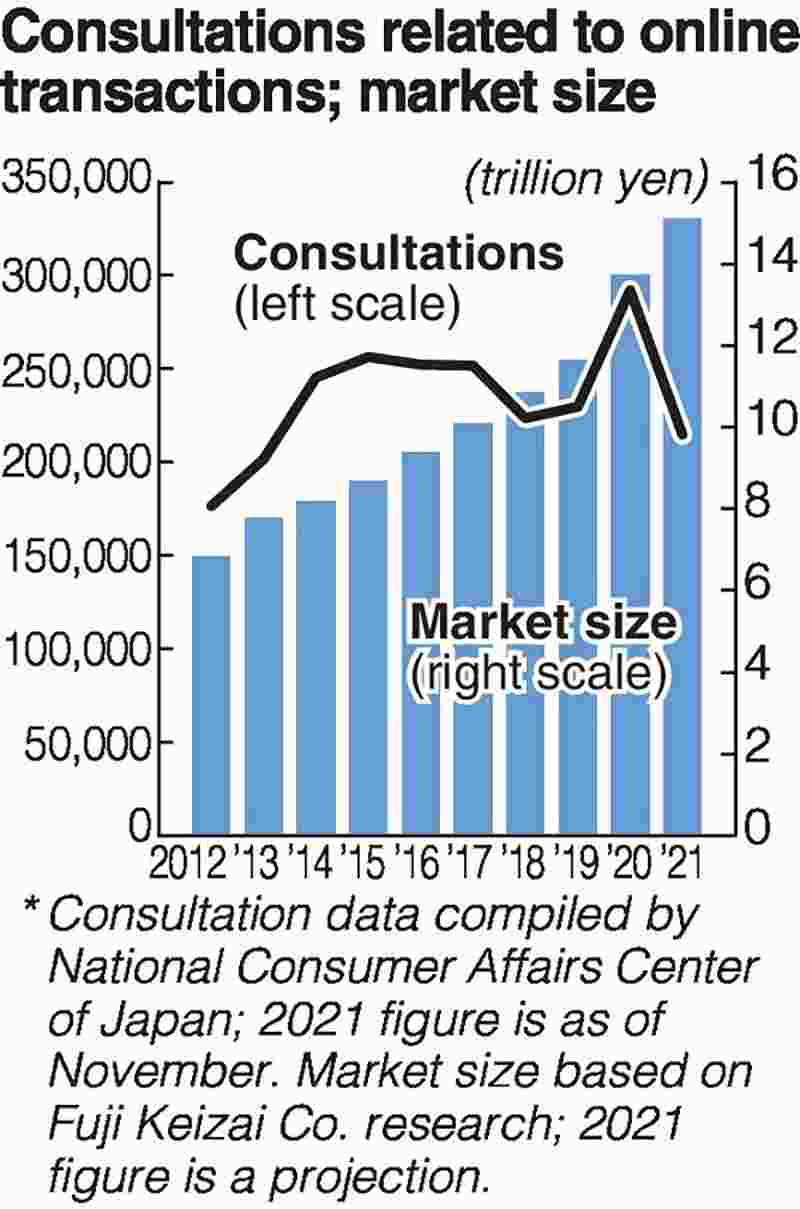
According to the National Consumer Affairs Center of Japan, there were 292,060 consultations about problems with online shopping in 2020, the highest level since comparable data became available in 2012. The center attributed the increase to growing demand for online shopping amid the pandemic.
In 2021, the center had received more than 210,000 consultations by the end of November.
According to Fuji Keizai Co., a research firm based in Tokyo, the market for online trade has grown every year, and is expected to reach about ¥15 trillion in 2021.
The Consumer Affairs Agency planned to present a draft of the guidelines to a council comprising people from academia, online shopping industry groups, and other members of the public and private sectors.








Most Read
Popular articles in the past 24 hours
-

Japanese High School Student Aims to Share Kaiten History Through...
-

Business Hotels Expanding into Regional Areas in Japan, Aiming to...
-

Milano Cortina 2026: Japan Sees Leap in Olympic Performance Throu...
-

Chronic Issues Erode Thailand’s Economy as Political Confusion Pe...
-

Milano Cortina 2026: Japan's Satoshi Furuno Places 4th in Men's S...
-

Milano Cortina 2026: Speed Skater Takagi Finishes 6th in the 1,50...
-

Osaka: 40 Ninjas Display Shuriken Throwing Skills at Japan Champi...
-

Fiji Defense Minister Hopes Japan Will Support Stabilization of P...
Popular articles in the past week
-

Japan PM Takaichi’s Cabinet Resigns en Masse
-

Man Infected with Measles Reportedly Dined at Restaurant in Tokyo...
-

Sanae Takaichi Elected Prime Minister of Japan; Keeps All Cabinet...
-

Japan's Govt to Submit Road Map for Growth Strategy in March, PM ...
-

Bus Carrying 40 Passengers Catches Fire on Chuo Expressway; All E...
-

Milano Cortina 2026: Figure Skaters Riku Miura, Ryuichi Kihara Pa...
-

Japan, U.S. Name 3 Inaugural Investment Projects; Reached Agreeme...
-

U.S. Firm to Build Training Hub in Fukushima N-plant for Debris R...
Popular articles in the past month
-
Japan PM Takaichi’s Cabinet Resigns en Masse
-

Japan Institute to Use Domestic Commercial Optical Lattice Clock ...
-

Israeli Ambassador to Japan Speaks about Japan’s Role in the Reco...
-
Man Infected with Measles Reportedly Dined at Restaurant in Tokyo...
-

Videos Plagiarized, Reposted with False Subtitles Claiming ‘Ryuky...
-

Man Infected with Measles May Have Come in Contact with Many Peop...
-

Prudential Life Insurance Plans to Fully Compensate for Damages C...
-

Woman with Measles Visited Hospital in Tokyo Multiple Times Befor...
Top Articles in Business
-
Prudential Life Insurance Plans to Fully Compensate for Damages Caused by Fraudulent Actions Without Waiting for Third-Party Committee Review
-
Narita Airport, Startup in Japan Demonstrate Machine to Compress Clothes for Tourists to Prevent People from Abandoning Suitcases
-
Japan, U.S. Name 3 Inaugural Investment Projects; Reached Agreement After Considerable Difficulty
-

Toyota Motor Group Firm to Sell Clean Energy Greenhouses for Strawberries
-

SoftBank Launches AI Service for Call Centers That Converts Harsh Customer Voices into Softer Voices
JN ACCESS RANKING
-
Japan PM Takaichi’s Cabinet Resigns en Masse
-
Japan Institute to Use Domestic Commercial Optical Lattice Clock to Set Japan Standard Time
-
Israeli Ambassador to Japan Speaks about Japan’s Role in the Reconstruction of Gaza
-
Man Infected with Measles Reportedly Dined at Restaurant in Tokyo Station
-
Videos Plagiarized, Reposted with False Subtitles Claiming ‘Ryukyu Belongs to China’; Anti-China False Information Also Posted in Japan