
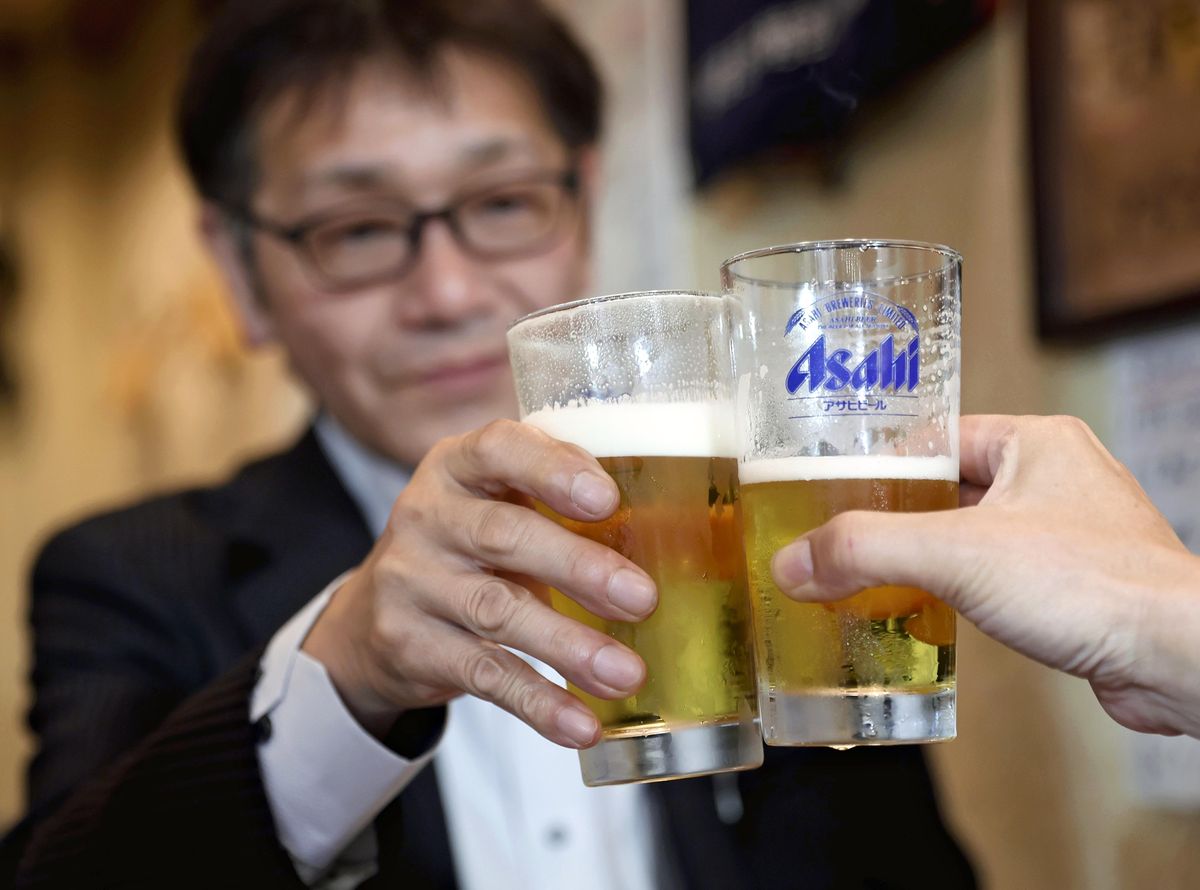
A customer toasts with a beer at a restaurant in Minato Ward, Tokyo, earlier this month.
15:54 JST, October 19, 2025
A computer system failure caused by a cyberattack on major food and beverage company Asahi Group Holdings, Ltd. is raising concerns that the restaurant industry and retail stores will be hit by a prolonged beer shortage.
In an effort to maintain its supply, Asahi began manually accepting orders via telephone and fax. On Wednesday, the company managed to increase the number of products it could ship. However, there are no prospects for the company’s computer system to be fully restored, and a sense of uncertainty is looming with the approach of the end of the year, when demand for beer is at its highest.
Substitute orders increasing
“We are concerned that beer may be in short supply toward the year-end party season,” said the manager of Kushiyaki Tosaka, an izakaya bar in Minato Ward, Tokyo.
The bar had been serving Asahi Super Dry exclusively, but its deliveries have been delayed since the start of the company’s system failure on Sept. 29. As a result, the product has been out of stock for many days.
To make up for the shortage, the bar started buying draft beer from Sapporo Breweries Ltd. because its products are compatible with the same dispenser as Asahi products.
Other major beer manufacturers are now accepting orders as substitutes for Asahi products. However, it is difficult for the manufacturers to quickly increase production, as their production plans of this year have already been determined. Sapporo, Suntory Holdings Ltd. and Kirin Brewery Co., Ltd. have begun adjusting their shipments of commercial beer products, prompting concerns that the products may not reach all the shops and restaurants in need.
The problem is also impacting on competition for sales of year-end gifts. On Oct. 3, Takashimaya Co., Ltd. opened a website to sell year-end gifts. All Asahi products on the website, including assortments of Super Dry, are marked “out of stock.”
At Takashimaya, sales of alcohol products, including beer, account for about 10% of all year-end gift-related sales in an average year. About 40% of those are Asahi products.
“Asahi products make up the largest portion among all beer manufacturers,” said Takashiyama President Yoshio Murata. “So we are watching the situation closely.”
A department store official expressed concern: “We may have to turn down some orders as we might not have the products in time.”
Manual work
Asahi is continuing to take desperate actions. Although the company is unable to accept orders or make shipments with its computer system, its plants’ production lines are unaffected. Therefore, the company has been able to gradually resume shipments by accepting orders via telephone and fax.
The company resumed shipments of Super Dry on Oct. 3, followed by 16 other products, including Asahi draft beer and Clear Asahi on Wednesday. It plans to expand the shipments to more products as early as Oct. 24.
Asahi’s domestic sales of beer products stood at ¥592.8 billion in 2024. The current problem is significantly impacting the firm and others, as Asahi is believed to have the largest share of domestic beer sales. It remains uncertain how successful the company will be in bringing its beer distribution back to a normal level by accepting orders via telephone and fax.
Beverage makers typically sign multiple-year contracts with restaurants. Therefore, temporary use of other makers’ products is unlikely to drastically change Asahi’s market share.
However, an industry source said increasing contacts with other makers may prompt restaurants and other businesses to switch manufacturers when it comes time to renew their contracts.
“The longer the current distribution confusion continues, the more it will impact the company’s relationship of trust with its business partners,” said Naoko Kuga, a senior researcher at NLI Research Institute. “It will be important for the company to present principles for improvement, such as strengthening its business continuity plan in anticipation of cyberattacks.”






Most Read
Popular articles in the past 24 hours
-
Japanese High School Student Aims to Share Kaiten History Through...
-
PM Takaichi Spells out Plans to Advance Bold Policy Shifts in Spe...
-
Chronic Issues Erode Thailand’s Economy as Political Confusion Pe...
-

Tottori: 95-Year-Old Japanese Descendent from Philippines Visits ...
-

Japan to Monitor Trump Administration's Response to U.S. Supreme ...
-

Milano Cortina 2026: Speed Skater Takagi Finishes 6th in the 1,50...
-
Osaka: 40 Ninjas Display Shuriken Throwing Skills at Japan Champi...
-

Miyazaki: Japanese Woman Walks in Footsteps of Samurai Ancestor W...
Popular articles in the past week
-

Japan PM Takaichi’s Cabinet Resigns en Masse
-

Man Infected with Measles Reportedly Dined at Restaurant in Tokyo...
-

Sanae Takaichi Elected Prime Minister of Japan; Keeps All Cabinet...
-

Japan's Govt to Submit Road Map for Growth Strategy in March, PM ...
-

Bus Carrying 40 Passengers Catches Fire on Chuo Expressway; All E...
-

Milano Cortina 2026: Figure Skaters Riku Miura, Ryuichi Kihara Pa...
-

Japan, U.S. Name 3 Inaugural Investment Projects; Reached Agreeme...
-
U.S. Firm to Build Training Hub in Fukushima N-plant for Debris R...
Popular articles in the past month
-
Japan PM Takaichi’s Cabinet Resigns en Masse
-

Japan Institute to Use Domestic Commercial Optical Lattice Clock ...
-

Israeli Ambassador to Japan Speaks about Japan’s Role in the Reco...
-
Man Infected with Measles Reportedly Dined at Restaurant in Tokyo...
-

Videos Plagiarized, Reposted with False Subtitles Claiming ‘Ryuky...
-

Man Infected with Measles May Have Come in Contact with Many Peop...
-

Prudential Life Insurance Plans to Fully Compensate for Damages C...
-

Woman with Measles Visited Hospital in Tokyo Multiple Times Befor...
Top Articles in Business
-
Prudential Life Insurance Plans to Fully Compensate for Damages Caused by Fraudulent Actions Without Waiting for Third-Party Committee Review
-
Narita Airport, Startup in Japan Demonstrate Machine to Compress Clothes for Tourists to Prevent People from Abandoning Suitcases
-
Japan, U.S. Name 3 Inaugural Investment Projects; Reached Agreement After Considerable Difficulty
-

Toyota Motor Group Firm to Sell Clean Energy Greenhouses for Strawberries
-

SoftBank Launches AI Service for Call Centers That Converts Harsh Customer Voices into Softer Voices
JN ACCESS RANKING
-
Japan PM Takaichi’s Cabinet Resigns en Masse
-
Japan Institute to Use Domestic Commercial Optical Lattice Clock to Set Japan Standard Time
-
Israeli Ambassador to Japan Speaks about Japan’s Role in the Reconstruction of Gaza
-
Man Infected with Measles Reportedly Dined at Restaurant in Tokyo Station
-
Videos Plagiarized, Reposted with False Subtitles Claiming ‘Ryukyu Belongs to China’; Anti-China False Information Also Posted in Japan