
Foreign students return / Overseas tech degrees in hand, Japanese language students seek to use skills in Japan
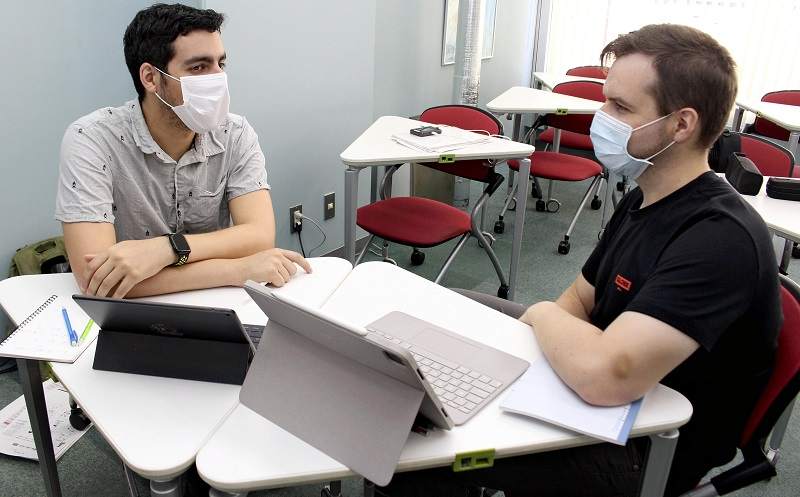
Michael Agreda, left, and Daniel Bourne talk about jobs they would like to get in Japan while studying at Kai Japanese Language School in Shinjuku Ward, Tokyo, on July 28.
10:27 JST, August 18, 2022
The recent relaxation of entry restrictions for foreigners opened the door again for overseas students to study in Japan. The Yomiuri Shimbun talked with students at Kai Japanese Language School in Shinjuku Ward, Tokyo. This is the fourth of a five-part series.
***
In early August, Michael Agreda, a 31-year-old from Tennessee, was sitting in a classroom at Kai Japanese Language School, working on a Japanese composition. From time to time, he looked at a textbook on his iPad. A dedicated app for hiragana and kanji drills, as well as Japanese conversation listening materials, are also found on the device.
Agreda said he chose Kai because of its digital environment, which is no surprise for a highly skilled tech professional. He is in Japan because the country has a shortage of such human resources.
From an early age, Agreda was fascinated by Japanese video games such as the “Super Mario Bros.” and “The Legend of Zelda” series. After studying graphic design at a state university, he studied game development at a graduate school in Florida. He then worked as a software engineer for a U.S. company and was involved in a project with Universal Studios Japan in Osaka.
He came to Japan in June with this dream in mind: To be involved in the development of Japanese video games.
After enrolling in the Japanese language school, he was surprised to find that many fellow students were from his industry.
During a break in class, he chatted with Daniel Bourne, a 33-year-old Australian, about the types of skills needed to work for a Japanese company and interesting aspects of the video game industry.
Bourne also came to Japan in June. He is studying in the same beginner’s class as Agreda. In Australia, he worked for a local tech company for more than 10 years, then studied cybersecurity at a university. There are few tech-related companies at home, so he decided to work in a foreign country to find a place where he can make better use of his skills.
He had planned to look for a job in an English-speaking Western country, but the COVID-19 pandemic made him decide to work in a country closer to home in case he had to return immediately.
He plans to study at the language school for just under two years, then work for a Japanese company as a bilingual information technology expert.
Another student who entered the school in June is a blockchain expert from Hawaii called John Bui. The 28-year-old came to Japan after meeting a Japanese person who was eager to learn about blockchain technology.
Although Bui has only been in Japan for a short time, he is already advising some companies using his expertise. He says he wants to share his knowledge and skills to advance the blockchain industry in Japan.
Seeking skilled professionals
According to a survey conducted between 2018 and 2021 by Yu Korekawa, director of the department of international research and cooperation at the National Institute of Population and Social Security Research, about 40% of students from abroad at Japanese language schools are graduates of universities or graduate schools. Many of these highly educated students are eager to pursue higher education or find employment in Japan.
In May 2012, the government launched a system to certify foreign nationals who exceed a certain score as “highly skilled professionals” based on their educational background, work experience and Japanese language skills, in order to promote the acceptance of excellent foreign human resources. In April 2015, a highly skilled professional status of residence was established and preferential measures, such as easing the requirements for permanent residency, have been implemented.
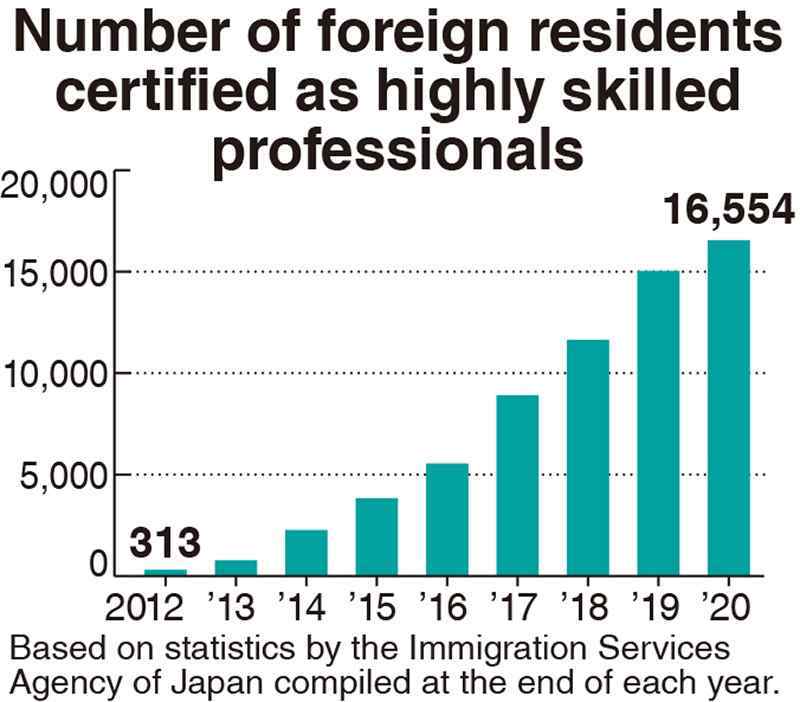
According to the Immigration Services Agency of Japan, the number of foreign residents certified as highly skilled professionals was 313 at the end of 2012, but increased to 16,554 by the end of 2020.
An issue facing many Japanese companies is the shortage of tech personnel. In January this year, the Information-technology Promotion Agency conducted a survey of 1,935 tech companies in Japan and about 80% of them responded that there is a shortage of such personnel in terms of quantity and quality. The need for excellent foreign human resources is expected to increase in the future.





Most Read
Popular articles in the past 24 hours
-
Japan Govt Aims for 10-Fold Increase in Computing Power of Superc...
-

Fukushima Towns Only Back to 20% of Population Before Nuclear Dis...
-

Reopened Fukushima Municipalities Lure New Residents with Educati...
-

2 People Reportedly Found on Mt. Fuji; Hiking Trail Currently Clo...
-

Japan's TEPCO to Raise Electricity Rates for Corporations in Apri...
-

Kesennuma, Miyagi Pref., Locals Raise Carp Streamers as Symbol of...
-

Iran Situation: Significance of Rule of Law Must Be Conveyed
-

Japan’s Nikkei Stock Average Ends Higher as Traders Gauge Efforts...
Popular articles in the past week
-

Ibaraki Pref.'s 1st Foreign Bus Driver Hired in Tsukuba
-

Amid Strait of Hormuz Blockade, Shipping Companies Scramble to Ge...
-
2 Unpublished Early Novellas by Japan's Kenzaburo Oe Discovered, ...
-
Govt to Utilize ODA for Ensuring Economic Security; Securing Ener...
-
Japan Govt Survey Finds Just 10% of Workers Want Working Hours to...
-
Japan's 2nd Round of U.S. Investments May Be Worth Over $100 Bill...
-

Imperial Family Watches World Baseball Classic Game Against Austr...
-

Donald Keene’s Drinking Buddy and Translator Yukio Kakuchi Pays T...
Popular articles in the past month
-

Producer Behind Pop Group XG Arrested for Cocaine Possession
-

Japan PM Takaichi’s Cabinet Resigns en Masse
-

Man Infected with Measles Reportedly Dined at Restaurant in Tokyo...
-

Videos Plagiarized, Reposted with False Subtitles Claiming ‘Ryuky...
-

iPS Treatments Pass Key Milestone, but Broader Applications Far f...
-

Sanae Takaichi Elected Prime Minister of Japan; Keeps All Cabinet...
-

Nepal Bus Crash Kills 19 People, Injures 25 Including One Japanes...
-

Japan's Govt to Submit Road Map for Growth Strategy in March, PM ...
Top Articles in Society
-
Producer Behind Pop Group XG Arrested for Cocaine Possession
-
Man Infected with Measles Reportedly Dined at Restaurant in Tokyo Station
-

Bus Carrying 40 Passengers Catches Fire on Chuo Expressway; All Evacuate Safely
-

Tokyo Skytree’s Elevator Stops, Trapping 20 People; All Rescued (Update 1)
-

U.S. Firm to Build Training Hub in Fukushima N-plant for Debris Removal; Plans to Establish Training Center by 2029
JN ACCESS RANKING
-
Producer Behind Pop Group XG Arrested for Cocaine Possession
-
Japan PM Takaichi’s Cabinet Resigns en Masse
-
Man Infected with Measles Reportedly Dined at Restaurant in Tokyo Station
-
Videos Plagiarized, Reposted with False Subtitles Claiming ‘Ryukyu Belongs to China’; Anti-China False Information Also Posted in Japan
-
iPS Treatments Pass Key Milestone, but Broader Applications Far from Guaranteed