
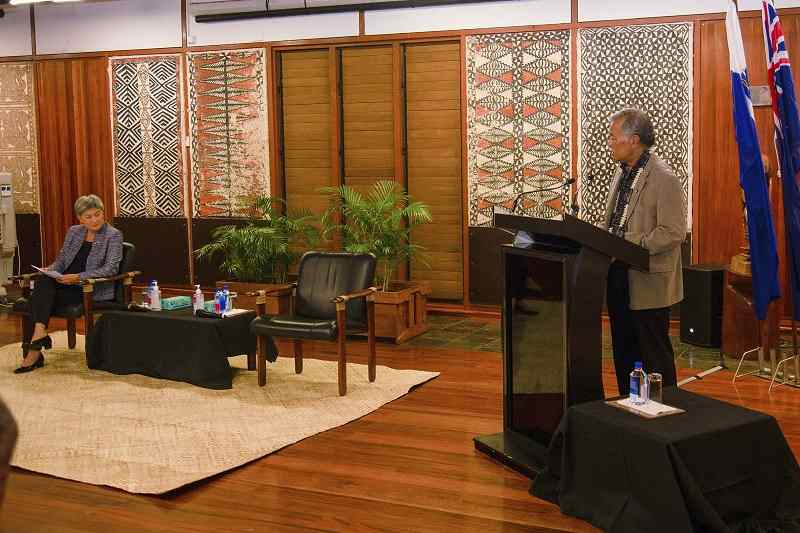
Australia’s Foreign Minister Penny Wong, left, is welcomed by Secretary General of the Pacific Islands Forum Secretariat Henry Puna during her visit to the secretariat in Suva, Fiji, on Thursday.
17:46 JST, May 31, 2022
The United States and Australia are moving to counter China’s active engagement with South Pacific island nations.
Australian Foreign Minister Penny Wong visited Fiji from Thursday to Friday, which coincided with Chinese Foreign Minister Wang Yi’s tour of the region. Wong conveyed Canberra’s policy of strengthening its assistance to South Pacific island nations in such fields as climate change and infrastructure development. The region is strategically significant for Australia’s security, and China’s expanding influence poses a direct threat.
At a press briefing on May 25, U.S. State Department Spokesperson Ned Price said that “importing security forces” from China “could only seek to fuel regional and international tensions.”
In February, U.S. Secretary of State Antony Blinken visited Fiji, the first U.S. secretary of state to do so in 37 years, to maintain his country’s relationships with South Pacific island nations. Washington also plans to reopen its embassy in the Solomon Islands, which closed in 1993.
Japan, too, hopes to stop the expansion of China’s influence in the region’s security field. The Japanese Foreign Ministry became aware in advance of the moves to conclude a security agreement between China and the Solomon Islands and tried to persuade the island nation not to go ahead with it. However, a Foreign Ministry official said, “The Solomon Islands did not listen.”
In late April, after the announcement of the signing of the security agreement, Parliamentary Vice Minister for Foreign Affairs Kentaro Uesugi visited the Solomon Islands. In early May, Foreign Minister Yoshimasa Hayashi visited Fiji and Palau. The two conveyed to the countries’ leaders Japan’s concerns over China’s hegemonic moves.
During the Quad summit on May 24 attended by leaders of Japan, the United States, Australia and India, the leaders proposed strengthening maritime surveillance in the Indo-Pacific region. Tokyo intends to further strengthen cooperation through information-sharing among the Quad members and the South Pacific island nations.
In January 2023, Japan plans to open an embassy in Kiribati, which broke off diplomatic relations with Taiwan and is strengthening its pro-China stance. The Japanese government intends to continue to convey its positions through occasions such as the triennial Pacific Islands Leaders Meeting, which invites leaders of the Pacific island nations to Japan.





Most Read
Popular articles in the past 24 hours
-

Visitors Enjoy Early Blooming Flowers Set Against Mt. Fuji
-

‘Bonbon Drop’ 3D Stickers Fly Off Shelves in Japan
-

Social Media and Disinformation: Risks Becoming More Serious with...
-

Milano Cortina 2026: Japan’s Ayumu Hirano Points toward Com...
-
Hidetoshi Nishijima Puts Fatherhood on Display in Amazon Drama Se...
-

JR Yamanote Line Suspends Service Due to Accident on Saikyo Line
-

Japan’s Nikkei Stock AverageRallies on Earnings in Unsteady Trade...
-
Japan IT Groups Urge Apple, Google to Waive New Commissions
Popular articles in the past week
-

Man Infected with Measles May Have Come in Contact with Many Peop...
-
Australian Woman Dies After Mishap on Ski Lift in Nagano Prefectu...
-
Foreign Snowboarder in Serious Condition After Hanging in Midair ...
-
Chinese Embassy in Japan Reiterates Call for Chinese People to Re...
-

BTS to Hold Comeback Concert in Seoul on March 21; Popular Boy Ba...
-

Toyota Motor Group Firm to Sell Clean Energy Greenhouses for Stra...
-

Beer Yeast Helps Save Labor, Water Use in Growing Rice; Govt Hope...
-

Japan Tourism Agency Calls for Strengthening Measures Against Ove...
Popular articles in the past month
-
Univ. in Japan, Tokyo-Based Startup to Develop Satellite for Disa...
-
JAL, ANA Cancel Flights During 3-day Holiday Weekend due to Blizz...
-

Japan Institute to Use Domestic Commercial Optical Lattice Clock ...
-

China Eyes Rare Earth Foothold in Malaysia to Maintain Dominance,...
-
China Confirmed to Be Operating Drilling Vessel Near Japan-China ...
-
Man Infected with Measles May Have Come in Contact with Many Peop...
-

Japan, Qatar Ministers Agree on Need for Stable Energy Supplies; ...
-
Australian Woman Dies After Mishap on Ski Lift in Nagano Prefectu...
Top Articles in Politics
-
Japan Tourism Agency Calls for Strengthening Measures Against Overtourism
-
Japan Seeks to Enhance Defense Capabilities in Pacific as 3 National Security Documents to Be Revised
-

Voters Using AI to Choose Candidates in Japan’s Upcoming General Election; ChatGPT, Other AI Services Found Providing Incorrect Information
-

Japan’s Prime Minister: 2-Year Tax Cut on Food Possible Without Issuing Bonds
-
Japan-South Korea Leaders Meeting Focuses on Rare Earth Supply Chains, Cooperation Toward Regional Stability
JN ACCESS RANKING
-
Univ. in Japan, Tokyo-Based Startup to Develop Satellite for Disaster Prevention Measures, Bears
-
JAL, ANA Cancel Flights During 3-day Holiday Weekend due to Blizzard
-
Japan Institute to Use Domestic Commercial Optical Lattice Clock to Set Japan Standard Time
-
China Eyes Rare Earth Foothold in Malaysia to Maintain Dominance, Counter Japan, U.S.
-
Man Infected with Measles May Have Come in Contact with Many People in Tokyo, Went to Store, Restaurant Around When Symptoms Emerged