
Strait of Hormuz Closure Shakes Markets; Prolonged Closure Could Deal Heavy Blow to Japanese Economy
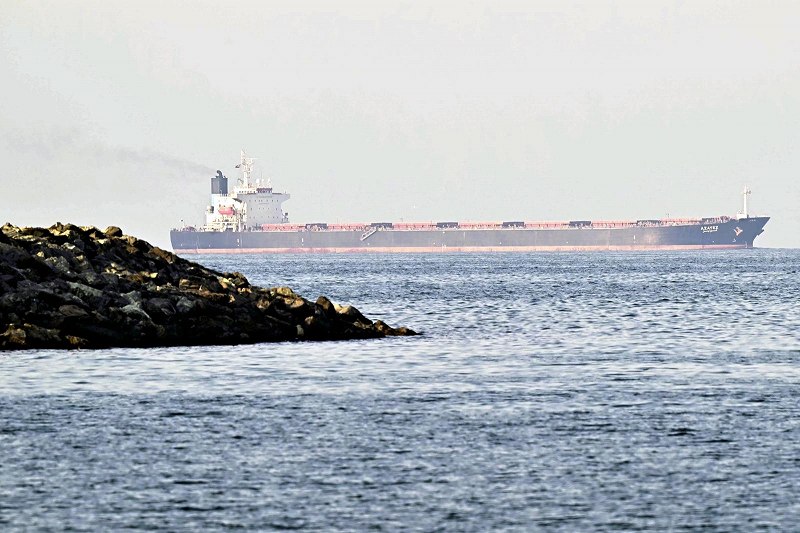
A cargo ship passes through the Strait of Hormuz on Feb. 25.
14:38 JST, March 3, 2026
Financial markets were shaken at the start of the week following the U.S. and Israeli attacks on Iran. Crude oil prices surged as the Strait of Hormuz, a vital maritime shipping route, was effectively blocked, heightening the risk of disrupted supplies from the Middle East.
In Japan, the situation could reignite inflation, which had been showing signs of slowing down, and a prolonged closure could deal a major blow to the Japanese economy.
“If [the price surge] continues, it will impact fuel costs,” said Yuji Saito, executive vice president of Japan Airlines Co., at a press conference on Monday. “We hope for a resolution as soon as possible.”
There is currently no mechanism to pass on fuel price fluctuations to domestic flight fares, so a direct consequence of rising fuel prices would be a drop in profit for airline operators.
In addition, many airports in the Middle East are hubs for connecting flights to Europe and Africa, so a decline in passenger numbers is another cause for concern.
90% dependence
Japan imports nearly all its fossil fuels from overseas, relying on the Middle East for over 90% of its crude oil and over 10% of its liquefied natural gas.
Production areas are concentrated around the Persian Gulf, which includes the United Arab Emirates, Saudi Arabia and Kuwait. The majority of giant tankers bound for Japan pass through the Strait of Hormuz, making the waterway a vital artery for Japan.
Although alternative export routes exist, such as one via Saudi Arabia’s pipelines on the Red Sea side, they are limited. If a blockade of the Strait of Hormuz, which accommodates a large amount of traffic, were to persist for a prolonged period, widespread impacts would be unavoidable.
As of December 2025, the public and private sectors in Japan had about 254 days’ worth of crude oil reserves, or about eight months.
A major Japanese energy company said there would be no immediate impact on the distribution of petroleum products. However, rising crude oil prices would ripple through a wide range of sectors, affecting gasoline prices, electricity bills and logistics expenses. Since gasoline and kerosene are also used in the agricultural and fisheries industries, such rises would also lead to higher food prices.
GDP could drop
According to estimates by Nomura Research Institute, Ltd., if crude oil prices were to rise to around $140 per barrel — their peak before the 2008 global financial crisis triggered by the collapse U.S. investment bank Lehman Brothers — Japan’s gross domestic product would fall by 0.65% annually, and inflation would rise by around 1.14% annually.
In a worst-case scenario, gasoline prices could surge to around ¥320 per liter.
The government has implemented measures to counter rising prices, such as subsidizing electricity and gas bills and abolishing the provisional gasoline tax surcharge.
Tomomichi Akuta of Mitsubishi UFJ Research and Consulting Co. pointed out that “the negative impacts could offset the government’s countermeasures.”







Most Read
Popular articles in the past 24 hours
-

Record Snowfall in Japan Causes Serious Agricultural Damage in To...
-

Japan Police Told to Boost Security, Vigilance Around U.S., Israe...
-

Japan Traditional Puppet Performance Held at Onsen Resort in Shiz...
-

U.S. Urges Citizens to Immediately Depart over A Dozen Middle Eas...
-
Strait of Hormuz Closure Shakes Markets; Prolonged Closure Could ...
-

Joichi Ito’s Japan Government Role Uncertain Amid Fresh Epstein S...
-

Japanese Firms Ban Business Trips, Cancel Vacation Tours Amid Mid...
-

2 of Japan's Opposition Parties Submit Bill to Revise Political F...
Popular articles in the past week
-

Milano Cortina 2026: Japanese Gold Medalist Figure Skater Miura S...
-

Tokyo Spends Big on Children, Wins Over Parents
-

Japan’s Miura, Kihara Announce Withdrawal from Figure Skating Wor...
-

Exhibition Featuring Yoshiharu Tsuge’s Manga World Underway in Ch...
-

Yokohama to Test Out Renewable-Powered Offshore Floating Data Cen...
-

BOJ Keeping Eye on Economy and Takaichi's ‘Proactive Fiscal Polic...
-

Tokyo Measles Patient Traveled to Fukuoka Aboard JAL Planes; Susp...
-

Japan Seeks to Counter China's Expanding Influence in Pacific by ...
Popular articles in the past month
-

Producer Behind Pop Group XG Arrested for Cocaine Possession
-

Japan PM Takaichi’s Cabinet Resigns en Masse
-

Man Infected with Measles Reportedly Dined at Restaurant in Tokyo...
-

Israeli Ambassador to Japan Speaks about Japan’s Role in the Reco...
-

Videos Plagiarized, Reposted with False Subtitles Claiming ‘Ryuky...
-

Man Infected with Measles May Have Come in Contact with Many Peop...
-

Prudential Life Insurance Plans to Fully Compensate for Damages C...
-

Woman with Measles Visited Hospital in Tokyo Multiple Times Befor...
Top Articles in Business
-
Prudential Life Insurance Plans to Fully Compensate for Damages Caused by Fraudulent Actions Without Waiting for Third-Party Committee Review
-

Japan, U.S. Name 3 Inaugural Investment Projects; Reached Agreement After Considerable Difficulty
-

Japan’s Major Real Estate Firms Expanding Overseas Businesses to Secure Future Growth, Focusing on Europe, U.S., Asia
-

SoftBank Launches AI Service for Call Centers That Converts Harsh Customer Voices into Softer Voices
-

Green Tea Exports Hit Record High in 2025 Amid Growing Demand, Likely to Be Driving Force Behind Govt Export Target
JN ACCESS RANKING
-
Producer Behind Pop Group XG Arrested for Cocaine Possession
-
Japan PM Takaichi’s Cabinet Resigns en Masse
-
Man Infected with Measles Reportedly Dined at Restaurant in Tokyo Station
-
Israeli Ambassador to Japan Speaks about Japan’s Role in the Reconstruction of Gaza
-
Videos Plagiarized, Reposted with False Subtitles Claiming ‘Ryukyu Belongs to China’; Anti-China False Information Also Posted in Japan