
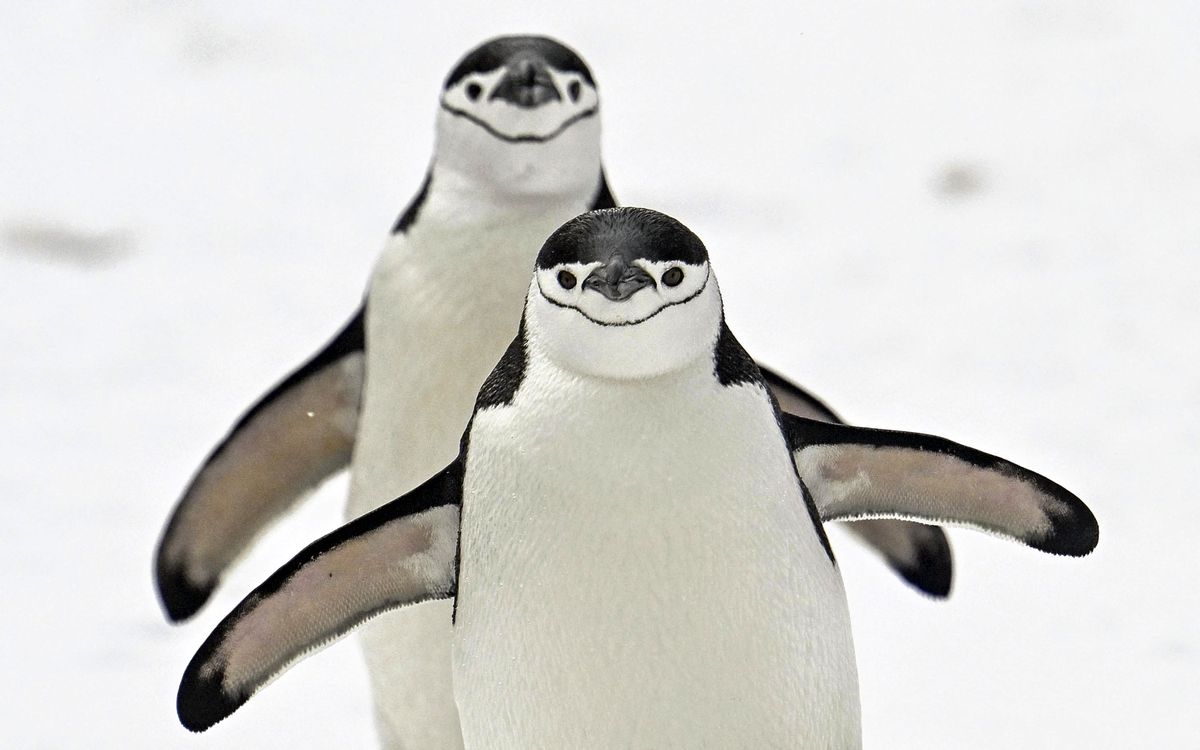
Chinstrap penguins are seen at Deception Island, in the western Antarctic Peninsula, in January 2024.
14:23 JST, February 5, 2026
PARIS (AFP-Jiji) — Penguins are bringing forward their breeding season at record rates as Antarctica rapidly warms due to climate change, according to research published by a global team of scientists last month.
The unprecedented shift observed over a decade in penguin breeding patterns was “highly correlated” with rising temperatures on the frozen continent, said the study’s lead author Ignacio Juarez Martinez.
Penguin breeding is closely linked to food availability, and less sea ice has meant hunting grounds and nesting sites are more available during the year.
Scientists observing penguin populations in Antarctica had expected breeding to occur a little earlier but were “very surprised both by the scale and the speed of the advance,” Martinez told AFP.
“The scale is so great that penguins in most areas are now breeding earlier than in any historical records,” said Martinez, a scientist from the University of Oxford and Oxford Brookes University.
For this study, scientists observed nesting zones of Gentoo, Chinstrap and Adelie penguins between 2012 and 2022 using dozens of time-lapse cameras placed at colonies across Antarctica.
Gentoo penguins demonstrated the greatest change with the timing of their breeding season brought forward 13 days over the decade — and up to 24 days in some colonies.
This is the fastest change in breeding season observed in any bird — and possibly vertebrate — to date, the scientists said.
Adelie and Chinstrap penguins also advanced their breeding season by an average of 10 days.
The findings were published in the Journal of Animal Ecology.
Winners and losers
Antarctica is one of the fastest-warming regions in the world and annual average temperatures there reached record highs last year, the EU climate monitor Copernicus said last month.
The exact mechanisms by which rising temperatures affect penguin behavior are not yet fully understood by scientists.
The three species traditionally staggered their breeding seasons but the earlier timing was likely causing an overlap, increasing competition for food and snow-free nesting space.
You may also like to read
Map Reveals Landscape under Antarctica’s Ice Arctic Sees Unprecedented Heat as Climate Impacts CascadeThis was better news for Gentoos — natural foragers suited to more temperate conditions — and less so for Chinstrap and Adelie penguins.
“We have already seen Gentoos take nests that were previously occupied by Adelies or Chinstraps,” said Martinez.
Gentoo numbers are already expanding in a milder Antarctica while Chinstrap and Adelie penguins, more dependent on krill — tiny shrimp-like creatures on which they feed — and specific ice conditions, are declining.
“As penguins are considered ‘a bellwether of climate change,’ the results of this study have implications for species across the planet,” Fiona Jones, a coauthor of the study from Oxford University, said in a statement.
Martinez said it was “too early to tell” if this adaptation was beneficial or if penguins were being forced to make drastic changes that could affect their breeding success.
“We are now studying their ability to raise chicks of each species. If they maintain a high number of chicks, that will mean this is a good news and they are indeed adapting to climate change,” he said.








Most Read
Popular articles in the past 24 hours
-

Many Candidates in Japan’s Lower House Election Focusing on Econo...
-

U.N. Plans to Set Safety Regulation Standards on Automated Drivin...
-

Milano Cortina 2026: Milano Cortina Olympic Athlete Villages Offe...
-

Yamagami Appeals Against Life Sentence for Murdering Abe; Defense...
-

Seeking Shelter from Trump's Fury, U.S. Trade Partners Reach Deal...
-

Masataka Yoshida Named Final Samurai Japan Selection for March Wo...
-

U.S., Japan, Europe to Develop Critical Minerals Supply Action Pl...
-

Britain Names Robertson as Next Envoy to Japan
Popular articles in the past week
-
Australian Woman Dies After Mishap on Ski Lift in Nagano Prefectu...
-
Foreign Snowboarder in Serious Condition After Hanging in Midair ...
-

Man Infected with Measles May Have Come in Contact with Many Peop...
-

Chinese Embassy in Japan Reiterates Call for Chinese People to Re...
-

Narita Airport, Startup in Japan Demonstrate Machine to Compress ...
-

Toyota Motor Group Firm to Sell Clean Energy Greenhouses for Stra...
-

Beer Yeast Helps Save Labor, Water Use in Growing Rice; Govt Hope...
-

Japan Tourism Agency Calls for Strengthening Measures Against Ove...
Popular articles in the past month
-
Univ. in Japan, Tokyo-Based Startup to Develop Satellite for Disa...
-
JAL, ANA Cancel Flights During 3-day Holiday Weekend due to Blizz...
-

Japan Institute to Use Domestic Commercial Optical Lattice Clock ...
-

China Confirmed to Be Operating Drilling Vessel Near Japan-China ...
-

China Eyes Rare Earth Foothold in Malaysia to Maintain Dominance,...
-
M6.2 Earthquake Hits Japan's Tottori, Shimane Prefectures; No Tsu...
-

Japan, Qatar Ministers Agree on Need for Stable Energy Supplies; ...
-
Australian Woman Dies After Mishap on Ski Lift in Nagano Prefectu...
Top Articles in News Services
-

Prudential Life Expected to Face Inspection over Fraud
-

South Korea Prosecutor Seeks Death Penalty for Ex-President Yoon over Martial Law (Update)
-

Trump Names Former Federal Reserve Governor Warsh as the Next Fed Chair, Replacing Powell
-

Suzuki Overtakes Nissan as Japan’s Third‑Largest Automaker in 2025
-

Japan’s Nikkei Stock Average Alls from Record as Tech Shares Retreat; Topix Rises (UPDATE 1)
JN ACCESS RANKING
-
Univ. in Japan, Tokyo-Based Startup to Develop Satellite for Disaster Prevention Measures, Bears
-
JAL, ANA Cancel Flights During 3-day Holiday Weekend due to Blizzard
-
Japan Institute to Use Domestic Commercial Optical Lattice Clock to Set Japan Standard Time
-
China Eyes Rare Earth Foothold in Malaysia to Maintain Dominance, Counter Japan, U.S.
-
Japan, Qatar Ministers Agree on Need for Stable Energy Supplies; Motegi, Qatari Prime Minister Al-Thani Affirm Commitment to Cooperation