
AI-Doctored Video of Campaign Broadcast Goes Viral; Expert Warns of Possible Distortion to Election

7:00 JST, February 2, 2026
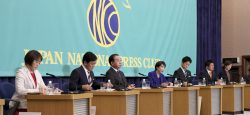
A doctored version of a “campaign broadcast” by the Centrist Reform Alliance for the Feb. 8 House of Representatives election has gone viral on the X social media network.
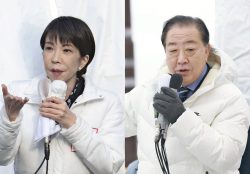
Altered via artificial intelligence to show the party’s co-chairmen Yoshihiko Noda and Tetsuo Saito dancing together, the video has been viewed more than 1.6 million times. Experts are warning that the alteration of such broadcasts could affect the judgment of voters and distort the election.
Candidates for national and gubernatorial elections, political parties and political organizations use campaign broadcasts, which are disseminated on TV and radio, to present their platforms. The Public Offices Election Law stipulates that they must be broadcast unedited, but there is no provision prohibiting voters from altering the content and posting it on social media.
In the original campaign broadcast, Noda and Saito advocate their policies and call in unison for voters to vote for their party. They then bow to a sign language interpreter. The altered footage has the two men push over the podium, stand up and dance with a fan in their hands.
The altered video was posted on Friday morning by a personal account purportedly located in Japan and had been viewed more than 1.6 million times by around noon Saturday. A number of viewers posted critical comments, saying it would cast a shadow over the fairness of the election.
The account deleted the video in question around Saturday noon and posted a comment saying that the footage had been altered through AI. The account owner apologized, saying the video was extremely inconsiderate and inappropriate, and that they had simply intended to be funny.
The Yomiuri Shimbun requested an interview with the account owner but had not received a response as of 7 p.m. Saturday.
A spokesperson for the Centrist Reform Alliance told The Yomiuri Shimbun, “We are extremely disappointed, as it runs counter to the purpose of campaign broadcasts to covey the views of a political party.”
In a separate case related to the ongoing election, footage of a candidate from another opposition party waving their hands on the street before the official kickoff of campaigning was altered via generative AI to show them in a tank top.
“If fake videos of campaign broadcasts are created, viewers could easily believe that the content is real. If political claims, policies and facts are altered, this could affect voters’ judgment and distort the election,” said Harumichi Yuasa, a professor of information law at Meiji University and an expert on election systems.
“Under the current law, it’s illegal to tear down an election poster but the law does not address the internet being flooded with misinformation and disinformation from AI. The law needs to be reviewed in line with reality,” Yuasa said.


Related Tags


Most Read
Popular articles in the past 24 hours
-

Voters Using AI to Choose Candidates in Japan's Upcoming General ...
-

Japan's Snow-Clad Beauty: Camellia Flowers Seen in Winter Bloom a...
-

Monkey Strikes Junior High School Girl from Behind in Japan's Yam...
-
Genichiro Inokuma's Mural in Ueno Station That Gave Hope in Postw...
-
Senior Japanese Citizens Return to University to Gain Knowledge, ...
-

Heavy Snow Linked to 30 Deaths across Japan since Late Jan.; JMA ...
-
Tokyo Police Arrest Head of Resignation Assistance Firm
-

Foreign and Security Policy: Political Parties Must Discuss How T...
Popular articles in the past week
-

Japan Institute to Use Domestic Commercial Optical Lattice Clock ...
-
Australian Woman Dies After Mishap on Ski Lift in Nagano Prefectu...
-
Foreign Snowboarder in Serious Condition After Hanging in Midair ...
-
Chinese Embassy in Japan Reiterates Call for Chinese People to Re...
-
Narita Airport, Startup in Japan Demonstrate Machine to Compress ...
-

Toyota Motor Group Firm to Sell Clean Energy Greenhouses for Stra...
-

Sakie Yokota, Last Surviving Parent of a North Korea Abductee, Ur...
-

Beer Yeast Helps Save Labor, Water Use in Growing Rice; Govt Hope...
Popular articles in the past month
-
Univ. in Japan, Tokyo-Based Startup to Develop Satellite for Disa...
-
JAL, ANA Cancel Flights During 3-day Holiday Weekend due to Blizz...
-
China Confirmed to Be Operating Drilling Vessel Near Japan-China ...
-

China Eyes Rare Earth Foothold in Malaysia to Maintain Dominance,...
-
M6.2 Earthquake Hits Japan's Tottori, Shimane Prefectures; No Tsu...
-
Japan Institute to Use Domestic Commercial Optical Lattice Clock ...
-

Japan, Qatar Ministers Agree on Need for Stable Energy Supplies; ...
-
Japan, Italy to Boost LNG Cooperation; Aimed at Diversifying Japa...
Top Articles in Politics
-

Japan Seeks to Enhance Defense Capabilities in Pacific as 3 National Security Documents to Be Revised
-

Japan Tourism Agency Calls for Strengthening Measures Against Overtourism
-

Japan’s Prime Minister: 2-Year Tax Cut on Food Possible Without Issuing Bonds
-
Japan-South Korea Leaders Meeting Focuses on Rare Earth Supply Chains, Cooperation Toward Regional Stability
-

Japanese Government Plans New License System Specific to VTOL Drones; Hopes to Encourage Proliferation through Relaxed Operating Requirements
JN ACCESS RANKING
-
Univ. in Japan, Tokyo-Based Startup to Develop Satellite for Disaster Prevention Measures, Bears
-
JAL, ANA Cancel Flights During 3-day Holiday Weekend due to Blizzard
-
China Confirmed to Be Operating Drilling Vessel Near Japan-China Median Line
-
China Eyes Rare Earth Foothold in Malaysia to Maintain Dominance, Counter Japan, U.S.
-
Japan Institute to Use Domestic Commercial Optical Lattice Clock to Set Japan Standard Time