
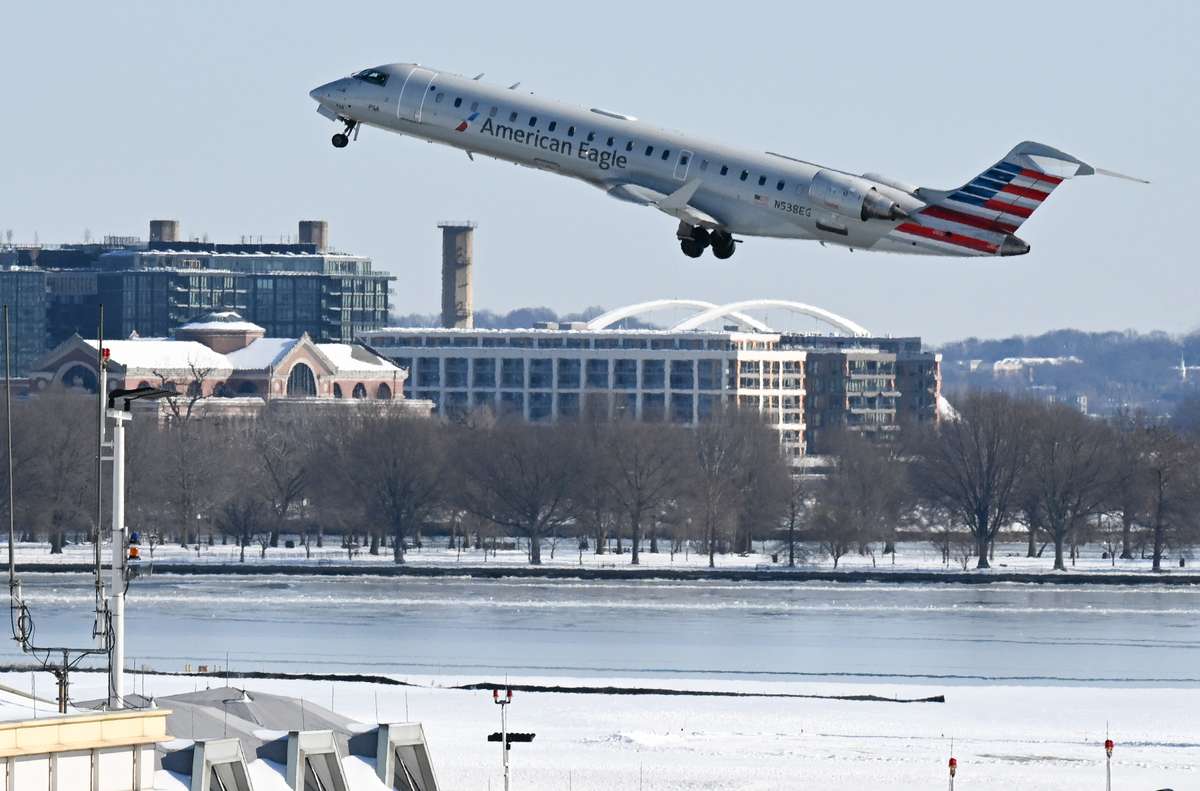
Bombardier makes planes that are used by American airlines for regional travel.
15:39 JST, January 31, 2026
President Donald Trump said he is “decertifying” all aircraft built in Canada and threatened to impose 50 percent tariffs on Canadian aircraft sold to the United States, in an escalation of trade tensions between the neighboring countries that could have ramifications for U.S. air travel.
In a Truth Social post late Thursday, Trump accused Canada of “wrongfully, illegally, and steadfastly” refusing to certify models of Gulfstream jets and “effectively prohibiting” the sale of the American-owned business jets in Canada.
“We are hereby decertifying their Bombardier Global Expresses, and all Aircraft made in Canada, until such time as Gulfstream, a Great American Company, is fully certified, as it should have been many years ago,” he said.
“If, for any reason, this situation is not immediately corrected, I am going to charge Canada a 50% Tariff on any and all Aircraft sold into the United States of America.”
It was not immediately clear how Trump would restrict the planes. The role of certifying aircraft is a well-established process to ensure aircraft safety and traditionally falls to the Federal Aviation Administration. FAA Administrator Bryan Bedford was nominated by Trump.
In an interview Friday with the Canadian Broadcasting Corporation, Canadian Industry Minister Mélanie Joly said she believed the situation could be resolved. When asked whether the certification process could be accelerated, she said the process was “well underway” and emphasized that it is something that “we don’t politicize.”
Canadian Transport Minister Steve MacKinnon said Friday that he had spoken with the chief executive of Bombardier, the Quebec-based manufacturer of the Global Express jet, as well as senior leadership at General Dynamics, Gulfstream’s parent company.
“Transport Canada officials are in communication with their U.S. counterparts, and our government is actively working on this situation,” MacKinnon said on X. “Canada’s aviation industry is safe and reliable. We will stand by it.”
The threat is the latest salvo between the traditionally friendly allies, whose relationship has soured under Trump’s second term. Trump has threatened to make Canada the 51st state, imposed tariffs on Canadian goods and traded barbs with Canadian Prime Minister Mark Carney at the World Economic Forum in Davos, Switzerland, this month.
The Bombardier Global Express is a private jet made by the Quebec-based manufacturer, which has facilities across the U.S., Canada and Mexico and makes planes used commercially as well as by governments and militaries, including the U.S.
The company said it had “taken note” of Trump’s post and was in contact with the Canadian government in a statement on Thursday that sought to highlight its U.S. footprint.
“Bombardier is an international company that employs more than 3,000 people in the U.S. across 9 major facilities, and creates thousands of U.S. jobs through 2,800 suppliers,” it said.
“Thousands of private and civilian jets built in Canada fly in the U.S. every day. We hope this is quickly resolved to avoid a significant impact to air traffic and the flying public,” it added.
The International Association of Machinists and Aerospace Workers, which represents hundreds of thousands of aerospace, defense and other manufacturing workers in both the U.S. and Canada, warned in a statement that Trump’s threat could put jobs at risk.
“Any attack on Canadian aircraft harms both Canadian and American workers alike,” said IAM Canadian Vice President David Chartrand in a statement. “Aircraft certification must remain independent and grounded in safety, not politics. Politically motivated decertification would create instability, threaten thousands of jobs on both sides of the border, and undermine the integrity of the aviation system we all depend on.”
According to Cirium, an aviation data firm, there are nearly 2,700 Bombardier aircraft manufactured in Canada and registered in the United States. Of those, about 150 are the Global Express aircraft that Trump specifically named.
Other aircraft made in Canada include Airbus’ A220 family of jets. Delta Air Lines has 46 of those aircraft in service, while JetBlue has 10 and Breeze two. Bombardier’s regional jets, including the CRJ900 and CRJ700, are popular among regional carriers. In the U.S., SkyWest and Endeavor operate the largest number of the jets.
In a statement, Faye Malarkey Black, CEO of the Regional Airlines Association, said that it was not aware of its members’ fleets being grounded, including SkyWest and Endeavor and referred additional questions to the FAA. The agency referred all questions to the White House, which did not immediately respond.
Companies including American Airlines and Delta use Bombardier planes for regional flights, and any disruption to their ability to fly would upend air travel in the United States. “It would be a transportation disaster,” Richard Aboulafia of the industry consulting firm AeroDynamic Advisory told CNN. “If it’s only the Global Express, it’s not that big of a problem. But if it’s all Canadian-made jets … the [U.S. air travel] system would be seriously impacted.”
Transport Canada has approved several Gulfstream jets to operate in the country, including the G350, G450, GV, G550 and G500. The G700 and G800 received FAA certification in March 2024 and April 2025 respectively, according to the company.
Gulfstream and its parent company General Dynamics did not immediately respond to requests for comment early Friday.
Simmering tensions between Trump and Carney were on full display in Davos last week when Carney declared the rules-based international order “over” and called for middle powers to join forces to avoid being “on the menu” in a speech that received a standing ovation.
A day later, Trump used his own Davos address to take a swipe at Canada, claiming it “gets a lot of freebies” from the U.S. and warning Carney to remember that “Canada lives because of the United States.” Trump later rescinded Carney’s invitation to his Board of Peace.
On Thursday, Carney said he expected the U.S. to “respect Canadian sovereignty” following a Financial Times report that members of the Trump administration had met with a separatist group about plans for an independence referendum. Speaking to reporters the same day, British Columbia Premier David Eby described asking a foreign government for assistance in breaking up Canada as “treason.”
The State Department said in an emailed statement Friday it “regularly meets with civil society types. As is typical in routine meetings such as these, no commitments were made.”








Most Read
Popular articles in the past 24 hours
-

Voters Using AI to Choose Candidates in Japan's Upcoming General ...
-

Japan's Snow-Clad Beauty: Camellia Flowers Seen in Winter Bloom a...
-

Monkey Strikes Junior High School Girl from Behind in Japan's Yam...
-
Genichiro Inokuma's Mural in Ueno Station That Gave Hope in Postw...
-

Senior Japanese Citizens Return to University to Gain Knowledge, ...
-
Heavy Snow Linked to 30 Deaths across Japan since Late Jan.; JMA ...
-

Foreign and Security Policy: Political Parties Must Discuss How T...
-

Tokyo Police Arrest Head of Resignation Assistance Firm
Popular articles in the past week
-

Japan Institute to Use Domestic Commercial Optical Lattice Clock ...
-

Australian Woman Dies After Mishap on Ski Lift in Nagano Prefectu...
-

Foreign Snowboarder in Serious Condition After Hanging in Midair ...
-
Chinese Embassy in Japan Reiterates Call for Chinese People to Re...
-

Narita Airport, Startup in Japan Demonstrate Machine to Compress ...
-

Toyota Motor Group Firm to Sell Clean Energy Greenhouses for Stra...
-

Sakie Yokota, Last Surviving Parent of a North Korea Abductee, Ur...
-

Beer Yeast Helps Save Labor, Water Use in Growing Rice; Govt Hope...
Popular articles in the past month
-

Univ. in Japan, Tokyo-Based Startup to Develop Satellite for Disa...
-

JAL, ANA Cancel Flights During 3-day Holiday Weekend due to Blizz...
-
China Confirmed to Be Operating Drilling Vessel Near Japan-China ...
-

China Eyes Rare Earth Foothold in Malaysia to Maintain Dominance,...
-
M6.2 Earthquake Hits Japan's Tottori, Shimane Prefectures; No Tsu...
-
Japan Institute to Use Domestic Commercial Optical Lattice Clock ...
-
Japan, Qatar Ministers Agree on Need for Stable Energy Supplies; ...
-

Japan, Italy to Boost LNG Cooperation; Aimed at Diversifying Japa...
Top Articles in News Services
-

Arctic Sees Unprecedented Heat as Climate Impacts Cascade
-

Prudential Life Expected to Face Inspection over Fraud
-

South Korea Prosecutor Seeks Death Penalty for Ex-President Yoon over Martial Law (Update)
-

Trump Names Former Federal Reserve Governor Warsh as the Next Fed Chair, Replacing Powell
-

Japan’s Nagasaki, Okinawa Make N.Y. Times’ 52 Places to Go in 2026
JN ACCESS RANKING
-
Univ. in Japan, Tokyo-Based Startup to Develop Satellite for Disaster Prevention Measures, Bears
-
JAL, ANA Cancel Flights During 3-day Holiday Weekend due to Blizzard
-
China Confirmed to Be Operating Drilling Vessel Near Japan-China Median Line
-
China Eyes Rare Earth Foothold in Malaysia to Maintain Dominance, Counter Japan, U.S.
-
Japan Institute to Use Domestic Commercial Optical Lattice Clock to Set Japan Standard Time